Letters to the Editor | Sept. 16, 2025
Inquirer readers on the killing of Charlie Kirk and the price tag for repairs at the governor's mansion.
Words as weapons
I deliberately waited to see what some of the commentary on the assassination of Charlie Kirk would be before weighing in. It has been about what I expected. To me, the political climate we find ourselves in today was not only entirely foreseeable, it was preventable. While many seek to blame one side or the other for the overheated rhetoric, they are all missing the point. If you are older than 40 years old or so, you were likely raised on the philosophy that “sticks and stones may break my bones, but names can never hurt me.” Somewhere along the way in the last 30 years, that stopped. We started teaching our children that words are just another form of violence. Worse yet, we institutionalized this nonsense in our schools. We started teaching our children that they had a “right” to be protected from speech that offended them or made them uncomfortable.
So, is it a surprise that a recent survey of college students conducted by the Foundation for Individual Rights and Expression showed that only 66% of respondents said violence is never a justified response to speech? Luigi Mangione has raised millions for his legal defense after being accused of killing a man in broad daylight simply because he didn’t get his way. The vast majority of his donations apparently come from younger people. In the grievance economy where speech is just another form of violence, violence becomes just another form of expression. Supporting speech you agree with is not supporting free speech. In a rational society, we would recognize the damage we have done to generations of our youth in teaching them this drivel. Alas, we are not a rational society.
Kenneth Rayca, Cinnaminson
Fact or opinion
When anyone uses the phrase “prove me wrong,” it is important to understand what they mean. If it is a fact of a physical nature which can be measured quantitatively, then it can, of course, be challenged. However, if it is an opinion, one cannot definitively prove or disprove whether it is factual. For example, if you say, “The world is flat,” I can prove by physical measurements that it is indeed not flat. But if you say, “I believe the world is flat,” I cannot prove that you don’t actually believe it is, because that’s your opinion, to which you are entitled. This embrace of opinions is justified and revered as an expression of “free speech,” and it’s protected by the Constitution.
This tactic is very effective in terminating debate, and it’s used by people who depend on “alternative facts” as a basis for constructing and implementing policies that affect the rest of us. “I believe there was election fraud” is one example that comes to mind.
Young people seem to frequently use this argument, but asking someone to disprove your opinion seems like an especially fruitless exercise to this octogenarian.
Joe Sundeen, Yardley
Shed light
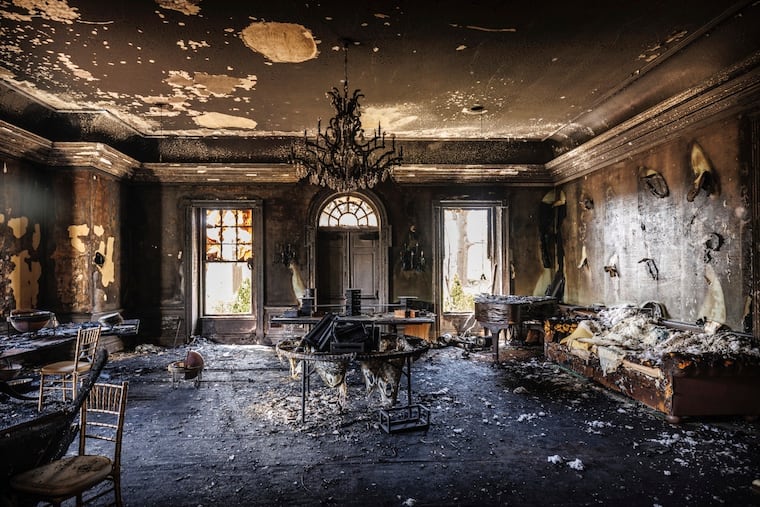
According to a recent article in The Inquirer, repairs to the governor’s mansion following the arson attempt during Passover will cost at least $6 million of taxpayer money, with a quarter of that total allegedly shielded from public scrutiny. These repairs are necessary for adequate living conditions.
Donald Trump is spending $200 million of taxpayer money on a ballroom that the White House certainly doesn’t need, and the entire project is shrouded in secrecy.
I don’t remember seeing Trump’s boondoggle on the front page of The Inquirer. It is certainly a more important story.
Jeff Ettinger, Huntingdon Valley
Join the conversation: Send letters to letters@inquirer.com. Limit length to 150 words and include home address and day and evening phone number. Letters run in The Inquirer six days a week on the editorial pages and online.