Letters to the Editor | Sept. 28, 2025
Inquirer readers on the state of political discourse and President Trump's speech to the United Nations.
Reject false narrative
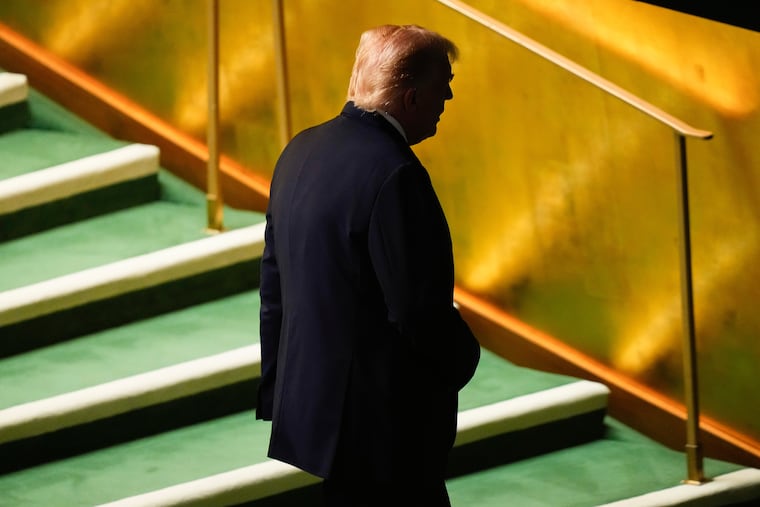
In his address to the United Nations General Assembly, Donald Trump portrayed climate agreements as a “globalist concept” that forces successful nations to “inflict pain on themselves.”
This framing is deeply misleading. The real “pain” comes from failing to act: fires, floods, food shortages, and widespread economic disruption are not abstract risks, but lived realities that will worsen without emissions reductions.
International agreements, far from being acts of self-punishment, are acts of solidarity and recognition of common responsibility. Industrialized nations, which built their prosperity on fossil fuels, have both the capacity and the obligation to lead the transition.
Far from a burden, this shift is an opportunity — clean energy industries already create millions of jobs, while preserving habitability for future generations.
Rejecting cooperation because it is “globalist” ignores the reality that the atmosphere has no borders. A politics of denial and isolation may sound defiant, but it leaves us all weaker in the face of this shared crisis.
Terry Hansen, Milwaukee
Civility matters
I fear we are losing sight of how effective democratic political discourse has historically depended on applying the “Golden Rule” across party lines — that is, treating others as you would like to be treated yourself. In one notable example, then-presidential candidate, Republican John McCain, publicly defended his opponent, Democrat Barack Obama, during a town-hall meeting in 2008 when one person stated, “I don’t trust Obama … he is an Arab.” “No, ma’am,” McCain responded. “He’s a decent family man, citizen, that I just happen to have disagreements with on fundamental issues, and that’s what this campaign is all about.”
At that time, political debates emphasized policy differences rather than constant ad hominem personal attacks. Lawmaking in our democracy was understood to nearly always require compromise. However, this administration’s stated intention is to “flood the zone” with divisive and inflammatory rhetoric, purposely cutting off constructive and factual dialogue over policy differences.
A return to resilient American democracy calls for increased bipartisanship, collaboration across political lines, and stopping the personal attacks on character, integrity, and motives of those with differing political views. Recently, there was widespread public advocacy for a renewed commitment to our First Amendment rights. We must seize the moment and extend it to encouraging “Golden Rule” practices within our democracy. Healthy debate requires that we disagree without being disagreeable. A return to respectful and civil political discourse is essential if our Great American Experiment is to survive.
Douglas Coe, retired captain, U.S. Navy, and former senior executive at U.S. Nuclear Regulatory Commission, Gaithersburg, Md.
Join the conversation: Send letters to letters@inquirer.com. Limit length to 150 words and include home address and day and evening phone number. Letters run in The Inquirer six days a week on the editorial pages and online.