Letters to the Editor | Sept. 8, 2025
Inquirer readers on National Guard deployments and the lingering budget impasse in Harrisburg.
Learn to acquiesce
When I arrived at the University of Pennsylvania Carey Law School in August 2023, I was promised debate, dissent, and truth-telling — a place to challenge power, not submit to it. Within weeks, that promise unraveled.
After Oct. 7, 2023, the culture shifted. Law students who voiced support for the Palestinian cause were doxed, had their firm offers rescinded, and were intimidated into silence. Professionalism was redefined — not by conviction, but by silence.
In a profession that prides itself on precedent, this set a chilling one: you may study law only if you accept that survival requires silence on certain truths. Where silence took hold, fear followed.
The nation’s leading law schools, including mine, met this culture of fear not with condemnation but with inaction. They yielded to pressure, allowing dissent to be punished and leaving the right to argue undefended. What they abandoned in practice, they continue to claim in legacy.
Students are drawn to Penn Law — and its Ivy League peers — for the legacy they trade on: alumni who argued before the U.S. Supreme Court, drafted civil rights legislation, and fought for justice in ways these institutions claim as their heritage. Our schools produced lawyers whose dissent reshaped how justice was defined. But for those of us educated in the aftermath of Oct. 7, that legacy feels less like a living tradition than a relic.
Since Gaza debates consumed campus life, we were taught to look away, to hold our tongues, and to put ambition above conscience. Silence became second nature, and that reflex now threatens to hollow out the very legacy our schools lionize in brochures, but discourage in practice.
Graduates of schools like mine don’t just practice law; we shape it. The silence ingrained in us will not remain confined to the classroom, nor to one geopolitical issue. It will follow us into courtrooms, boardrooms, and every place where power is exercised.
If silence was our training, then silence will be our legacy. And I fear that legacy will not uphold justice. It will bury it.
Noor W. Shater, Philadelphia
Call out the abusers
Some of the Epstein survivors appeared together in Washington on Thursday. Their stories of abuse were horrible. I believe all files should be released. The news conference on the U.S. Capitol steps would have been a good time for the victims to not only describe the horror they went through, but also to name the names of the men Jeffery Epstein passed them off to, but not one of them mentioned any names. This would have been a perfect time to release the names of the people who abused them. I just wonder why no names of the men who abused these victims were mentioned at this news conference. We all want the information in the Epstein files released. This would have been a great start in the right direction.
William Smith, Philadelphia
Misuse of troops
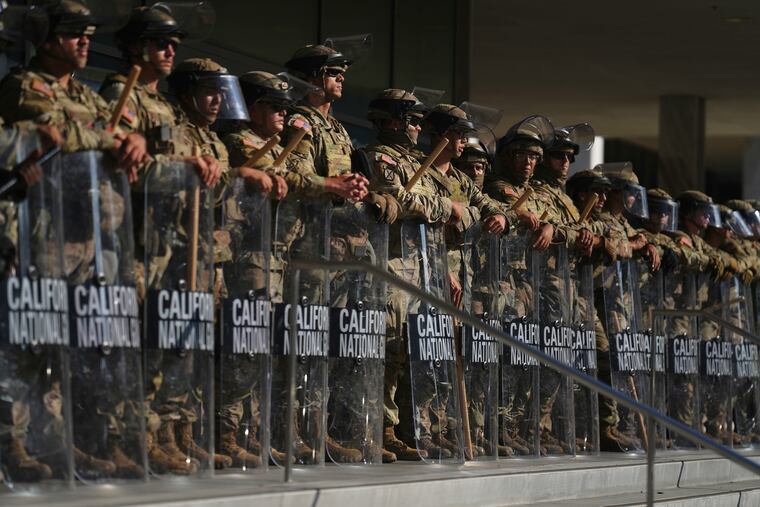
As a veteran of the Pennsylvania Army National Guard, I’m appalled at the use of the guard in Washington, D.C. I’m even more outraged that our troops will soon be deployed to other U.S. cities.
When I served, the officers trained us for use as military and civilian support.
My unit, the 103rd Engineering Battalion, part of the 28th Division, did not see action in Vietnam. However, we were activated for Hurricane Ann in 1972 to assist the people of Northeastern Pennsylvania.
The 28th Division has a proud history. The 28th was very much involved in World War II, and we were also activated for Iraq and Afghanistan.
To watch National Guard members picking up trash and working on landscaping jobs in D.C. was absolutely disgusting. Those jobs could have been done by President Bone Spurs.
The cost for the guard is $1 million per day. These people have been pulled away from their families and jobs.
My question is, why not provide those funds to the various cities the president feels need help? Let the money be used to hire more professionally trained police officers. Surely, they would be better trained for civilian populations. And they would be better acclimated to cities they are part of as civilians.
Once again, true common sense is not even considered. This applies to many programs the Trump administration has started. Our response to immigration is a horror show, and look at what’s happening with vaccines. When will we wake up?
Alan I. Golombek, Langhorne
Corruption crisis
As the budget impasse continues to spiral out of control in Harrisburg, one thing is evident: Regular people are told there’s never enough. Never enough for public transit, housing, healthcare, or any of the basic things we need. But somehow, billionaires always get a tax break.
Why does this keep happening? Lawmakers take gifts and campaign contributions from big money special interests; those always come with strings attached. It’s no wonder the budget favors the wealthy.
Billionaires like Jeff Yass continue to amass millions while working Pennsylvanians struggle. Our upside-down tax system has workers paying more and the richest paying less. In Pennsylvania, the poorer you are, the higher your tax rate. The average family pays over 12% of their income in state and local taxes. The richest 1% pay just 6.2%. An excess wealth tax could help fix this imbalance, generating $6.2 billion for the state while lowering the burden on working families.
Real change requires lawmakers who can’t be bought. Until we get money out of politics, this chaos will continue, budget after budget. Harrisburg needs to end the influence of money in politics, starting with a gift ban, so funding priorities reflect the needs of people.
Andrea Pauliuc, Philadelphia, andrea@mohpa.org
Hot mic admission
Last week, a hot mic captured a conversation between China’s leader, Xi Jinping, and Russian President Vladimir Putin that called to mind reports by human rights groups detailing allegations that China is engaging in forced organ harvesting. Xi and Putin were discussing increasing longevity through organ transplants, possibly extending one’s life span to 150 years. The Chinese government has been accused of arranging organ transplants to help officials improve their health and extend their lives. China performs a staggering number of transplants, far more than the U.S., but no credible source of donations has been identified. Instead, research going back to 2006 has made it clear that China receives the majority of its organs from unwilling donors, specifically prisoners of conscience, including Falun Gong practitioners, Uyghurs, and other persecuted groups. U.S. transplant centers train Chinese physicians who will likely return to China to commit mass murder through organ procurement. Patients, desperate to save their lives, are lured by China’s short wait times for organs. After almost two decades of evidence and now blatant admissions, it is past time for our elected officials to take action. Contact our U.S. senators to cosponsor the Falun Gong Protection Act, Senate Bill 817, a measure that will save lives and end our complicity in this atrocity.
Jessica Russo, Philadelphia
Extra set of eyes
As a driver of a motor vehicle, I am supposed to not only be vigilant of other cars, but also of bicycles, both motorized and not, scooters, both motorized and not, and skateboarders. How does one do this when all of these modes of transport do not stop at red lights, do not stop at stop signs, operate on streets in the opposite direction of the flow of traffic, and in every respect pay no attention to cars and traffic laws? Extra eyes won’t do the trick, either. The authorities have to enact measures requiring these modes of transport to obey traffic laws, too — and then enforce those laws.
Michael A. Seidman, Philadelphia
Sad commentary
It says a great deal about our society when FanDuel, a company that legally profits from a traditional form of vice, comes to the aid of SEPTA. We can easily find money to ferry people to sports games, but hardworking citizens and students who rely on SEPTA are left in limbo?
Nick D’Orazio, Philadelphia, nickdorazio01@gmail.com
Join the conversation: Send letters to letters@inquirer.com. Limit length to 150 words and include home address and day and evening phone number. Letters run in The Inquirer six days a week on the editorial pages and online.