Marra’s goes and the Rail Park grows as Philly communities change | Shackamaxon
As more members of a community live and work outside the city, it becomes harder to maintain the institutions that helped forge their identity in the first place.
This week’s Shackamaxon is all about how cities change, whether some like it or not.
Meno Italiano
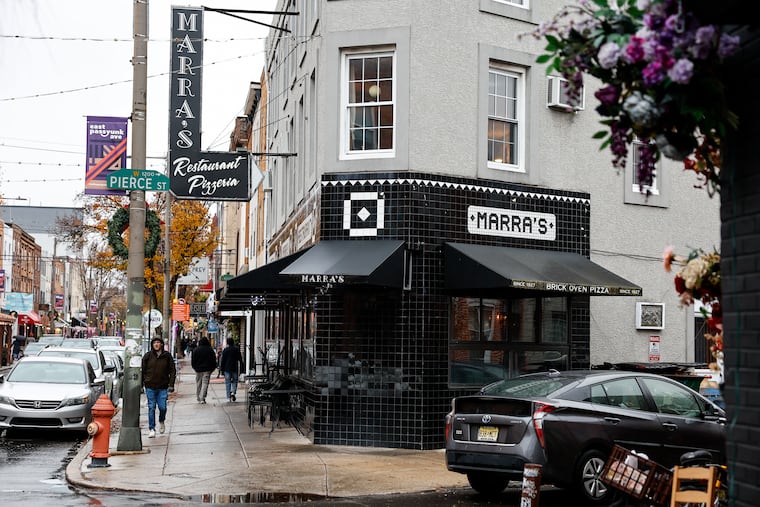
Like so many of my neighbors in South Philadelphia, I had been meaning to go back to Marra’s on East Passyunk Avenue for a while when I heard the news of its imminent closure. The classic Italian restaurant was just two years shy of a century’s worth of business when the owners found an interested buyer in Dan Tsao, the owner of Chinatown’s EMei.
In an interview with my colleague Michael Klein, Marra’s owners blamed a lack of parking for contributing to their decision to close and potentially relocate. Given their location on a thriving and increasingly renowned dining corridor, some have expressed skepticism about this diagnosis. To me, however, it rings true in a different way.
After all, when Marra’s initially opened, parking would not have been much of a concern. Their customer base, like much of the customer base for the new restaurants on the corridor, would have lived nearby. The pizzeria was part of an extensive Italian American community that came to be synonymous with South Philadelphia during the 20th century. Over the years, the center of gravity for this lively community moved to places like Cherry Hill, where people get around by driving, not walking. This means that, over time, many existing businesses have become more dependent on the ease of parking.
Marra’s is not the only neighborhood institution to fall victim to this phenomenon. While many still call it the “Italian Market,” the stalls on Ninth Street are now more likely to be occupied by Asian and Latino entrepreneurs. When I first moved to South Philly in 2011, I’d regularly hear older residents conversing with each other in Sicilian. That’s much less common today.
I call this process suburbanization. As more members of a community live and work outside the city, it becomes harder to maintain the institutions that helped forge their identity in the first place. After all, who wants to fight for a parking spot in South Philadelphia when there’s unlimited free parking at the many Italian restaurants closer to home?
Fight displacement, not change
Marra’s and South Philadelphia are hardly alone when it comes to managing suburbanization. The same phenomenon affects Chinatowns across America, including Philadelphia’s own. Szechuan and Cantonese cuisine are now available throughout the region, just like traditional Italian fare. The largest Chinese restaurant in the city is now Northeast Philadelphia’s China Gourmet, not a Chinatown banquet hall. This is why so many business owners feared the possibility of a Sixers arena on Market Street. They felt fans would be more interested in General Tso’s chicken and bubble tea than the authentic fare that defined the neighborhood. Meanwhile, they’d also take up parking spots that would otherwise be used by their own patrons.
Suburbanization even affects places of worship. During the debate over bike lane parking in Center City, I talked to Tim Geiger — then interim pastor of Tenth Presbyterian Church on Spruce Street — about why his congregation was so reliant on parking spaces. The answer was clear: They had gone through the suburbanization process decades before South Philadelphia or Chinatown.
While Geiger told me he encourages congregants to walk, use paid parking, or take transit, it can be a hard sell when so many can attend services closer to home, at a church that offers free parking.
For many people, this process is a reason to abhor or prevent change. They cite the increase in residential density in and around Center City, the work of groups like the Passyunk Avenue Revitalization Corp., and civic interventions like the Schuylkill River Trail as catalysts for gentrification. At a recent City Council meeting, members of the Committee on Public Property and Public Works echoed these sentiments, expressing a concern that a proposal to turn an abandoned railway viaduct into an expanded Rail Park and pedestrian pathway could drive out low-income residents.
This is the wrong way to conduct public policy.
After all, the South Philadelphia neighborhood that hosted Marra’s hasn’t seen a massive shift in its built environment. It has changed significantly anyway.
Whose community?
As usual, Council members expressed their skepticism about the park proposal by putting their thoughts into the mouths of residents who conveniently were not there to express their opinions themselves. Jeffery “Jay” Young and Quetcy Lozada, in particular, were concerned that there hadn’t been enough community engagement, or that the park would serve as a playground for wealthy residents, leaving the rest of the city behind.
Paul Levy, the former head of the Center City District, is heading up the planned expansion of the Rail Park. Levy said the plan is to unite neighborhoods and offer a useful amenity, not to push anyone away. Unlike Councilmember Young’s plans to demolish the Cecil B. Moore Library, the Rail Park has already earned the support of local civic associations. Center City District held 15 meetings to gauge community reaction to the idea.
It is a process that’s already been successful for the Center City District’s other big projects, Dilworth and Sister Cities Parks. Both serve as urban oases for families across Philadelphia thanks to thoughtful programming and design choices. Levy told me to think in three concentric rings: community involvement in design, community involvement in programming, and a comprehensive housing and development plan for the surrounding neighborhoods.
That’s a lot more thought than obstructionists like Young and Lozada likely put into their opposition.