From a departed colleague, life lessons about fatherhood, forgiveness, and second chances
For years, I worked in the same newsroom as the pioneering editor Michael Days. It was only after his passing that I learned how his life exemplified the power of commitment and unconditional love.
I had the pleasure of working with Michael Days for a number of years, but didn’t get to fully know him until after his sudden passing last month at age 72.
Days had an impressive career. Born in North Philadelphia, he rose to eventually become the first Black editor to lead the Daily News — after formative stops at Roman Catholic High School, College of the Holy Cross, the Wall Street Journal, and other newspapers.
In a rollicking newsroom filled with big and sometimes difficult personalities, Days was calm and universally liked. He oversaw the Daily News’ Pulitzer Prize-winning series on police corruption in 2010 and continued to mentor many young reporters after retiring in 2020. Days served as president of the Philadelphia chapter of the National Association of Black Journalists, and was inducted into NABJ’s Hall of Fame.
But those professional accomplishments pale in comparison to his achievement as a father to four boys he and his wife, Angela Dodson, adopted. That part of his life — which he didn’t discuss much with newsroom colleagues — was revealed by his son, Edward, in a eulogy for the ages.
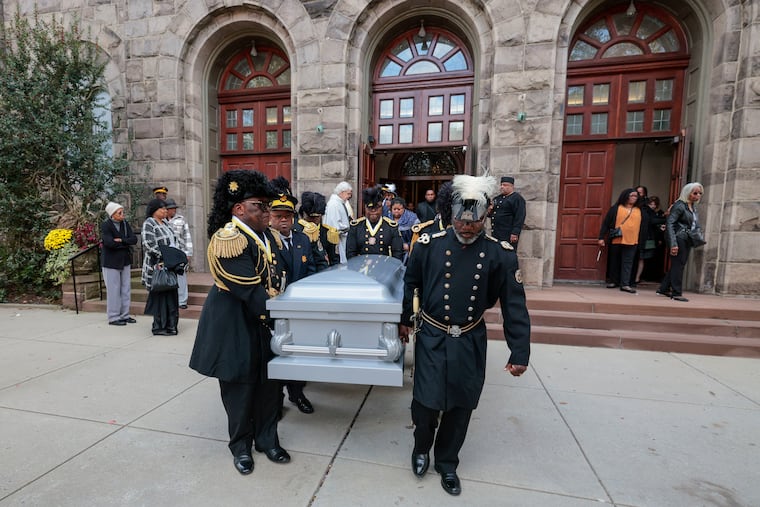
The written version doesn’t capture the moment, which is why, after returning from the funeral at Sacred Heart Church in Trenton three Saturdays ago, I showed my family the video.
More incredible, in the days leading up to the service, Edward told me he struggled to get his thoughts down on paper. He told his mom he couldn’t do it. She told him to talk to the priest, who, in turn, encouraged Edward to go ask his late father, a devout Catholic, for strength.
The deadline appeal was answered. Edward climbed the lectern in the 136-year-old Romanesque Revival church as the sun shone through the stained glass windows. In a resolute voice, he mesmerized the mourners, speaking from the heart for about 14 minutes.
Edward, 43, recounted how at lunch at Cooper’s Riverview in Trenton last August, Days mentioned he was writing a piece about fatherhood.
Michael had one question for his son: “How did I do?”
Edward proceeded to paint a picture of his life before and after Michael and Angela adopted him and his three younger brothers — even after the social workers warned the parents they were crazy to take all four boys.
Imagine children so hungry that they had to steal their grandma’s stuff.
Imagine when the caseworker pulls up to your house and there’s no running water.
You open the cabinet and there’s no cups … We [drank from] vegetable cans.
Imagine a child walking the street with no shoes on his feet — and that’s here in America, in Pleasantville, New Jersey.
Imagine a child who had to witness his brother get killed.
Or imagine children who were left by themselves in a building with no adult supervision and it caught on fire. After the building caught on fire, those children had to be taken to a hotel, where, again, there was no supervision.
His professional accolades pale in comparison to his achievement as a father to four boys he and his wife adopted.
Imagine a child whose role model was a pimp or whose mother was a professional thief.
Imagine a child whose brother sold drugs and the rest of his family were in jail for murder.
All too often, the media coverage of foster care details similar horror stories or systemic missteps leading to a tragedy. Rarely do we read about the positive outcomes.
The same goes for misleading studies and right-wing rhetoric that wrongly portray Black fathers as absent, but fail to mention the systemic issues of mass incarceration, or that many are more involved than nonresident white fathers.
Michael and Angela, also an accomplished journalist, showed another overlooked dimension of how a loving and stable two-parent household can change the trajectory of an adopted child’s life.
Edward’s story gave witness to that impact.
Let me tell you about Michael Days.
This wasn’t your average man. This wasn’t your average father.
This was a man who dedicated his life to see that his children became something.
This was a man who was willing to give up himself to see that his family would thrive and nothing ever got in his way.
Edward then referenced the running debate among psychologists between “nature vs. nurture.” Do inherited genes determine human behavior and personality? Or is a person shaped by their surroundings and upbringing?
My father was a nurturer. He looked at my nature, my beginnings, and he often told me that your beginnings didn’t have to be your end.
He nurtured. And if you look at the psychology of nurture, it’s even proven that genetics with something called unconditional love and commitment.
Edward underscored how his father’s daily example left a lasting impact.
I’m going on almost 23 years of marriage. Who do you think I learned that from?
I have three children who can’t tell you the same story that I told you. The only thing they’ve known in life is that they’re blessed, not only with possessions, but with friends and family.
I had foster children for about five years. Where do you think that inspiration came from?
Edward said Days showed him the power of unconditional love.
All my dad wanted for his family and for those around him was he wanted you to thrive. No illicit motivation, no backdooring.
Genuinely, his heart was gold, and a man like that is crafted by God specifically for the assignment.
At first, Edward didn’t get it. He figured at some point he would wear out his welcome, and he and his brothers would be sent to another foster family.
All my dad wanted for his family and for those around him was he wanted you to thrive.
I’m still struggling with some of the things that I did to my father. You see, when you’re in foster care and you don’t get love, the only thing you know is rejection.
Even as a child, you can reason and rationalize. You make business decisions, and a lot of time those businesses decisions hurt my father.
Edward recounted the time when he was in eighth grade and figured out his father’s ATM pin code. Over several weeks, he stole money from his dad.
Days found out and confronted Edward, who figured his time was up.
He said, “Son, I need to talk to you.” And I said, “Yeah, where the bags at?”
And I’ll never forget what he said to me. He didn’t scream at me. He didn’t yell at me. He said in a very quiet voice, “Son, I’m very disappointed in you.”
Even as a child who had been rejected his entire life, I felt that. I felt the inflection in his voice. Then he said to me, “I can’t believe you did that to us.”
Days then combined the old-fashioned Catholic guilt with some unconditional love.
But then he grabbed me and he said, “When I brought you in this house, I told you I was always going to love you.
“I told you I was always going to be your father.
“I told you that I would never leave you or let you go.”
Then, Days put his hand on Edward’s shoulder and said they would get through this together. That calm reassurance transformed Edward.
That selfish, callous heart that had formed all those years due to the rejection, it began to soften.
And I’ve spent my life trying to become half the man that you know is Michael Days.
As for the debate about “nature vs. nurture,” Edward said nurture won out.
I am proof, my family is proof, that no matter how you start, when you have a man like Michael Days, your ending won’t be the same.
What a legacy.
Remembering Michael Days
Philadelphia’s Department of Human Services has information for anyone interested in becoming a foster parent.
Donations in memory of Michael Days may be made to the following: College of the Holy Cross, St. Rose of Lima school, Dodson, Dotson and Hairston Family Scholarship through the Marshall University Foundation.
A second memorial service for Days is scheduled for Nov. 10 from 5 to 7:30 p.m. at WHYY Studios, 150 N. Sixth St. in Philadelphia. The event is open to the public, but registration is required.