If the Philadelphia Orchestra wants to find new fans, it should bring back its neighborhood concerts
It may seem unimportant where the orchestra performs, but location figures strongly into issues of access, class and race, and barriers both real and perceived.
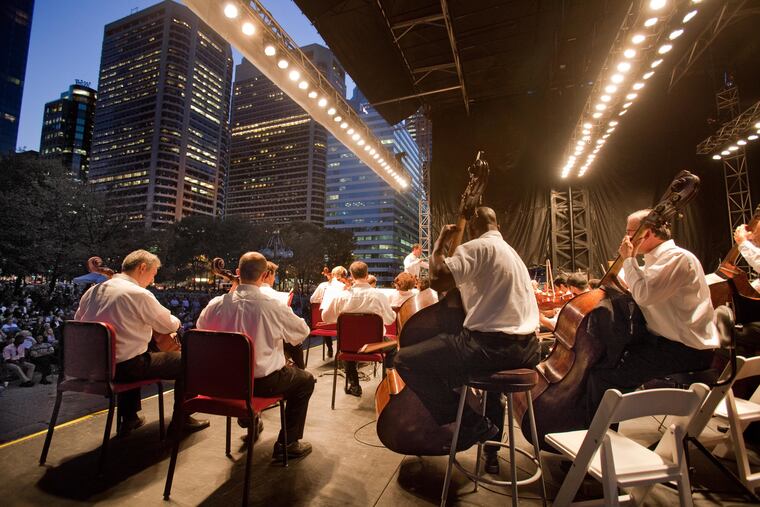
If the Philadelphia Orchestra were to invent a way of luring new listeners at a time when equal access to live music was never under greater threat, it might look like a series of free summertime concerts popping up in Philadelphia neighborhoods.
Frayed links with orchestra fans would be repaired, and newbies might be drawn into a previously unknown love. No one could fail to be wowed by the wall of sound and subtle expressive qualities of one of civilization’s greatest inventions — the symphony orchestra.
Actually, our orchestra launched its neighborhood concerts long ago. And today, at a time when the arts need to be reaching beyond the elites more energetically than ever, it has abandoned these concerts, at least for now.
This summer, listeners in the tony resorts of Vail and Saratoga Springs will hear the ensemble as usual, as will fans in Center City and Fairmount Park. But there will be no Tchaikovsky’s 5th in Camden or Ravel’s Bolero in West Philadelphia’s Clark Park, nothing in Chestnut Hill’s Pastorius Park or the Navy Yard.
It’s now been three years since the orchestra’s last free neighborhood concert, on May 31, 2023, at Northeast High School. In the next few months, the orchestra will be hunkered down downtown more than usual. The ensemble will perform six concerts at the Highmark Mann Center — about the usual number — but, curiously, four other concerts this summer are happening not at the Highmark Mann, but in Marian Anderson Hall.
So what happened to the crown-jewel program that used to tell Philadelphians that if they couldn’t come to the Philadelphia Orchestra, the Philadelphia Orchestra would come to them?
Rising costs and a lack of corporate sponsorship or other funding.
“The neighborhood concert series was previously funded, allowing us to bring free performances directly into communities across Philadelphia,” a spokesperson wrote in a statement. When the orchestra started its neighborhood concerts in 2000, “each performance cost approximately $80,000 to stage. Today, those costs have risen to more than $225,000, reflecting a significant increase in expenses associated with building a stage, providing sound and lighting, and transporting the orchestra.”
The Philadelphia Orchestra and Ensemble Arts has an annual budget of about $125 million.
It may seem unimportant where the orchestra performs; after all, it can often be heard several times a week in Marian Anderson Hall. But location figures strongly into issues of access, class, and race, and barriers both real and perceived.
Location largely determines who hears the orchestra in a city like ours, where the high price of tickets puts the music out of reach for many. The orchestra’s neighborhood concerts were free. Tickets downtown can run from $29 (for rush tickets) to $230.
Another factor might be less tangible, but no less real. Neighborhood concerts send a message. When a historically elite institution like the orchestra reaches into one of the city’s sections, perceptions of exclusion fall away. Listeners feel embraced in a way they don’t in the concert hall when the orchestra comes to their home turf.
Some of my most memorable souvenirs from these neighborhood concerts over the years:
Residents around Capitolo Playground in South Philadelphia leaning out of their rowhouse windows to hear the orchestra playing Verdi and Mendelssohn; blissed-out listeners leaning against trees and stretched out across the grass of Rittenhouse Square; a mother who used to hear the orchestra downtown, but not in years — “Not since kids,” she told me — but here she was in Villanova listening to Stravinsky with her 7-year-old daughter, in 2006.
The public response was emphatic. About 2,500 listeners showed up for a neighborhood concert in 2000 at Deliverance Evangelistic Church in North Philadelphia, and in 2004 a performance at Montgomery County Community College in Blue Bell drew 8,000.
A symphony orchestra is a miraculous thing. We happen to have one of the world’s best. There’s no one anywhere who doesn’t deserve a chance to be in its presence and discover whether it’s for them.
“Music is a unique language that helps us experience the joys and sorrows of our daily lives more easily. In these troubled and uncertain times, it provides a way to express our angers and our fears. And, through its familiar traditions, music reminds us of the humanity we share with our neighbors.”
So wrote Joseph H. Kluger in an Inquirer commentary piece when he was orchestra chief.
That was in 2004. These days, messaging around the orchestra catches a similar zeitgeist.
“Music connects us, across generations, across cultures, across everything that divides,” says orchestra music and artistic director Yannick Nézet-Séguin in a marketing video promoting the orchestra’s 2026-27 season.
But the major divider of our times now might well be the wealth gap, which has become a chasm. And unless everyone has the chance to know what this music might mean to them, with access to all regardless of barriers, talk about music connecting us across divides feels a little empty.
The orchestra says it “would love the opportunity to resume neighborhood performances if funding can be secured.” The group is “exploring sustainable partnership models that would allow us to bring the orchestra back into neighborhoods across the city in the years ahead,” the orchestra’s spokesperson wrote in a statement.
I appreciate the need to balance the budget and the pressure to minimize expenses and maximize revenue. But the neighborhood concerts have been frustratingly funding-dependent, on-again off-again, and it’s time to make them a permanent, core program rather than provisional.
If the orchestra is only serving listeners downtown, Vail, and Saratoga Springs, or even Fairmount Park, it’s not reaching the vast majority of its city. It’s not the Philadelphia Orchestra, not in the fullest sense of what it could mean to the place whose name it carries in its title.