Platner, Fetterman, and the myth of the working-class politician
A recent feud between Graham Platner and John Fetterman underscores the political differences between the two men. But Jonathan Zimmerman writes that they have one important thing in common.
When I was a kid, my father told me something I’ve never forgotten. When you dislike someone, he said, it’s often because you see a part of them in yourself.
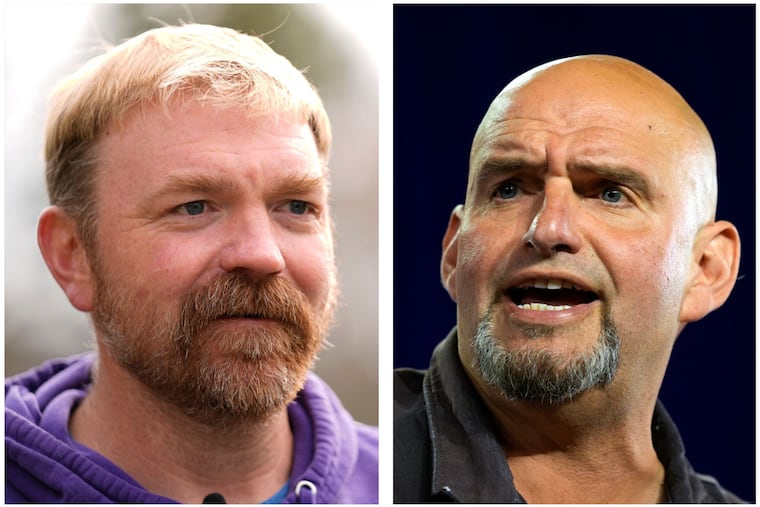
I’ve been thinking about Dad’s comment during the recent slugfest between Sen. John Fetterman (D, Pa.) and Graham Platner, the Democratic Senate nominee from Maine.
Noting Platner’s Nazi tattoo (since covered up) and reports about sexually themed messages he sent to several women, Fetterman called Platner a “bona fide dirtbag.” Platner fired back, labeling Fetterman an “a-hole” as well as a “stooge” for the American Israel Public Affairs Committee.
The two men have important political differences, especially about the Middle East. But here’s what they have in common: They’re both pretending to be rough-hewn, working-class guys.
In fact, both of them were born into significant family wealth. And so were almost all of America’s political leaders, past and present. We just don’t want to admit it.
Consider Andrew Jackson, supposedly our first common-man president. In high school, I learned that the first six presidents included four wealthy Virginia planters (Washington, Jefferson, Madison, and Monroe) and two prosperous New England lawyers (John Adams and his son, John Quincy Adams). But then came Jackson, who grew up in hardscrabble circumstances.
Not quite. Jackson was raised on a Carolina farm with a gristmill, a whiskey still, and enslaved laborers. To be sure, he lacked the elite pedigree of his predecessors. But he was hardly poor or working-class by the standards of his time.
Ditto for Abraham Lincoln. Supporters celebrated him as a “rail-splitter” who did hard agricultural work as a young man. Lincoln fed that myth, declaring that his childhood echoed the famously sad line in Thomas Gray’s poem “Elegy Written in a Country Churchyard”: “the short and simple annals of the poor.”
Again, not quite. When Lincoln was born in 1809, his father owned two farms and several town lots. Five years later, Thomas Lincoln was in the top 15% of taxpaying property owners in his rural Indiana community.
The only early American president who arguably came from poverty was Lincoln’s successor, Andrew Johnson. At 14, Johnson was indentured to a local tailor. He ran away two years later and opened up his own tailor shop, where he earned enough to purchase a modest house.
Lyndon Baines Johnson (no relation to Andrew) liked to say that he had grown up poor, too. But his father owned a chauffeur-driven car, a newspaper, and the only hotel in Johnson City, Texas. And Johnson’s dad was elected to several terms in the state legislature, which was itself a mark of wealth: Lawmakers earned a nominal salary, so only well-to-do Texans could afford to serve.
Likewise, Ronald Reagan trumpeted his humble roots. “We didn’t live on the wrong side of the tracks, but we lived close enough that we could hear the whistles,” he quipped. But his family was rich enough to send him to college. And after Reagan graduated, his father was put in charge of a New Deal work-relief program in their Illinois town.
As historian Edward Pessen wrote in The Log Cabin Myth, refuting Reagan’s claims, anti-poverty programs “are not normally directed by men themselves poor.” Pessen’s 1984 book should be required reading for anyone who still believes that our leaders come from the working class. They just pretend to.
In that sense, Fetterman and Platner are the latest chapters in a story as old as America. In his 2022 Senate campaign, a TV ad for Fetterman called him a “blue-collar tough guy.” But Fetterman grew up in a “cushy” suburb (as he has called it) and received large payments from his parents during the 13 years he served as mayor of Braddock, Pa. The hoodie and shorts say working class. But the financials say something else.
Likewise, Platner recently told a Maine television station that he’s “a working-class guy that lives a working-class life.” But his father was a prominent local lawyer, and his grandfather was an architect who built a family estate modeled after chateaus in France. Platner briefly attended Hotchkiss, one of America’s most prestigious boarding schools. Yes, he has operated an oyster farm. But his biggest client was a restaurant owned by — wait for it — his mother.
So both of these guys are scions of privilege who present themselves as working folk. No wonder they don’t like each other. They are more alike than they would care to admit.
We want to believe that every American can become anything they wish — a senator, or even a president — if they try hard enough. That’s why we’re attracted to figures like Fetterman and Platner, who enact this dream for us. They play the part, and we play along. Maybe it’s time we woke up.
Jonathan Zimmerman teaches education and history at the University of Pennsylvania. He is the author of “Whose America? Culture Wars in the Public Schools.”