On North Broad, a job placement program offers ‘third, fourth — however many chances’
One in three U.S. adults has a criminal record, which limits their access to education, jobs, housing, and other opportunities.
In a perfect world, no one would need a second chance. Our lives would be on rails with the terminus at success. But in a life of choices and challenges, it’s easy to lose your way. What’s difficult is getting yourself back on track.
This is even harder for those who were formerly incarcerated, many of whom struggle with basic needs like food and housing once they leave prison. The odds are also stacked against them. More than 60% of people who leave prison are rearrested within three years, and almost 40% return behind bars.
This is an appalling situation not only for those directly affected by it, but for civil society as a whole.
One in three U.S. adults has a criminal record, which limits their access to education, jobs, housing, and other opportunities, according to Prison Fellowship, a Christian nonprofit advocating justice reform.
In 2017, the group helped establish April as Second Chance Month to bring awareness to the many barriers faced by the men and women leaving incarceration.
The largest predictor for recidivism is poverty, so having a job is a vital part of successful reentry. But simply giving someone employment is not a solution. Not only do people need help reestablishing their lives, but they also often need support to overcome the underlying circumstances that derailed them in the first place.
That’s where an organization like the Center for Employment Opportunities (CEO) comes in. I recently visited the Philadelphia branch of the national nonprofit, which operates in 30 cities and offers justice-impacted people the chance to find financial and emotional stability.
“There’s something about when a person has a job, it transforms everything around them,” said Verna Hamilton, program manager at CEO Philadelphia. People return home with fines and fees they must pay back. These fines and fees prevent them from moving on to the next stage of their life, she said, and the only way to do so is through employment.
But to get there, the program starts with the basics.
“We take so much for granted. Library cards, voter registration, driver’s licenses, IDs. Imagine you’re a person who comes with none of these,” Hamilton told me. “You don’t have a smartphone; you may not even know what a smartphone is.”
She likened the initiative to a lifetime mentorship program. Participants are taught about the importance of being at work on time, camaraderie, interaction with supervisors, and financial literacy.
“What to do when life and work collide, how to handle it,” Hamilton said. “How to speak about your justice-involved background in a way that preserves a person’s dignity and takes them forward.”
Participants enter a six-month position in which they are paid $15 an hour. They work in crews with tasks that include addressing illegal dumping, landscaping, and snow removal, which kept them busy over the winter.
Crew members are out four days a week and spend another day devoted to vocational guidance and applying for permanent employment. As participants find work, they will cycle out of the crews, allowing newcomers to take their place. There are currently five crews working with around 40 members in total, and a 20-person wait list.
Firsthand support
“It’s kind of hard to go to work when you’re hungry, when you have no place to stay,” said Tyrone Davis, the social enterprise operations manager for CEO, whose offices on North Broad Street are in the shadow of City Hall. “We provide all those supportive services, always with the approach of being in their shoes, putting ourselves in their space.”
For Davis, this isn’t just theory. It wasn’t that long ago that he was on the other side. He was once a crew member, went through the group’s training program, and worked his way to his current position. His experience comes in handy when speaking with participants, especially young people, through the city’s Group Violence Intervention Initiative’s juvenile program.
“I’ve been where they’ve been, and I understand the parameters, I understand what they’re facing,” he said. “We’re doing our best to assure them that it’s OK to have a normal existence. There’s nothing wrong with being normal.”
Regnarian Jenkins, the group’s senior community intervention specialist, is also justice-impacted. Under the director of supportive services, he is tasked with helping CEO participants find the assistance they need, whether it’s food, clothing, housing, or healthcare.
But like Davis, he understands the recently incarcerated do not have the luxury of acting out after a bad day, that one small slipup can land someone back in prison, so empathy can be just as crucial as a hot meal.
“Having someone to talk to, to vent to, is a big deal, and knowing what to say, sometimes what not to say, just to be a listening ear, is the best thing,” he said.
But even with the best intentions and mindful support, challenges can be overwhelming.
Pitfalls remain
Last fiscal year — which ran from July 1, 2024, through June 30, 2025 — 172 people completed the program. As of the second week of April, 121 people had done so. Once program participants find employment, the group follows them for a year and offers job retention services. More than 50% of participants were employed six months later. Almost 50% are still working a year after leaving the program.
Some, however, never make it that far.
“We meet people where they are and provide the opportunity to do what we can, yet at the end of the day, it’s the person’s internal motivation and action,” program head Hamilton said. “We can set the parameters, but we cannot provide the impetus for a person to get up and come and be here at 7 a.m. for crew launch.”
When a participant is not putting in the work needed — whether showing up for crew duty or filling out job applications — and they don’t respond to the help being offered, they are given the chance to move on while leaving the door open.
“If someone has personal issues or medical issues where they cannot continue participation, there is a way to end their participation with the person’s self-respect intact,” Hamilton said. “I have seen where people have come back in a better state to try it again. And we’re the place of second, third, fourth — however many chances.”
‘A blessing’
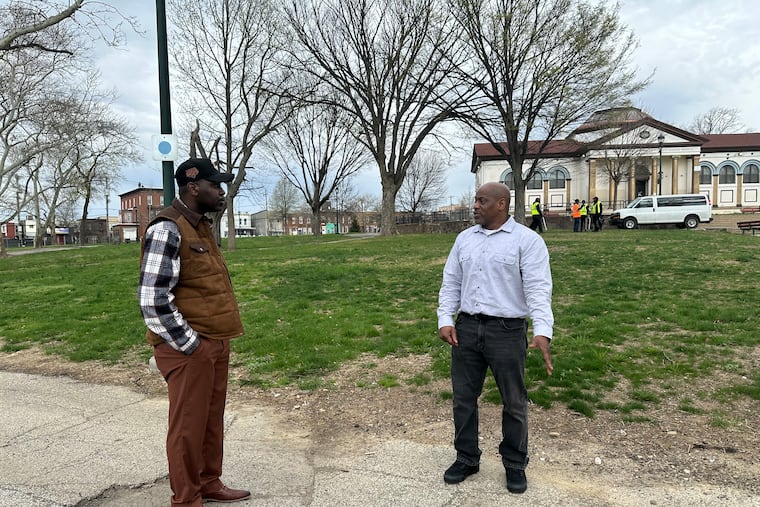
Meeting up with a CEO work crew on an April morning at McPherson Square Park in Kensington, I spoke with crew supervisor Linwood Sanford. He told me he graduated from the program and came back to work at CEO five years ago.
“I never thought this would happen for me, like I never thought I’d be doing this good without street stuff involved,” he said. “It was a blessing.”
Now 57, Sanford said he had been on the street since he was 10 years old, “no parents, no money, struggling.” He now sings the praises of getting that second chance and offering it to others. “I tell my guys, I tell them all the time, ‘Listen, you can do it. If I can do it, you can do it.’”
He is proud of himself and his crew members, and said it makes him happy to see how far they go. When he was out recently, a former participant jumped out of a new car to say hello.
“He said he was still working, doing great,” Sanford beamed. “I was like, damn, that’s what’s up, man. You love to see that.”