Even as Trump seeks to alienate our European partners, their faith in the foundational promise of America remains
Visiting an exhibition of photos about American life at a Berlin art gallery helped bring into clearer focus many of Europe’s fears — and hopes — for our nation under Trump.
BERLIN — I never see America more clearly than when I’m 4,000 miles away.
One of the corollaries of travel is that as you interact with other cultures, you learn to better appreciate your own. You get to compare and contrast, be proud of the good, and try to understand the bad.
It’s also fascinating to learn how others see us.
I lived in Berlin for nine months almost a decade ago, a plus-one tagalong while my wife was part of the Robert Bosch Foundation fellowship. That program, launched in 1984 and which sought to strengthen transatlantic relations, died by the end of Donald Trump’s first term. (Feel free to read into that fact.)
Returning to the city recently, I thought about how much had changed since 2016 as I tried to use my limited knowledge of German during an artist talk by photographer Josef Wolfgang Mayer. His work is part of an exhibition at the Studio Koschmieder gallery in the Kreuzberg section of the city titled “Roadside USA — There have been better days.”
A photographer friend invited us to the event that was described as such:
For many people in the United States, the American dream of freedom and a better life seems to be over. Trump’s slogan “Make America Great Again,” a promise for some, but for others just the lies and deceit of an autocrat, is dividing American society. So, what remains today of this country that for so long shaped the symbols of the Western way of life?
Ouch. Why don’t you tell us how you really feel?
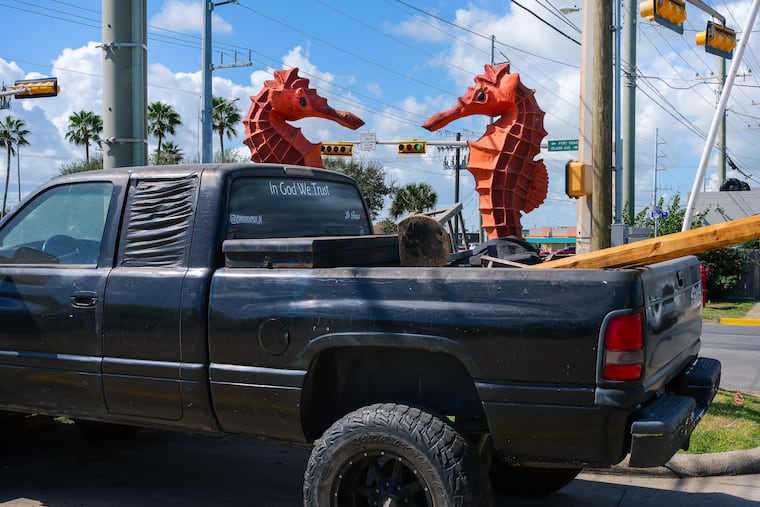
Now, while some of the images on display showed a comically distorted vision of the United States — big hair, bigger hats, and the biggest trucks — at the same time, you can’t help but nod in recognition. This is America. Part of it, anyway. And I love it.
Fortunately, I’m not alone.
“For a lot of people of our generation,” gallery owner Annette Koschmieder said, “the United States was the land of pop culture, of wonderful music, of love and peace, and of great landscapes.”
“Of hope and future,” Mayer chimed in.
“Of democracy,” Koschmieder added.
The married couple — 78-year-old Mayer and 69-year-old Koschmieder — spent three months driving around the U.S. in 2024, traveling across Minnesota, North Dakota, Montana, Washington, Oregon, California, Arizona, New Mexico, Texas, and Louisiana.
Throughout, they saw a country of contrasts.
“It was so clear, after one or two sentences, to find out people’s politics. If they were telling us, ‘Oh, it’s so bad. Our country is in such a bad condition. Everything is so awful.’ I knew they are looking to elect Trump,” Koschmieder said. “When people were telling us that they are afraid for the election, and they were afraid because of the division in their country, I already knew that they were from the Democratic Party.”
Regardless of whom they supported politically, the people they met were invariably friendly, they told me. Many of them were also struggling.
“What you see is that there are a lot of people not having enough money, not having enough to pay their rent, for education,” Koschmieder said. Even if the German couple opposes Trump’s policies, “we understand that people are hoping for someone who will make their lives better.”
Mayer recalled photographing a truck driver who was riding with his little dog. “He’s 62, driving for 42 years,” he said. “He wanted to retire, but his wife got cancer, and now he’s driving to afford the medicine.”
This was difficult to comprehend for someone who lives in a country with the world’s oldest national healthcare system. “You see a lot of people having health problems … limping … you see a lot of people a little damaged,” Mayer said.
In our conversation, Koschmieder and Mayer echoed what others I spoke with in Berlin told me. While it’s true that disapproval of the U.S. is high and many in Germany believe relations between the two countries are poor, the feelings spring out of disappointment, not hate.
» READ MORE: Republicans continue to sow distrust in elections. The SAVE America Act won’t change that. | Luis F. Carrasco
And make no mistake, while Germans may be surprised by some of our cultural quirks — like our apparent fascination with giant fiberglass animal sculptures — people have a clear-eyed and nuanced understanding of America.
“It was always very different and difficult this USA,” Mayer said. “You shouldn’t forget how bad it was between the Ku Klux Klan thing, the McCarthy era … during the Vietnam War, student protesters were shot at a university.”
While people here may be tempering their expectations as the Trump administration seems intent on doing all it can to alienate Europe, so far America — with all its flaws — has yet to default on its foundational promise.
“The best idea is to have a democratic way of life with a lot of freedom. And that’s what we learned from the United States,” Koschmieder said. “So, I don’t know. Maybe we need this hope.”