Latino voters were crucial to the Democratic wins last week. Let’s leverage that, mi gente.
Last week’s election showed Republican candidates hip-deep in Trump’s muck. But it would be a mistake for the Democratic Party to take that as a prompt to go back to business as usual with Latinos.
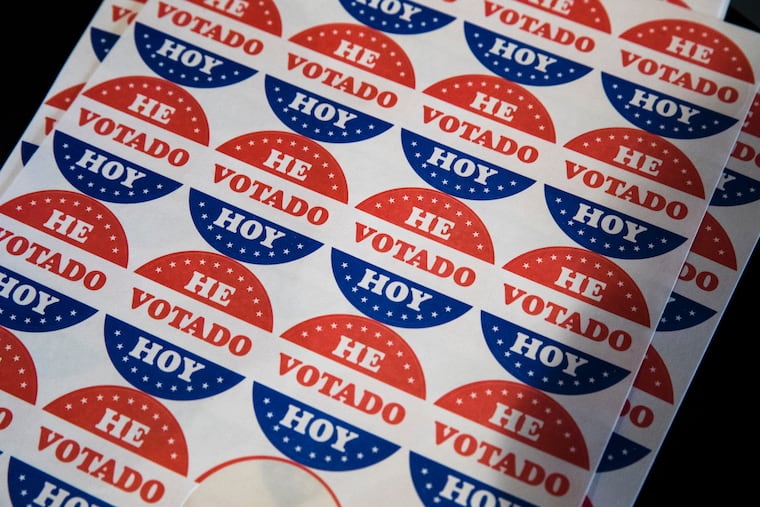
I’ve lost track of the number of times people have let me know they blame Donald Trump’s victory in his second presidential bid on the 50% of Latino men and 46% of Latina women who voted for him. The Democratic Party has counted on Latinos as a fairly reliable voting bloc since John F. Kennedy first started courting our vote in 1960 (en español, even), so the 2024 results prompted a slew of think pieces about our seemingly inexplicable betrayal.
The results of last week’s elections — with Latino voters strongly favoring the Democratic gubernatorial candidates, for example — might make the Democratic National Committee draw a relieved breath.
While it remains to be seen what the specifics of the Latino vote reveal regionally and locally, on a national level, according to exit polling cited by the Washington Post, most of the statewide candidates won Latino voters “by at least 30 points,” with especially marked jumps in localities with a high concentration of Latino and immigrant voters.
Along with skyrocketing inflation and federal cuts, it appears undeniable that Trump’s increasingly unpopular immigration policies had an impact on the recent election results.
The newly elected governors — Abigail Spanberger in Virginia and Mikie Sherrill in New Jersey — addressed U.S. Immigration and Customs Enforcement excesses under the Trump administration during their campaigns, while New York Mayor-elect Zohran Mamdani — whose whole campaign was loudly and proudly an American immigrant tale — vowed that he’d legally oppose any Trump administration ICE enforcement actions akin to those that have taken place in Chicago.
» READ MORE: ‘Say it with me: Our government is forcibly disappearing people’ | Sabrina Vourvoulias
In Bucks County (where Latinos number more than 40,000), the sheriff’s race turned on the issue of immigration. The Democratic challenger, Danny Ceisler, said that for voters in that Philadelphia collar county, rejection of collaboration with ICE was integral to his victory. “[V]oters overwhelmingly voted … to elect the candidate who wanted to end the ICE partnership,” he told WHYY.
Nationwide, Trump’s approval rating among Latinos has taken a nosedive, from 44% to 25%, according to an AP-NORC poll released at the end of October. Many of the Latinos whose votes contributed to Trump’s victory now express regret at having voted for him, citing the cruelty and indiscriminate targeting of immigrant and Latino communities as part of what fuels their rising anger.
For the Republican Party, which has tied itself so inexorably to Trump that it shuns and shames members who don’t genuflect to him, this is bad news. Trump looms so large over the supine GOP that it can’t not own the stink he emanates. Last week’s election — for all of the president’s protests that it meant nothing — showed Republican candidates hip-deep in that muck.
But it would be a big mistake for the Democratic Party to take last week’s election as a prompt to go back to business as usual. While Latino voters have long felt ignored by both political parties, we take it more personally when the neglect comes from the bigger-tent, more inclusive Democrats.
» READ MORE: Dear DNC — where are the Latinos? | Sabrina Vourvoulias
Mi gente, how many times have we noticed that political outreach to Latino voters is an afterthought — cobbled together and lobbed at our communities in a last-minute Hail Mary pass? Now is the time to remind those we helped get elected that this modus operandi is deficient and substandard, and we’re done accepting it as our lot. You want our vote? Ponte las pilas and actually work for it.
We’re here, and we’re not going away.
Mi gente, how many times have we been shamed — by ally and antagonist alike — as low-impact, low-turnout voters? I would like to hope that when Sherrill won the 10 New Jersey counties where one in five people are Latino last week, the rest of the electorate realized that our participation is very consequential.
Now is the time for us to get loud about the things we’ve talked about entre nos: making Election Day a federal holiday and extending early voting periods so that low-wage Latino workers don’t have to choose between voting and being paid, for example, and can vote after going to church on Sunday.
And, while we’re at it — since even bilingual people have a language that is their dominant one — let’s make language assistance available to our folks at the polls and for those mailing in ballots.
There were 36.2 million eligible Latino voters in the U.S. in 2024, and since we are the youngest major racial/ethnic demographic in the nation, those numbers will just continue to climb as our children turn into voting-age adults. Especially in areas like the Route 222 corridor north and west of Philadelphia, which Fortune has named “one of the fastest growing Hispanic communities in the country.”
Along with Eddie Morán, who was reelected as Reading’s mayor in 2023, that’s where Jaime Arroyo, Lancaster City’s first Latino mayor, was elected, and where Matt Tuerk, Allentown’s Latino mayor, was reelected to a second term last week.
We are going to play an important part in determining the outcomes in the 2026 midterm elections, mi gente, and in every election beyond.
What was the takeaway about Latino voters from last week’s election? Aquí estamos y no nos vamos — we’re here, and we’re not going away. Act accordingly.