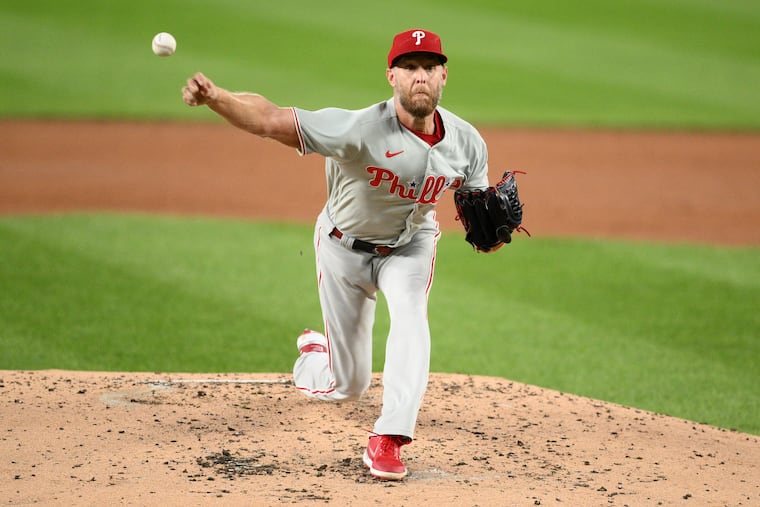
Andrew Painter has reached his Roy Halladay moment. It is on him to seize it.
Failing is easy. The hard work is what comes next with his demotion to triple A. It's an endeavor upon which Painter must embark, much like Halladay did at his age.
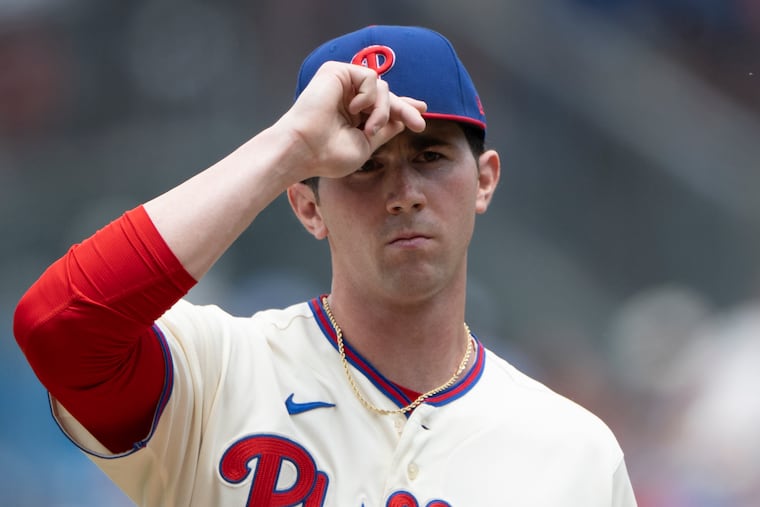
Somebody needs to tell Andrew Painter to remember one number.
10.64
He needs to say it out loud until it is ingrained in his memory, then he needs to take that memory with him.
Ten-point-six-four.
He needs to carry it, to own it, to believe in it. All the way down to Allentown and then to wherever his career takes him next. Buy a notebook, maybe. That’s what Roy Halladay did. Halladay knew that number better than anybody. He felt it. He owned it, rather than letting it own him.
» READ MORE: After his latest rough start, can Andrew Painter keep pitching for the Phillies?
That number — 10.64 — was Halladay’s ERA in 67⅔ innings as a 23-year-old big leaguer. It is nearly three runs higher than the ERA that just earned Painter a demotion to triple-A Lehigh Valley after allowing six runs in two innings of the Phillies’ 12-4 loss to the Marlins on Wednesday. Halladay ended up spending his 24th birthday facing class-A minor league hitters in Dunedin, Fla. As the old saying goes: It’s not how far you fall, it’s how high you bounce.
Painter is 25 days older than Halladay was when he lost his spot in the Blue Jays’ rotation in 2000. He is nearly a full year younger than Halladay was when he began the process of reinventing himself, both mechanically and mentally. It is a shame that Halladay is no longer around. He almost certainly would have shared all of this with Painter personally.

David Murphy alerts
Failing is easy. The hard work is what comes next. It’s an endeavor upon which Painter must embark. The 65 innings he has logged as a major leaguer offer plenty from which to learn. They have told him that his fastball will not play in its current form, whether he grips it with four seams or two. Against the Marlins on Wednesday, Painter threw just 19 of them on 56 pitches. Ten of those fastballs prompted swings. None of them were whiffs.
Unlike a lot of young pitchers, Painter’s issues are not related to control. Heading into Wednesday, he was walking an average of 3.1 batters per nine innings, against 7.1 strikeouts. The big issue is the contact, a lot of it loud. The two-run home run he allowed to Kyle Stowers in the first inning was his 13th in the last 49⅔ innings. It is an unsustainable pace, grotesquely so. The Phillies had no other choice even without better options.
You aren’t going to win many games when your starter lasts only two innings, allowed eight of 14 batters to reach base, and allows six of those eight batters to score. By the end, the Phillies had used six relievers, two of whom threw 26-plus pitches. That didn’t include backup catcher Garrett Stubbs, the human white flag. He was one of two pitchers who didn’t allow a run.
It was not a fun afternoon, especially for Don Mattingly. The Phillies interim manager got a good look at two of the biggest reasons his team may be destined to spend the rest of the season attempting to yo-yo away from .500 and toward 90 wins. It is very hard to break off a long winning streak when you have holes at the top of your lineup and the back of your rotation. In Painter and Trea Turner, the Phillies had both. Now, they have one.
On Wednesday, Mattingly went back to the old drawing board with Turner, his struggling leadoff hitter. Turner went 3-for-5 with a double, his first three-hit game since May 9. The Phillies desperately need it to be the start of something.
» READ MORE: Trea Turner gets ‘on a good track’ with three hits in return to the Phillies lineup
With Painter in the minors and no obvious replacement, the onus will fall even more squarely on Turner. He entered the day with a brutal .595 OPS. He has a lot more work to do to reestablish a rightful claim as a set-it-and-forget-it leadoff man. Mattingly can’t afford to be too patient, especially given the aftertaste of success from Tuesday’s experiment with Brandon Marsh in the one-hole.
If the manager’s latest exhibition of patience doesn’t result in a serious heater from Turner, he shouldn’t hesitate to climb back outside of the box and see what happens with Marsh setting the table. Three consecutive lefty-on-lefty matchups for an opposing bullpen isn’t ideal, but it can be better than anybody-on-Turner. I don’t know if that counts as a real solution. After all, Turner still has to hit somewhere.
It has been an unfortunate season for 24-year-old 40-man roster member Jean Cabrera, who has a 9.39 ERA in 13 starts between triple A and double A. Gage Wood, last year’s first-rounder, has pitched well in Reading. But a big-league promotion is a bit ambitious. The more realistic answer is to patch it together the way the Phillies did for much of 2024 and 2025.
The bigger concern is Painter’s future. The Phillies have clung to the hope of him for four years now. He has shown plenty to justify the belief. He was brilliant in his debut, more than adequate in his next two. He logged back-to-back quality starts as recently as late May. He has not recorded more than four strikeouts in any of his last eight starts. But the fastball is a problem, and he must figure it out. The velocity isn’t there like it was in his peak prospect days. But 94-96 mph is not a bad baseline.
Can it be fixed? If it can, it wasn’t going to happen at the major league level. With the All-Star break drawing near and Painter probably needing some form of workload management in his first big league season, it was hard to make an argument for keeping him in the majors. A lot of what comes next comes down to Painter. Responding to failure isn’t easy. But it is a personal choice.

The Phillies and Braves are set to square off again this weekend in Atlanta, so it's the perfect time to check in with Jeff Francoeur, who played for both teams and calls Braves games on TV and radio. Francoeur joined Phillies Extra to help break down the race for NL East supremacy. Watch here.
You can also subscribe to the podcast version of Phillies Extra on Spotify or Apple Podcasts.
Previous episodes: Luke Murton | Mike Hazen | Tony Gwynn Jr. | Kevin Stocker | Bobby Dickerson | Jim Bowden | John Middleton | Ryan Howard | Dan Baker | Ricky Bottalico