Bryce Harper is off to a strong start. And ‘protecting himself’ has played a key role.
The cleanup spot is still an issue, but Don Mattingly says Harper is his own best lineup protection. That means laying off balls out of the zone, and making hard contact on the strikes he sees.
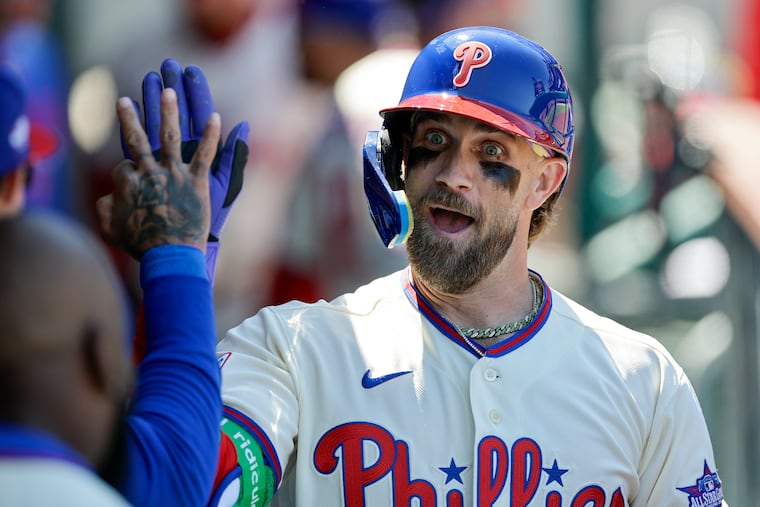
Before most games, Bryce Harper gets treatment from the trainers, attends scouting meetings with other Phillies hitters, and takes swings in the indoor tunnel.
And that’s where the conversations usually begin.
Oh, to be a fly on the batting cage when Harper talks shop with Don Mattingly.
“I think one thing that Donnie has told me a lot,” Harper said, leaning forward in a folding chair in the cramped quarters of Fenway Park’s visiting clubhouse, “is just [the importance of] protecting yourself. Just not really worrying about other guys around you. Whatever happens, happens.”
» READ MORE: Over? History shows it’s not over for the Phillies’ season. Here’s what it took for others to turn it around.
It sounds so simple. Unless you’re the guy in the lineup that opponents pitch around all the time, no matter the situation, out of fear of giving up a tide-turning hit.
Unless you’re Harper.
Or, 40 years ago, Mattingly.
Harper is off to a solid start in his 15th major league season. Through his four-hit game Friday night in an 11-9 comeback victory in Pittsburgh, the 33-year-old had 10 homers and a .906 OPS, 12th among all left-handed hitters. He was 49% more productive than league average, based on OPS-plus.
Two months from Philly’s All-Star Game, Harper is on track to be the main attraction, The Showman at the center of baseball’s midsummer show.
“I feel like my strikeouts are down, so I’m pumped about that,” he said, having chopped his strikeout rate to 16.4% from 20.9% last season. “I’m putting the ball in play. I feel like I’m hitting everything that’s a strike hard. So, if I can do that, then I’ll be right where I need to be at the end.
“But I feel good where I’m at right now.”
Harper didn’t get here as a result of the Phillies hiring Mattingly as bench coach in January and certainly not because they elevated Donnie Baseball to interim manager on April 28 after firing Rob Thomson amid a 9-19 start.
It’s probably helped, though, that Mattingly is around.
Because Harper’s focus coming into the season was to gain more control over the strike zone. Last year, batting mostly in the No. 3 spot in the Phillies’ order, he faced the lowest rate of strikes (42%) of any hitter in the sport. His natural urge was to chase after anything close, especially considering the lack of production behind him.
The Phillies didn’t fill the cleanup spot in the offseason. Not after free agent Bo Bichette walked away from their $200 million offer. And Harper came to spring training with lineup protection on his mind.
» READ MORE: The Phillies have an Alec Bohm problem. What are their options? And how long can they wait?
“Whoever’s in that four spot,” he said in February, “is going to have a big job to do.”
But Harper has no control over that. So, Mattingly tells him the same thing he told Blue Jays slugger Vladimir Guerrero Jr. last season while coaching in Toronto.
“We didn’t really have a true four-hole guy behind him, and I remember the year before he was chasing a lot, trying to do it, trying to be that guy,” Mattingly said. “But last year, Vlad started taking his walks, and then they started pitching to him. It forces them to throw you strikes.”
Harper is chasing non-strikes at a similar rate as last year (35.9% through Thursday compared to 35.6% last year). But he’s making more contact on pitches in the zone (85.4%, up from 80.9%) and out (52.6%, up from 49.9%).
But Harper is also walking at a higher clip (13.1%, up from 12.1%), striking out at a far lower rate, and generally getting himself out less.
Mattingly cited a recent at-bat in which Rockies righty Chase Dollander threw seven consecutive pitches below the zone to try to get Harper to go fishing. Harper fouled off a few but finally accepted a walk.
“It’s hard for guys like Harp because he can do so much and always wants to be the guy up in a big spot,” Mattingly said. “But over the course of a season, if he’s chasing all the time, it’s only hurting him, right? He has to protect himself. That just means swinging at strikes. That’s all it means.”
» READ MORE: Dave Dombrowski is ‘responsible’ for this reeling Phillies roster. And these decisions helped get them here.
Surely, though, that’s easier said than done for Harper when the Phillies rank 29th in the majors with a .569 OPS out of the cleanup spot.
“It definitely is,” Harper said. “But I understand where Donnie’s coming from. I get that. I think it was just a good unlock for me in my mind. It kind of made me feel better about the situation or whatever, right? Like if guys aren’t pitching to me, just protect your box, protect your count, protect your zone.
“So, it kind of just like turned something in my head, I guess. I understand it.”
There are other areas that have contributed to Harper’s solid start. Let’s dive in:
Spin city
Last season, for the first time in his career, more than 40% of pitches thrown to Harper were breaking balls, defined as varieties of curveballs or sliders.
It’s becoming a trend.
When opponents do pitch to Harper, they tend to attack him with spin, especially early in the count and often out of the strike zone in an attempt to get him to chase. In two series against the Braves last month, 42 of the 90 pitches to Harper were breaking balls.
Overall, 39.4% of the pitches he saw through Thursday were curves or sliders — and 25.6% were out of the strike zone.
“You probably know the numbers more than I do because I don’t like looking at that stuff,” Harper said, laughing. “But I feel like I’ve been thrown off-speed since I was 7 years old.”
The difference this season: Harper is hitting it.
Entering the weekend, he was teeing off on sweepers (.333 average, .889 slugging) and curveballs (.417, .500), in particular. Three of his homers have come against sweepers; he hit four homers on sweepers all of last season.
If Harper keeps mashing breaking pitches, or at least laying off the ones that aren’t strikes, he’s bound to force pitchers to throw him more fastballs.
» READ MORE: The Phillies have elite speed at the top and bottom of the order. And it could be key for an inconsistent offense.
“The sequencing is becoming more and more real,” Scott Boras, Harper’s agent, said recently on The Inquirer’s Phillies Extra podcast. ”That is the way to approach the Phillies and Bryce Harper. So, the adjustment is one where you have to be more refined at what you offer at, and that’s clearly Bryce’s goal."
Said Harper: “It’s just trying to understand hitting strikes and hitting strikes hard. That’s the biggest thing I can get to. If I miss pitches, it really bothers me. Or if I chase, it bothers me. But when I have good days, it’s just understanding, ‘Hey, stay in the zone, hit the ball hard.’ That’s the best I can do.”
Walk the walk
In the eighth inning of the World Baseball Classic final in March, Harper banged a game-tying, two-run homer, the biggest moment of the tournament for Team USA.
He returned to spring training with a goal in mind.
“If I can walk 140-150 times this year,” Harper said, “then I think I’ll be right where I want to be.”
It felt like an ambitious goal. Harper has drawn 100 walks four times, including in his MVP seasons in 2015 and 2021. His career-high: 130 walks in 2018 with the Nationals.
Since 2016, only one player has walked more than 140 times: Juan Soto, with 145 in 2021.
» READ MORE: The Showman returned for a ‘huge’ WBC moment. And it could be big for Bryce Harper and the Phillies, too.
With 24 walks in 44 games through Thursday, Harper is on pace for 88, which would be his highest total since 2021. But he says now that he wasn’t being literal with his “140-150″ target.
“No, it was just more of an idea, right?” Harper said. “I could’ve said 160; I could’ve said 200. It was just the notion of trying to walk and see better pitches and hone in my zone as much as possible. That was kind of my thought process behind that.”
Indeed, it’s more about a mindset than a specific goal.
It also enables Harper to focus on something other than how little the Phillies are getting out of the cleanup spot. Because if he concentrates on laying off the non-strikes, opponents will eventually have to come in the zone against him.
“I mean, I want to hit, you know?” Harper said. “I do. But I know when I’m walking, I am a better player.”
And, as Mattingly says, he’s his own best lineup protection.

Let's talk about the Phillies' bullpen. Larry Andersen happens to be an expert on the subject. The popular Phillies radio analyst had a 17-year major-league career in which he appeared in 699 games – all but one in relief. He joins Phillies Extra to break down the biggest question standing between the Phillies and a long run through October: How will they bridge the gap to closer Jhoan Duran? Watch here.
You can also subscribe to the podcast version of Phillies Extra on Spotify or Apple Podcasts.
Previous episodes: Matt Klentak | Jeff Francoeur | Luke Murton | Mike Hazen | Tony Gwynn Jr. | Kevin Stocker | Bobby Dickerson | Jim Bowden | John Middleton | Ryan Howard