‘Phillies Extra’ Q&A: Greg Luzinski on 1980 World Series memories, a Schwarber comparison, and more
Luzinski joined The Inquirer's baseball podcast to discuss finally breaking through with a championship 45 years ago, and the crossroads facing today’s Phillies.
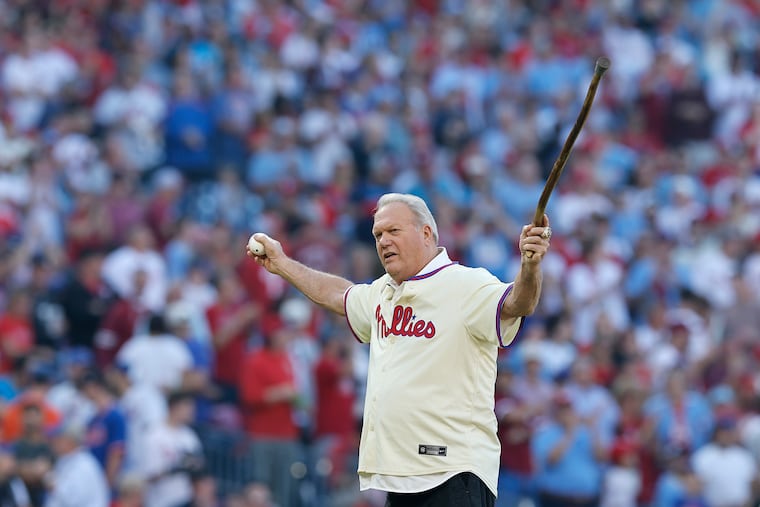
Forty-five years ago last week, the Phillies won their first World Series championship.
It wouldn’t have happened without Greg Luzinski.
Luzinski didn’t get a hit in the World Series. But “The Bull,” as he was known, picked up two game-winning hits in a five-game National League Championship Series for the ages against the Houston Astros, and there wasn’t a more important postseason series in franchise history.
Consider: The Phillies lost in the NLCS in 1976, 1977, and 1978. They signed Pete Rose before the 1979 season but missed the playoffs altogether, firing manager Danny Ozark late in the season. Owner Ruly Carpenter hinted at bigger roster changes if they didn’t win it all in 1980.
» READ MORE: ‘Phillies Extra’ Q&A: Mike Schmidt on Bryce Harper’s fit in Philly, Pete Rose’s Hall chances, and more
And Luzinski, a symbol of previous postseason failures after his role in the Black Friday loss in 1977, delivered. He hit a two-run homer in Game 1 at the Vet, then knocked a pinch-hit RBI double off the left-field wall at the Astrodome to break a tie in the 10th inning of Game 4.
Luzinski, 74, joined Phillies Extra, The Inquirer’s baseball podcast, last week to discuss that series, the World Series that followed, and the crossroads facing today’s Phillies. He also delivered a message to owner John Middleton and president of baseball operations Dave Dombrowski.
Here’s an excerpt from our conversation, edited for brevity and clarity. Watch the full interview below and subscribe to the Phillies Extra podcast on Spotify or Apple Podcasts.
Question: What resonates with you about that 1980 World Series 45 years later?
Answer: Well, I think there was the big play with Rose and Boonie [catcher Bob Boone], obviously. They’re at the dugout — and I was right there when it happened. And the story behind that is, Bob saying he had to go all that way for the ball, and Pete was really out of position and happened to be lucky enough to be right there. But that was a big play that was right in front of us, obviously. And that led to the Willie Wilson [game-ending] strikeout.
» READ MORE: Phillies 2026 infield outlook: Free-agent options, prospect forecast, and more
But I think the unique thing about the game was the excitement for the fans. When you’re in the Vet, it’s a full house. There was almost 70,000 people there, so that’s tremendous for Philadelphia. And then the next day was the parade. And I think one of the deep things about the parade was the parade route was jammed all the way, and then we entered the stadium, JFK Stadium, that was also just full of people. ...
I think a lot of people talk about going down Broad Street, but going into JFK Stadium was magnificent, and the fans were tremendous. And obviously for me, my Series wasn’t good [0-for-9 against the Royals]. My playoff series was a lot better. Obviously, I had a good [championship] series [an .882 OPS with a home run and four RBIs]. But the World Series goes by fast.
We had trouble getting there earlier, and it seemed like once you got there, the pressure was totally off. It was back to having more fun playing baseball. I think that’s probably some of the problems now with some of these playoff teams.
Q: I see some parallels between 1980 and what’s going on with the Phillies now. Going into or during the 1980 season, was there a sense that it was now or never for that group?
A: Well, we heard that. There’s no question about it. Because obviously there was some youngsters coming through the minor league system with great credentials, and they were younger than some of us at that time even though we were together at a young age in the big leagues. So, it’s a little bit different than it is now. But I don’t know.
You think the Phillies can just sit there and break that team up totally? I mean, we’ve got to be realistic. We’ve got to be realistic about some of it. You know, maybe a [Nick] Castellanos will move on. Do they really want the left fielder [Brandon Marsh] back?
We’re left-handed strong. There’s things we need, but guess what? Other teams know we need them, so it’s going to be harder to get them. And how much money is John Middleton going to spend to try to win a World Series?
» READ MORE: How can Bryce Harper have an ‘elite’ 2026 season? It starts with examining his atypical 2025.
Q: And when you’ve won 96 games and 95 the year before that, 90 the year before that, you’re doing a lot of things right during the regular season, and it’s about doing some of the little things in the postseason.
A: There’s no question about that. I think that Dave’s a smart enough baseball man that he’ll try to strengthen our outfield. Obviously, I think you’ve got to sign [J.T.] Realmuto. I think he’s strong behind the plate, maybe not as much offensively now, but he directs that pitching staff. The strength of your ballclub right now is your pitching staff, and I think [Ranger] Suárez would be another big addition to sign. Obviously offensively, you’re looking at [Kyle] Schwarber. Great player.
Q: Do you see maybe a mirror image of yourself in Schwarber? He’s going to be 33 next year. You retired at age 33, and he’s looking for a four- or five-year contract. What sort of things do you look for in a slugger like him that would tell you he’s a guy who could continue to do this into his mid-30s?
A: I think as long as he could stay short, and hit against his front side, like he’s been doing, that he’s going to hit home runs. Now, is he going to hit 50? I don’t know. That’s a pretty big number at 33 years of age. But I think he can still hit 30-35, maybe 40, in the 40s.
Don’t forget, it depends a lot how they’re going to pitch you, if Harper can start producing the way we hope Bryce Harper can produce, then they’ve got to go at somebody. ... And if [Trea] Turner gets on base again, hitting .305, or above .300 with walks, then you’ve got to go at people. There’s no question.
I heard Larry Bowa say yesterday that speed can hurt, and it does. When you get a guy at first base that can run, those catchers don’t want to be showed up. They’ve got some pride within their arms and their quickness to second base, so it puts more pressure on the pitcher to throw strikes and come at hitters compared to bouncing that curveball or slider in the dirt, and it makes a difference. …
» READ MORE: ‘Phillies Extra’ Q&A: Larry Andersen on another NLDS loss, being honest with fans, and what’s next
Schwarber, he’s a worker. You guys can see how he works, obviously, in the cage, and he hits during the game in the cage. I was a DH in Chicago, was fortunate enough to win the DH [of the Year] award two out of my four years there. And to me, if you’re not an offensive player, there’s no sense having a DH. He has to be an offensive player. There’s no question about it.
And I think Schwarber proved this year that he’s an offensive player, along with some of his past years, that he can drive the ball. You need a guy that can drive the ball in Citizens Bank Park. Home runs are a big part of the game for us there, and you can see we didn’t hit as many this year as we have in the past or the 2008 or 2009 team. And it hurt us.
Castellanos was behind. Marsh didn’t get going until halfway in the season, or better. So when you don’t have power at third, you don’t have power in left or right, you’re hurting a little bit as far as the lineup goes.
So, Dave — and I know Dave since I was in Chicago in ’81 — you got a job to look for some right-handed power. And Mr. Middleton, you may have to go to the free-agent market and spend a little money to bring one here to Philadelphia.

Phillies Extra is your deep dive into all things Phillies on Gameday Central! Hosted by Scott Lauber, each episode brings you insider analysis, exclusive interviews with players and experts, reader emails, and more to cover the hottest topics with the Phillies and across Major League Baseball. Don’t miss it — the conversation starts here!
You can also subscribe to the podcast version of Phillies Extra on Spotify or Apple Podcasts.