The Jhoan Duran Effect is real so far, and there’s precedent for what the Phillies hope he delivers
Kyle Schwarber can’t shake the feeling that he’s seen the impact a new closer like Duran has had on his team. Probably because he has.
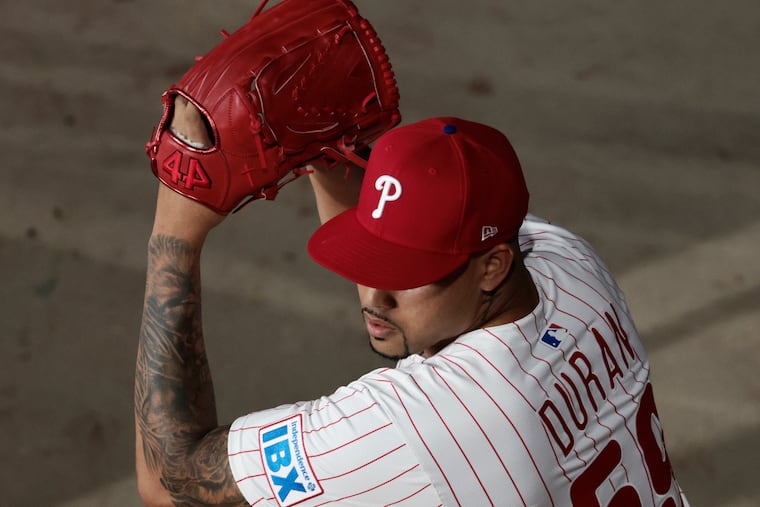
Jhoan Duran walked down the stairs and through the door. As he stepped on the warning track, the lights went out. Then came the gong, the song, and the scoreboard flames. Oh, and the tarantulas. Can’t forget the tarantulas.
“They haven’t had anything like that here,” Kyle Schwarber said. “Ever.”
Duran’s cinematic entrance is a sight to see, even for his new Phillies teammates. Schwarber concedes that he was as riveted by it as the 43,241 paying customers at Citizens Bank Park last Friday night.
But something else about the Phillies’ mountain of a closer — Duran is 6-foot-5, 230 pounds — caught Schwarber’s attention.
» READ MORE: Welcome to the Jhoan Duran Show: The new closer picks up his first save
“The stone face,” the MVP candidate slugger said before a game the other day. “If that’s me, I’m goose bumps and heart’s racing and trying to calm myself down. And he’s just like, ‘Another day at work.’ Nothing’s fazing him. I think that’s something that can’t go understated.”
It reminds Schwarber of 2016. The Cubs were in first place but needed a closer. So they met the July deadline by trading four players to the Yankees, including top prospect Gleyber Torres.
Two nights later, Aroldis Chapman stood atop the mound in the ninth inning at Wrigley Field. First pitch: 100.8 mph. Next: 101.4. Then 102.4. And so on, until the last pitch, 103 mph on the outside corner for a called third strike.
All across Chicago, jaws hit the pavement.
“You go out, and everyone’s just looking at the scoreboard,” Schwarber said. “Everyone sees the numbers. The numbers are great. But also, too, the demeanor, the attacking [hitters]. Chappy had that at the time.”
Schwarber pointed to Duran’s locker.
“I feel like he has that aspect to him, too,” he said.
Like the Cubs with Chapman, the Phillies ponied up for Duran. Three consensus top-100 prospects were traded at the July 31 deadline. Two went for Duran. Mick Abel, a 23-year-old former first-round pick, likely will join the Twins’ rotation before season’s end; 18-year-old catcher Eduardo Tait homered in his fourth game for high-A Cedar Rapids.
But Duran represents something the Phillies haven’t had since they traded Jonathan Papelbon in 2015 — and, really, before that with Brad Lidge. And it’s more than the showstopping entrance. It’s the splitter/sinker blend — a “splinker,” in pitching parlance. It’s a 103.3 mph heater, the Phillies’ fastest recorded pitch in the Statcast era (since 2008). It’s a reason to stay for the ninth inning rather than trying to beat traffic.
» READ MORE: An inside look at why Phillies closer Jhoan Duran’s signature ‘splinker’ is such an effective pitch
Most of all, it’s a jolt of confidence for a World Series-or-bust team that busted because of its bullpen in the 2023 NL Championship Series (Craig Kimbrel in Games 3 and 4 in Arizona) and in last year’s divisional round (Jeff Hoffman in Game 1 at home).
And it finally solves a riddle that has baffled the Phillies throughout this run of contention: Who will get the last three outs of a taut playoff game?
Call it the Duran Effect. And through one week with the Phillies, it’s real.
“You feel confident, and that’s what you want to feel,” Schwarber said. “It’s not like you expect him to go out and convert 30-for-30, you know? Everyone’s human. Everyone doesn’t have their A-stuff all the time. But you’re feeling pretty dang good whenever he’s rolling out there.”
So far.
The final piece
Relievers tend to be notoriously unpredictable from year to year and often even within a season. History is littered with star closers who changed addresses at the deadline and fizzled in the new location.
Josh Hader, for instance, had a 7.31 ERA in 19 games after getting traded to the Padres in 2022. And when Bryce Harper hit his pennant-clinching homer off Robert Suarez in the eighth inning of Game 5 of the NLCS, Hader was still in the bullpen.
But Chapman was the quintessential final piece in a championship puzzle.
» READ MORE: The Phillies and Mets had different approaches at the trade deadline. Whose moves will be enough?
Never mind that he came at a significant cost to the Cubs. Torres, 19 years old and in A-ball at the time, became a three-time All-Star. But the Cubs knew the ninth inning needed to be buttoned up, especially after Héctor Rondón blew four saves in six chances before the All-Star break.
And with a young core and a championship drought that spanned more than a century, the Cubs’ front office felt a unique now-or-never urgency.
The impact was immediate. After Chapman’s electric Cubs debut, starter Jason Hammel joked, “I’m not impressed. I thought we were getting a guy who could throw 105. We only got 103. Not enough adrenaline.”
“It’s an entirely different thing when you get a guy out there throwing 100 mph,” then-Cubs manager Joe Maddon said before the 2016 World Series. “You feel pretty good about it, regardless of who’s hitting. Our guys felt, if we got Aroldis, we’d have a chance to be sitting here, and they were right.”
Indeed, Chapman posted a 1.01 ERA and 16 saves in 18 chances after joining the 103-win Cubs.
“When we made that trade, I felt like we had a really good bullpen, but we didn’t have kind of the set closer,” Schwarber said. “Then you go and get probably the best closer on the market — or in baseball at the time, too.
“Besides just having a 104 [mph] fastball, I feel like Chappy developed a really good slider. You would see him spotting it up, down, going to get chase with the slider and things like that.”
Chapman was imperfect in the postseason. But he did close out the division series against the Giants and get the last five outs of the NLCS against the Dodgers. Although he blew a save at the worst possible time — Game 7 of the World Series — the Cubs rallied for the biggest win in franchise history — and broke a 108-year hex.
» READ MORE: How will the Phillies manage their new-look outfield? Let’s break down the options.
The Yankees traded another difference-making lefty reliever in 2016. Andrew Miller went to Cleveland for four players, including outfield prospect Clint Frazier, and was used in the highest-leverage moments, regardless of the inning, all the way through the pennant and World Series.
Miller’s numbers after the trade: 1.55 ERA, 46 strikeouts, and two walks in 29 innings.
Daniel Hudson threw the clinching pitch of the 2019 World Series for the Nationals after coming over at the trade deadline that season. In 2003, the Marlins dealt then-top prospect Adrián González for setup man Ugueth Urbina, who posted a 1.41 ERA in 33 appearances to help win a World Series.
There’s precedent, then, for what the Phillies are hoping Duran will deliver.
‘He’s like an explosion’
Historically, though, the most significant deadline additions have been starters (think of Randy Johnson in 1998 and CC Sabathia in 2008) and sluggers (Manny Ramirez in 2008; Manny Machado in 2018).
Probably not this season.
Fifty trades involving more than 100 players were made in the two days leading up to the deadline. But the only big-name hitters who moved were Eugenio Suárez (Mariners) and Carlos Correa (back to the Astros). The best starter: probably Merrill Kelly (Rangers), even though the contending Mets, Cubs, Yankees, and Red Sox sought rotation help.
» READ MORE: Inside the Phillies’ scramble to produce Jhoan Duran’s walk-out show, and what could be next
The stars of this deadline were the relievers, a reflection of the heightened value that teams place on swing-and-miss bullpen arms in the era of expanded playoffs. A partial list of the late-inning relievers who changed teams:
Duran, Phillies
Mason Miller, Padres
Ryan Helsley, Mets
Kyle Finnegan, Tigers
David Bednar, Yankees
Camilo Doval, Yankees
Tyler Rogers, Mets
Griffin Jax, Rays
Danny Coulombe, Rangers
The Phillies believe they got the best of the bunch, a fire-breathing dragon who intimidates as much with his entrance as with “close-the-door stuff,” as newly acquired outfielder Harrison Bader put it after coming over in a separate deadline deal with the Twins.
But there’s also this: Unlike even Chapman when he arrived in Chicago, Duran has closed out a postseason series. In 2023, he saved 3-1 and 2-0 victories in the Twins’ wild-card-round sweep of the Blue Jays. In five career scoreless innings in the playoffs, he gave up two hits and one walk and struck out six.
“There’s nobody else in the world that does what he does,” Twins manager Rocco Baldelli said two years ago. “He’s like an explosion. He goes at hitters with things they probably don’t know exactly what they’re looking at because they haven’t seen it before. He doesn’t just get the outs. He kind of looks the part, too.
“He can take over a game, both with the results and the feel of the game when he arrives in the ballgame.”
» READ MORE: Suspended Phillies reliever José Alvarado says he ‘made a mistake’ taking a banned substance
A week after Duran’s arrival, Schwarber can’t shake the feeling that he’s seen this before.
Probably because he has.
“The similarities [to Chapman] are there where I feel like we got one of the best back-end guys in all of baseball,” Schwarber said. “And I think you’re going to see even a better version of him. Getting him over here, getting him with our pitching coaches, getting him with J.T. [Realmuto], he’s going to understand his pitches a little bit better.
“Knowing we have him back there, that’s a huge lift for us.”

Matt Klentak's fingerprints are still on the Phillies' roster six years after he was the team's general manager. These days, Klentak is part of the front office for the Brewers, who recently clinched their fourth consecutive NL Central title. With the Brewers coming to town Tuesday, Klentak joined Phillies Extra to discuss his current and former teams. Watch here.
You can also subscribe to the podcast version of Phillies Extra on Spotify or Apple Podcasts.
Previous episodes: Jeff Francoeur | Luke Murton | Mike Hazen | Tony Gwynn Jr. | Kevin Stocker | Bobby Dickerson | Jim Bowden | John Middleton | Ryan Howard | Dan Baker