The Griffeys hope their legacy can be used as a force to attract interest in Black American players
With his father at his side, Ken Griffey Jr., is focused on the formula that assures Black players will be seen by scouts, teams, GMs and eventually fan bases. “This is very important to me,” he says.
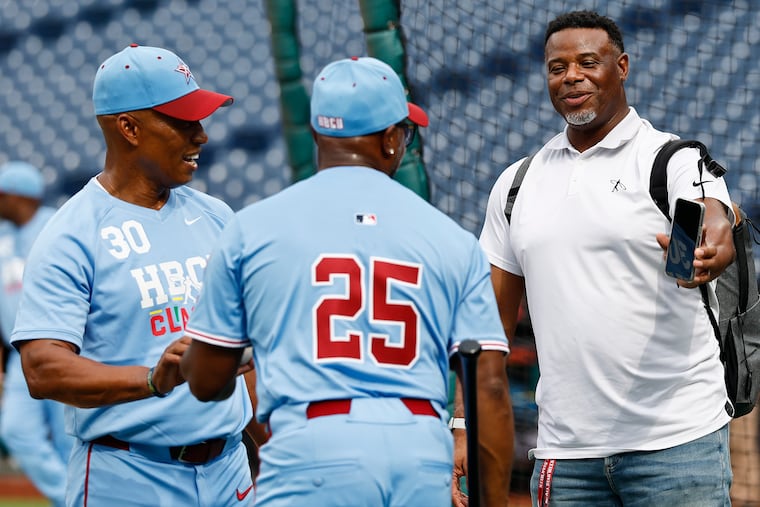
There was an obvious sense of pride coursing through Citizens Bank Park Friday night as every baseball player, coach and keeper of the game opened Philadelphia’s days-long All-Star Game celebration with the annual showcase HBCU Swingman Classic, a game featuring elite players from historically Black colleges and universities.
Alongside that sense of pride was also a palpable sense of urgency, too obvious to be an undercurrent, too important to be ignored.
Certainly, former players, coaches and managers who are African American don’t ignore the conundrum that in a game that is arguably more diverse than it’s ever been yet fighting a decline in the number of Black Americans participating on the field. The sport that annually celebrates color-barrier breaker Jackie Robinson has seen the percentage of Black players dwindle from a record high of approximately 18% in 1991 to 6.8% this season.
» READ MORE: The HBCU Swingman Classic kicks off the All-Star festivities in Philly: ‘It was just phenomenal’
The Swingman Classic, the brainchild of Hall of Famer Ken Griffey Jr., was born out of a belief that a game had to recapture the hearts and minds of Black America. To succeed completely, the game once more has to convince a culture that its history and populations have not been “lost, stolen and strayed,” to borrow a civil rights term from the 1960s.
Griffey Jr., who works with Major League Baseball, the players’ union and other entities to rebuild a shrinking constituency, makes clear his intent.
“This is very important to me,” Griffey Jr., 56, said prior to the Classic clash. “I feel that I’m helping the parenting of baseball and giving these young kids an opportunity to be seen. ‘Cause I’ve lived my dream. I’ve gone out there, played 22 years. I want the same opportunity for every kid. No matter your background, as a kid, you just want to be seen and be heard.”
From early childhood, Junior had no trouble being seen or heard, while growing up in major league clubhouses and watching and learning the game as his father, Ken Griffey Sr., thrived in 19 big-league seasons. “It was always, ‘Dad, I want to be a major league player.’ Junior was always so proud to get out on the field on Father-Son Day. It was fun. And he was good,” Griffey Sr. said.
He was also a great student, blessed with talent, genes, and a thirst to learn from the plenty of icons he mingled with. The likes of Willie Mays, Henry Aaron, Willie McCovey, and other greats graced his mother’s dinner table when in Cincinnati to play Senior’s Reds. He played on the field with the children of his father’s teammates like Pete Rose and Tony Perez. He was in the presence of Johnny Bench and Joe Morgan routinely.
Getting that close-up of an era that embodied the golden age of Black American ball showed Junior the way, and the sweet-swinging, Gold Glove-fielding center fielder made the most of what he learned, using his skills through 22 seasons to build a Hall of Fame career.
» READ MORE: Artist bringing a new mural to South Philly ahead of MLB’s All-Star Game: ‘It’s a love letter to Philadelphia’
Neither father nor son is willing to rest on their laurels. While both insist that their shared experiences did not lead them to ever judge teammates by color, nationality, or ethnicity, that did not mean either wanted to see the legacy built by their own culture disappear from the game.
Senior is especially too well aware of a change gone awry. “When I played in Cincinnati, I would walk into a clubhouse with Joe Morgan, George Foster, Ed Armbrister, Danny Driessen, Hal King and Tommy Hall.” And on the Yankees teams he played on? “Well, they put us altogether, on one side of the clubhouse, so it was easy to spot us,” he said, laughing. “There was Oscar Gamble, Andre Robertson, Billy Sample, Willie Randolph, Groove [Don Baylor], Big Blood [Dave Winfield]. And Rudy May was over with the pitchers.”
No major league team can point to such an abundance of homegrown players of color today. If a team has more than two or three African Americans, it makes headlines on Jackie Robinson Day. What also makes headlines is teams that have no African American players in highly publicized events like the 2022 World Series between the Phillies and Houston Astros.
Tuesday, the Phillies will have on hand the Black players who constructed positive vibes decades after the team treated Jackie Robinson horrifically. Jimmy Rollins and Ryan Howard surely will lend their support to the All-Star Phillies’ family fest. Dick Allen memories will abound. Gary Matthews and Garry Maddox should be easy to spot. And yet that urgency about how to include African Americans in the game’s massive number of people of color will linger long after the midseason classic ends.
That is why Junior Griffey, with his father at his side, is focused not on fastballs, but on the formula that assures that Black players will be seen by scouts, teams, GMs, and eventually fan bases.
It will require work as well as events like the Swingman Classic to begin to break the mesmerizing allure of the NBA and NFL when it comes to athletes gifted enough to go in more than one direction. This the Griffeys know. This Griffey Sr. has lived, as have three grandsons who chose to play football, one — Trey — professionally with the Steelers.
» READ MORE: MLB’s All-Star Village will pay homage to Philly neighborhoods. Here’s what to know before you go.
“Baseball was my fourth sport, behind football, basketball and track,” said Senior. “And we were a football family. My father played college football. I was all-state in Pennsylvania. But a baseball scout watched me. He got tryouts with the Pirates, then two with the Reds. I faced Doc Medich in batting practice and hit two home runs.”
A contract followed after Cincinnati drafted Griffey Sr. in the 29th and final round of the amateur draft. Years later, he watched Junior become the first pick in the 1987 draft. “Dad was the last person picked by the Reds in his draft,” Junior said. “He spent 19 years in the big leagues because somebody took a chance.
“Some of these kids here, going to these schools, they get lost in the shuffle,” Junior added. “Scouts or someone else, they don’t go into these inner-city kids and find these diamonds in a rough. So, I can see 15 guys, but it may be this one guy that’s playing over here that is a monster. The key is you look.”

Baseball's biggest stars are descending on Philadelphia for the 96th All-Star Game at Citizens Bank Park on July 14. Follow all of The Inquirer's coverage here.
- Everything you need to know about the All-Star Game
- Meet the All-Stars: What to know about baseball’s best coming to town
- Phillies get a sixth All-Star as Jesús Luzardo is added to NL roster
- Kyle Schwarber joins Bryce Harper in the Home Run Derby
- Who's competing in the Home Run Derby? Here's who is in already
- MLB All-Star Week brings a Philly MVP back to Citizens Bank Park’s food lineup
No one guarantees a Griffey will break through because of this one event. But 10 participants in past three HBCU Classics have been drafted.
Will baseball turn to its past, to a time when HBCUs used to be fonts of future baseball talents? For once Jackie arrived in 1947, the talent hunt was on, waged by forward-thinking teams that could not resist talents to be found within the Negro Leagues, on farm fields, in the factories and, yes, the nation’s HBCUs.
From Morgan State in Baltimore, Joe Black, one of Robinson’s first Black teammates in Brooklyn, and the first Black pitcher to win a World Series game. Hall of Famers Lou Brock (Southern University), Andre Dawson (Florida A&M), and mainstays such as Tommie Agee, (Grambling State), Cecil Cooper (Prairie View A&M), and Marquis Grissom and Vince Coleman (Florida A&M) followed.
» READ MORE: Phillies prospect Gage Wood will start in MLB Futures Game on Sunday at Citizens Bank Park
“Now people say Blacks don’t play baseball anymore,” Senior said. “That’s not true. Every year I go down to Vero Beach for the Hank Aaron Invitational. Over 200 kids show up, little kids to teens. And these kids can play.”
Indeed, graduates of the Aaron annual camp and showcase include the Braves’ Michael Harris II, the Cardinals’ Jordan Walker, White Sox rookie Braden Montgomery, the Yankees’ Carlos Rodon and the Nationals’ Nasim Nuñez. They all came through one or more of baseball’s programs designed to attract American players of color to the game.
Oh, and there is one other youngster worth mentioning. Justin Crawford, son of former major leaguer Carl Crawford, now patrols center field for the Phillies.
Crawford, like Griffey Jr., is working hard in the family business, building not only on a family legacy, but one baseball is dusting off and showing off again, the Griffeys hope.
Claire Smith is the founding executive director of the Claire Smith Center for Sports Media at Temple University. She is in the writers’ wing of the Baseball Hall of Fame and a Red Smith Award honoree.
The Phillies haven't won a playoff series since 2023, and their postseasons keep getting shorter and shorter. How can they fix it? Radio play-by-play announcer Scott Franzke joins Phillies Extra, The Inquirer's baseball podcast, to discuss Trea Turner's future, the managerial uncertainty, whether the Phillies can get "creative" to change the mix of the roster, and more. Watch here.
You can also subscribe to the podcast version of Phillies Extra on Spotify or Apple Podcasts.
Previous episodes: Larry Andersen | Matt Klentak | Jeff Francoeur | Luke Murton | Mike Hazen | Tony Gwynn Jr. | Kevin Stocker | Bobby Dickerson | Jim Bowden | John Middleton