The 2026 breakouts the Phillies need, starting with Aidan Miller
There is upside on this Phillies roster. It only means so much. But Miller and Justin Crawford offer plenty of reason to hope.
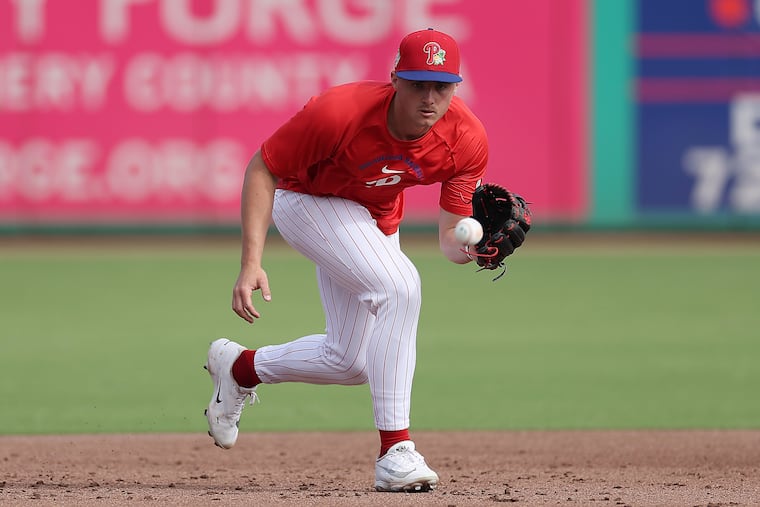
Aidan Miller on the Phillies roster on opening day? Don’t count on it. But don’t completely rule it out. And don’t mark your calendar too far into the future. The April showers could bring a lot more than flowers this year.
Two weeks into spring training, the Phillies aren’t going out of their way to disguise their hopes for their top prospect. The whole organization seems to understand that a certain degree of aggression is required in order to overtake the Dodgers in the National League and survive the Mets and Braves in the NL East. Bryce Harper made some news Sunday in an interview with Tom McCarthy and Ruben Amaro Jr. during the broadcast of the Phillies’ Grapefruit League game against the Pirates. Harper implied that Miller is battling an injury, jokingly saying that he wants to see the prospect “get off his butt and get in the game, that’d be nice. I need him to get healthy.”
It was later revealed that Miller has been battling some back soreness. But the important part of Harper’s comment was his overarching point.
» READ MORE: Kyle Schwarber homers in Phillies spring home opener; Aidan Miller dealing with sore back
“He could help us by the end, obviously,” the Phillies superstar said.
The path of least resistance is the wisest path for now. Start Miller in the minors. Get him some time at second and third base in addition to shortstop. Evaluate the big league lineup over the first couple of months of the season, with a particularly keen eye paid toward Alec Bohm and Bryson Stott. Let the facts on the ground make the decisions for you.
The important thing for the Phillies is not to fight those decisions should they become obvious. Miller is a special enough bat to warrant stepping outside your defensive comfort zones. He’ll be 22 years old by June 9. Over the last three seasons, 49 hitters have logged at least 200 plate appearances at the age of 22 or younger. That includes game-changers like Julio Rodríguez, Elly De La Cruz, James Wood, Corbin Carroll, and Gunnar Henderson.
Miller is in the same class of prospects as those hitters. If he starts this season the way he finished 2025 — hitting .356 with 23 extra-base hits in his last 39 games — the Phillies will need to find a spot for him. Every day they wait will be a wasted one. They are at a point in their trajectory where they will need something unforeseen to happen in order for their lineup to produce at even 2022 levels. Miller is both the most likely candidate and the one who can move the bar the furthest north.
Some others who still have some degree of upward mobility:
Brandon Marsh
Marsh is an interesting case. The gap between public perception and actual production is wider than for any player on the Phillies roster. In fact, it might be wider than for any athlete in the city. Look at Marsh’s final 2025 numbers compared with some randomly selected players:
Jackson Chourio: .270/.308/.463, 112 OPS+, 21 HRs, 589 PAs
Jackson Merrill: .264/.317/.457, 112 OPS+, 16 HRs, 483 PAs
Harrison Bader: .277/.347/.449, 117 OPS+, 17 HRs, 501 PAs
Steven Kwan: .272/.330/.374, 96 OPS+, 11 HRs, 693 PAs
Marsh: .280/.342/.443, 114 OPS+, 11 HRs, 425 PAs
Most interesting is the side-by-side comparison to Kwan, who was a hot trade-deadline name connected to the Phillies last summer. Marsh outproduced the Guardians’ veteran in virtually every category. Yet people would feel a lot differently about the Phillies’ outfield outlook for 2026 if it was Kwan in there instead of Marsh.
This isn’t a one-year phenomenon, either. In the three years since the Phillies acquired Marsh from the Angels, his 115 OPS+ ranks 28th out of 106 MLB outfielders with at least 800 plate appearances. That’s higher than Chourio and Kwan and also Jazz Chisholm, Jurickson Profar, and Taylor Ward, to name a few.
The lack of enthusiasm for Marsh isn’t entirely irrational. In the last two postseasons, he has reached base three times in 28 plate appearances over eight games. His left-handed bat is an inconvenience when attempting to construct a batting order around Harper and Kyle Schwarber. He hasn’t been the plus defender in center field that many expected when the Phillies acquired him. With a middling 39 home runs in 1,373 plate appearances over the last three seasons, he doesn’t bring prototypical corner-outfield power. Long story short, he hasn’t been the player the Phillies are sorely missing: a right-handed power bat who can hit behind Harper and/or Schwarber.
Marsh can’t do anything about the fact that he hits left-handed. But he does bring some positive uncertainty on the upper end of the range of outcomes. He made some noticeable improvements in his bat-to-ball game in 2025, raising his contact rate from 74.7% to 78.3%, according to FanGraphs. Much of that jump came out of the zone. He swung at more pitches out of the zone (30.5%, up from 26.1% in 2024) but also connected on more of those pitches (56.3%, up from 51.4%). The result was less power and fewer walks, but also fewer strikeouts and more base hits. All in all, the tradeoff was positive one vs. 2024. The question now is whether he can add on a little more power in the zone.
Marsh finished last season on a serious upswing. After a brutal first six weeks of the season, he hit .299 with an .835 OPS over his last 107 games. His last two months were especially spicy, with a .325/.367/.584 batting line and eight home runs in 166 plate appearances from July 28 to the end of the regular season. During that stretch, he ranked seventh among outfielders in weighted on-base average (.401) and sixth in slugging percentage (.584) with a home run pace of about 25 per 162 games.
Justin Crawford
Obvious, yes, especially now that it seems he has a spot locked up on the opening day roster. It would be a huge boost if Crawford could somehow bring his .334/.411/.452 triple-A batting line to the majors without much drop-off. Hello, leadoff spot. We’ll worry about lefties later.
But that’s not the real game-changer of a scenario. No, the one the Phillies can dream of is the one Crawford hinted at in his first at-bat of the spring, a double off the center-field wall off of big league lefty Eric Lauer. What if Crawford finally starts to develop the power suggested by his frame and his pedigree?
» READ MORE: Justin Crawford is ready to show he can take ‘control’ in the Phillies outfield
It’s awfully hard for a big league hitter to swing his way on base as routinely as Crawford did in the minors. But the Phillies would gladly sacrifice some of that average for some of the pop that his papa had during his prime. Carl Crawford’s power started to come at the age of 22, in his third season in the majors. That was his first All-Star season for the Rays, when he led the majors with 19 triples and also hit 11 home runs for a .450 slugging percentage that would continue to improve throughout his early 20s.
Justin has his dad’s frame. He has a similar swing. He finished last season with just 34 extra-base hits in 506 plate appearances. But the jump is going to come, as long as he can make big-league contact.
The moral of the story: There is upside on this Phillies roster. It only means so much. We’ve seen that with Bohm and Stott over the last few seasons. But Miller and Crawford offer plenty of reason to hope. At the very least, the Phillies seem to understand that they could be necessities.

Tim Mayza was among the best, most under-the-radar Phillies stories this year. And he's coming back for more after signing a new contract last week. The Lancaster County native joined Phillies Extra, The Inquirer's baseball podcast, to discuss his solid season, building a culture in the bullpen, the origin of his "Sheriff" nickname, and more. Watch here.
You can also subscribe to the podcast version of Phillies Extra on Spotify or Apple Podcasts.
Previous episodes: Aidan Miller | Scott Franzke | Larry Andersen | Matt Klentak | Jeff Francoeur | Luke Murton | Mike Hazen | Tony Gwynn Jr. | Kevin Stocker | Bobby Dickerson