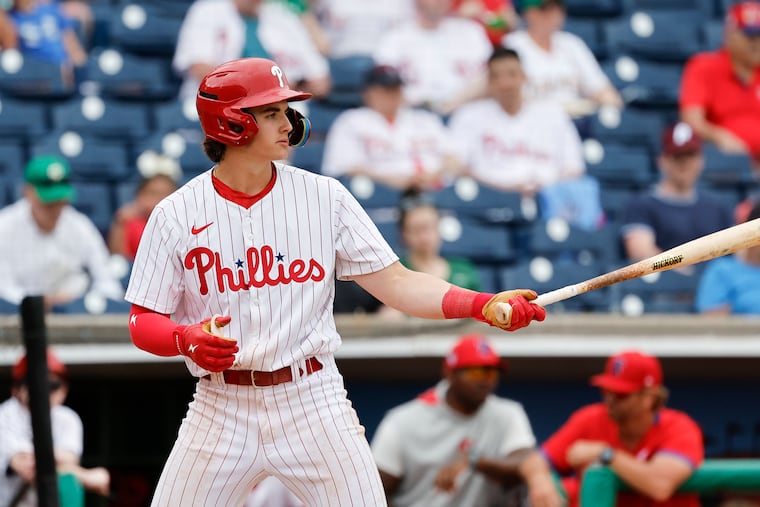
Believe it or not, Aidan Miller and the Dodgers are more connected than one might think
Miller is the kind of prospect who can alter a team’s long-term trajectory. It's the type of production the Dodgers are shelling out billions for, and what the Phillies are aspiring to.
The fun part of the baseball offseason is the illusion of control.
Unless you are Dave Dombrowski.
In which case, you’re a sitting duck. Or, even worse, you’re a floating duck, whose legs are tied, except they are tied beneath the surface, and so everybody thinks you’re a dumb little ducky because you don’t know how to swim.
The Phillies president has earned some of the criticism being lobbed his way. As ridiculous as it may seem for the Mets to pay Bo Bichette $42 million in annual average value, is it any more ridiculous than paying Taijuan Walker and Nick Castellanos a combined $38 million in AAV?
» READ MORE: ‘Phillies Extra’ Q&A: Rob Thomson on managing the Bo Bichette aftermath, Nick Castellanos, and more
The substitution costs are always what get you. Thirty-eight million dollars would have been enough to have Jeff Hoffman and Carlos Estévez in your bullpen last season. It would have been enough to have Edwin Díaz in your bullpen this season. General managing is all about the tradeoffs you make.
The irony is that the Castellanos and Walker contracts are easy ones to stumble into for the same reason that everyone thinks Dombrowski has done a lousy job this offseason. If you happened to be someone who pointed out the overinflated and potentially ill-advised nature of those deals at the time they were signed, you were met with a shrug of the shoulders.
Who cares? It’s not our money.
Well, it’s nobody’s money now.
But let’s get back to our original point. Whatever nickel-and-diming we do in hindsight, it wouldn’t erase the only conclusion we can draw from this offseason. No amount of fiscal prudence would have given the Phillies the means to catch up to, let alone keep pace with, the Dodgers. Over the last three offseasons, they have signed Shohei Ohtani, Blake Snell, Tyler Glasnow, Yoshinobu Yamamoto, and now Kyle Tucker and Díaz to contracts ranging from $22 million to $57 million in average annual value.
John Middleton might be a billionaire, but the Dodgers’ annual payroll is pushing half a billion once you factor in the luxury tax. How many billions? That’s the question you need to answer to compete at this level of spending.
» READ MORE: Opinion: ‘Not elite’ Bryce Harper might lose his No. 3 spot in the Phillies lineup, flip with Kyle Schwarber at No. 2
The Phillies know this. Could Middleton and his minority owners rub their pennies together a little harder? Sure. Their attempt to sign Bichette was a sign that they aren’t operating by any hard spending limits. What they lack — what everybody lacks, except for the Dodgers and Mets — is the ability to sign such contracts with the knowledge that they can outspend any mistakes. The Dodgers have plenty of seemingly dead money on their books after last year’s bullpen spending spree. But it doesn’t seem to matter.
The ability to sign Bichette for what would have been a reasonable seven-year, $200 million deal is a lot different from the ability to spend that money on whoever happens to be available. That’s how you end up hamstringing yourself by overpaying for players like Walker and Castellanos.
Those contracts only make sense if you can outspend the mistakes. The Phillies aren’t there, nor have they ever pretended to be. It’s plenty fair to criticize Dombrowski and Middleton for offering those deals to begin with. But you can’t fault them for their inability and/or unwillingness to offer another batch of them.
» READ MORE: What’s a better vacation: a week at the Jersey Shore or spring training in Clearwater?
Which brings us to the illusory aspect of the baseball offseason. Regardless of how the last few months would have played out, the Phillies were always going to enter spring training needing to look inward in order to catch up to the Dodgers. In more ways than one. They are going to need to get some sort of impact from their minor league system. And they are going to need to get the intestinal fortitude to create opportunities for it to happen.
The best news of the offseason might have come over the last week, when all of the national outlets released their Top 100 prospects lists. Aidan Miller showed up in the Top 10 of two of those lists: No. 6 on The Athletic’s and No. 10 on ESPN’s.
News? Perhaps not. But confirmation that the national scouting industry agrees with what all of us local yokels have seen with our own two eyes for the last two years. Miller is the kind of prospect who can alter a team’s long-term trajectory while massively boosting its present-day World Series odds.
Years ago, the Dodgers had one of those prospects in Corey Seager. He broke into the big leagues at 21 on a team managed by Don Mattingly. Mattingly happens to be the new Phillies bench coach and the father of the team’s general manager. The Dodgers went to the NLCS the following season, when Seager was 22, and the World Series the year after, when he was 23. Miller will be 22 in June.
Prospects are largely responsible for writing their own future. Miller needs to start the season the way he ended the last one. If he does, the Phillies need to do their part and find him a spot in the lineup. It could involve difficult conversations, but they will be necessary ones.
Same goes elsewhere. With Andrew Painter. With Gage Wood. With lesser-heralded prospects like Gabriel Rincones and Jean Cabrera. The Phillies need to be willing and flexible to bring guys up and find out what they have.
The Dodgers have set the bar high. The Phillies have no choice but to reach for it.

Tim Mayza was among the best, most under-the-radar Phillies stories this year. And he's coming back for more after signing a new contract last week. The Lancaster County native joined Phillies Extra, The Inquirer's baseball podcast, to discuss his solid season, building a culture in the bullpen, the origin of his "Sheriff" nickname, and more. Watch here.
You can also subscribe to the podcast version of Phillies Extra on Spotify or Apple Podcasts.
Previous episodes: Aidan Miller | Scott Franzke | Larry Andersen | Matt Klentak | Jeff Francoeur | Luke Murton | Mike Hazen | Tony Gwynn Jr. | Kevin Stocker | Bobby Dickerson