How Bo Bichette could wind up with the Phillies
Circumstance, context, and logic suggest that Bichette will end up signing elsewhere. Let's explore the chance that Bichette lands here anyway.
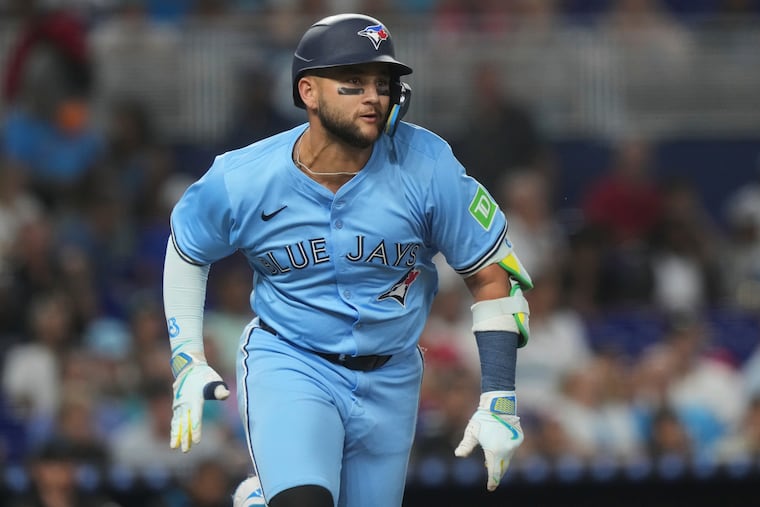
There is a long list of reasons that you shouldn’t waste your daydreams on visions of Bo Bichette wearing red pinstripes and hitting behind Bryce Harper. The Phillies’ reported interest in the Blue Jays star only barely distinguishes them from the 29 other major league teams that likewise are interested in signing very good baseball players at the right price. Interest is not a differentiator. You can’t buy a Bentley with affection.
Circumstance, context, and logic suggest that Bichette will end up signing elsewhere. And that’s great if you’re into those things. The rest of us will be over here indulging ourselves. On the 12th day of Christmas, the New York Post’s Jon Heyman gave to us a vaguely worded, thinly sourced report connecting the Phillies to a big-ticket free agent. What are we supposed to do? Underreact?
The least we can do is try to proceed with some level of dignity and decorum. This often is easiest to do under the guise of asking questions. There are no dumb questions, only dumb questioners, right? So let’s fire away.
Only a few weeks ago, Dave Dombrowski sounded like a man who didn’t expect any more major additions to his roster. What would have caused that to change? Is Bitcoin about to spike again?
This is the however-many-million-dollar question. Five weeks out from pitchers and catchers reporting, the roster looks pretty close to set. Ken Rosenthal of The Athletic reported Monday that the Phillies still were in the market for another right-handed-hitting outfielder, which is encouraging, because they really could use a viable Plan B in case Justin Crawford turns out to be late-stage Juan Pierre or Ben Revere. They don’t need anything major. Veteran Randal Grichuk, whom the report mentioned specifically, would make a lot of sense. Otherwise, there isn’t an obvious opening that would compel the Phillies to make an offer with the sort of necessity premium that often distinguishes a winning bid from the rest.

David Murphy alerts
One thing that may have changed is Dombrowski’s evaluation of the market. Not much has happened since the last time he spoke. Not only do most of the major free agents remain unsigned, we aren’t even seeing smoke. Bichette, Cubs outfielder Kyle Tucker, Red Sox third baseman Alex Bregman, Yankees outfielder Cody Bellinger, Mariners third baseman Eugenio Suárez, not to mention Ranger Suárez and the rest of the starting pitchers … the complete lack of movement at the top of the market is abnormal.
We’ve seen slow-moving markets before. But there is some reason to believe that this one is reaching a point of collapse. The money may not be out there this year. Virtually all of the big-market teams already are at or above the luxury tax threshold with the money on their books. Last year, the Phillies were at a disadvantage because teams like the Mets, Red Sox, and Cubs were in payroll expansion mode. Other teams simply had more money to spend than they did. That may not be the case this year.
» READ MORE: Can Don Mattingly save Phillies skipper Rob Thomson from himself?
The Cubs still are a potential market maker, with roughly $80 million in space before the first luxury tax threshold. It shouldn’t surprise anybody if they make a flurry of moves that alters the current narrative about the NL landscape. Same goes for the Mets, who presumably have whatever money they would have paid to Pete Alonso and Edwin Díaz before both signed elsewhere. The Orioles are always lingering. The Blue Jays are pushing $300 million but seem to be operating with the taste of blood in their mouths. So there still is plenty of reason to doubt that the Phillies can win via aggression.
But there are a lot of players out there. And there don’t seem to be the usual dark-horse lurkers among the midmarket clubs. It’s worth noting the situation in Minnesota, where the Twins are shedding payroll as if they need to make rent. The middle class might be content to sit this one out, especially with next year’s labor talks looming.
So Bichette might be more affordable than the Phillies thought?
Yes and no. It’s awfully hard to project a contract for a player who is an anomaly in terms of his age (only 28 this season), career production (24 home runs per 162 games and 121 OPS+) and pedigree (Dante Bichette’s kid), but who also is less than a year removed from a brutal 18-month stretch in which he posted a .651 OPS in 651 plate appearances. Trea Turner’s career numbers were nearly identical (minus the steals) when the Phillies signed him to an 11-year, $300 million contract heading into his 30-year-old season. FanGraphs had Bichette projected at seven years and $189 million entering the offseason. ESPN recently updated its projection to five years and $150 million. If that second number is close to reality, the Phillies may well readjust their expectations.
» READ MORE: ‘Not elite’ Bryce Harper could use better lineup protection. Here are the Phillies’ options.
What’s this about Bichette posting a .651 OPS in 651 plate appearances? Isn’t that a concern?
It is. But it also might be an opportunity, if other teams are worried. Once he snapped out of his funk early last season, Bichette was an MVP-level hitter. In his last 102 games, he hit .325/.372/.528 with 17 home runs. From the right side of the plate. While playing middle infield. He has always had the kind of skill set scouts drool over. Bichette’s contact rate ranked in the top 20% of qualified hitters last season. At 83.2%, it would have ranked third among Phillies regulars, behind Alec Bohm (87%) and Bryson Stott (86.1%). His chase rate also ranked at the high end of the spectrum — in a bad way. Only 18 qualified hitters chased more often: Bichette’s 37.9% ranked just behind Bryce Harper (38.1%).
That said, Bichette did make some steady progress last season. It’s fair to wonder if he emerged from his slump as a different hitter. Only 10 hitters in baseball had a lower strikeout rate after the All-Star Break — his 11.1% was a dramatic improvement over an already-solid roughly 15%. He coupled that with a huge boost in his walk rate, from an anemic 5.5% to a slightly-better-than-average 8.8%. If the Phillies think they can get a $250 million player for $175 million, that might change things.
Why wouldn’t the Blue Jays just match any offer?
I guess Christmas is over, isn’t it? Assuming Bichette likes Toronto, which seems to be the case, and the Blue Jays are willing to spend, which seems to be the case, the Phillies presumably would need to land Bichette the old-fashioned way: by guaranteeing him more than anybody else is willing to guarantee him. They have close to $60 million coming off the books next season and theoretically would be able to accommodate another big deal, biting the bullet on the luxury tax this season while freeing up $15 million to $20 million by trading Bohm and Edmundo Sosa and finding someone to pay a little bit of Nick Castellanos’ salary.
But, then, we’d be back where we started. Realizing that Bichette probably won’t be here.

Tim Mayza was among the best, most under-the-radar Phillies stories this year. And he's coming back for more after signing a new contract last week. The Lancaster County native joined Phillies Extra, The Inquirer's baseball podcast, to discuss his solid season, building a culture in the bullpen, the origin of his "Sheriff" nickname, and more. Watch here.
You can also subscribe to the podcast version of Phillies Extra on Spotify or Apple Podcasts.
Previous episodes: Aidan Miller | Scott Franzke | Larry Andersen | Matt Klentak | Jeff Francoeur | Luke Murton | Mike Hazen | Tony Gwynn Jr. | Kevin Stocker | Bobby Dickerson