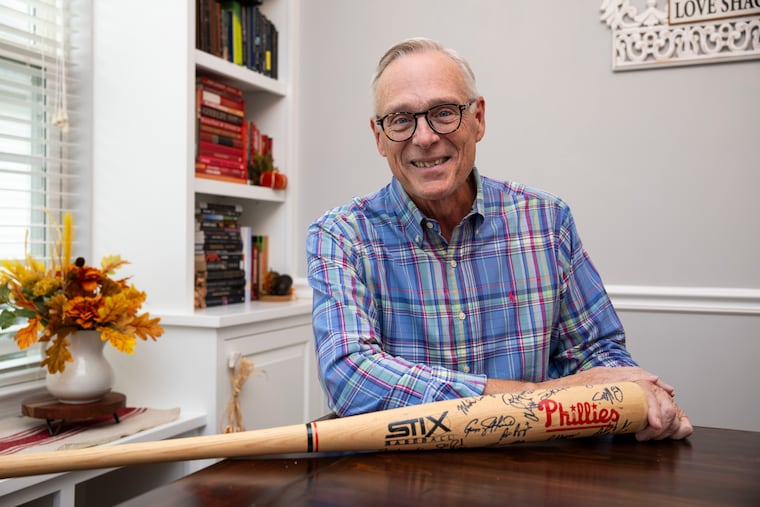
He’d never preached before. But in 1990, Jack Hibbard became the Phillies chaplain.
Hibbard, a Burlington County native, was the club’s chaplain from 1990 to 2000. It was a dream job full of colorful moments, especially in 1993.
In August of 1993, Roger Mason was on the mound at Joe Robbie Stadium, facing the Marlins, when he gave up a home run to Orestes Destrade. Determined to avoid the same outcome with the next batter, the Phillies pitcher decided to throw a slider to Darrell Whitmore, to keep the ball down.
His slider broke in, prompting the left-handed hitter to jump back.
The home plate umpire pointed at Mason.
“That’s a warning,” he said.
Darren Daulton pulled off his mask, turned around, and gave the umpire an incredulous look.
“Him?” He said. “Are you kidding? He’s our chapel leader!”
The catcher’s addendum got Mason out of paying a $200 fine. Everyone knew that being a God-fearing man on the 1993 Phillies was no small feat.
But it was not the greatest feat. That belonged to Jack Hibbard, the club’s chaplain from 1990 to 2000. For a decade, the lifelong Phillies fan from Pemberton, in Burlington County, preached to his favorite team on Sundays.
» READ MORE: Darren Daulton’s legacy lives on in the World Series with the Blue Jays’ Daulton Varsho
Hibbard, 64, served as spiritual counsel for players when they needed it, and invited guest speakers to talk to the group. He became friendly with everyone from Mason to Mitch Williams to Rico Brogna.
It was a dream job, that was not short on colorful moments (especially in 1993). Thirty-five years after he became chaplain, Hibbard is still grateful for the experience.
“Some guys came to chapel because they wanted to learn more about Jesus, or they wanted to grow in their faith,” he said. “Or, you know, because they wanted to go 4-for-4 that day.”
Preaching to the 1993 Phillies
Jack’s father, John Hibbard, was a pastor at First Baptist Church in Pemberton for three decades. His mother, Carolyn, worked as a church secretary.
Growing up, the boy was steadfast in his faith, but would also make time for his favorite club. As a kid, Jack would sneak his transistor radio into the classroom, so he could listen to By Saam, Harry Kalas, and Richie Ashburn.
Sometimes, he’d even bring it to church.
“If my father was preaching a sermon, and I could find a way to rig an earpiece through my ear, I wasn’t above that,” Hibbard said. “The fandom runs pretty deep.”
Both of his parents were heavily involved with Baseball Chapel, an MLB-affiliated organization founded in 1973 to give players access to weekly services.
By 1975, every big league team had a chapel program. By 1978, the minor leagues followed suit. In the late 1970s, Carolyn was contacted by Pat Williams, the Sixers general manager who was also running chapel for the Phillies. The basketball executive, a devout Christian, started his career as a minor leaguer in the Phillies system.
He asked if she’d consider holding Bible studies for players’ wives. Then, he invited John to do the same for the team. The Hibbards agreed, working for the Phillies throughout the 1980s and 1990s.
Jack graduated from Liberty University in 1983, with a radio broadcasting degree. He worked for a small nonprofit in Toms River in the mid-1980s and as assistant director of media services for Pemberton’s school district from 1986 to 1996.
Through his parents, he got to know Vince Nauss, the former Phillies assistant publicity director who replaced Williams as team chaplain. In 1990, Nauss was hired to do sales and marketing for Donruss, a trading card company, in Chicago.
So, he asked the younger Hibbard — only 29 at the time — if he’d take over as Phillies chaplain.
It was an “immediate yes.” Hibbard didn’t have preaching experience outside of leading an occasional Sunday school class, but he’d learned a lot from his father while growing up in their religious household.
“I felt like I was qualified to do what they asked me to do,” he said. “I just never thought I’d have an opportunity to do it in that realm.”
» READ MORE: Harrison Bader has been painting since he was a kid. And it has helped shape his game.
Hibbard started with the Phillies in April 1990, and was immediately in awe. He worked as an unpaid volunteer but collected enriching experiences. He was privy to information that the average fan didn’t have. He had wide-ranging access, including the clubhouse, the dugout, and batting practice.
He normally held chapel in the Veterans Stadium press room, but one Sunday, in 1993, it was being used for something else.
Manager Jim Fregosi told Hibbard to preach in the weight room, instead.
“We were sitting on equipment,” Hibbard recalled, “on weight benches. Fregosi kind of had a gruff exterior, but he really was a gentleman to me.”
Attendance at chapel varied year to year. Some players dropped in to break a hitting or a pitching slump. Others were regular attendees. Interestingly enough, the 1993 Phillies — a team known for its degeneracy — put up decent numbers.
Mason, who was traded to the Phillies in early July, was always in chapel. But so were Curt Schilling, Danny Jackson, Kevin Stocker, and Milt Thompson.
Even Williams — the “Wild Thing” — showed up to church. For a novice chaplain, navigating Macho Row, this was helpful.
“I didn’t know if [Lenny] Dykstra was going to spit at me, yell at me, cuss at me,” Hibbard said. “I couldn’t figure out that dude.”
He added: “Sometimes there’d be a little mocking. ‘It’s almost time for chapel!’ I can remember, early on, feeling intimidated. But the thing that saved me was that Mitch Williams, for the most part, was a consistent attendee. And he was in that Macho Row.”
Hibbard would preach to the players on most Sundays, but would also invite local pastors in the area to give sermons. As he became more entrenched with the team, players began to ask him to come to the ballpark to counsel them during the week.
The chaplain would talk to players in the dugout or while leaning against the batting cage. One day, Schilling approached Hibbard before a start — an atypical choice for a pitcher.
“He’d just gotten done with batting practice, back when pitchers hit, and walked out of the cage,” Hibbard said. “And he said, ‘Can I talk to you?’
“We sat at his locker for five or 10 minutes. Then he needed to get ready for the game.”
» READ MORE: Phillies wisely pick up José Alvarado’s option. They’d be wiser still to trade Nick Castellanos ASAP.
The more players he met, the more Hibbard realized that their problems were largely the same as his. Many were young fathers, like the chaplain, whose wives were young mothers.
They just happened to play a children’s game for a living.
“When I first got there, these guys were are all kind of in elevated positions to me,” Hibbard said. “They are who they are because they worked really hard to get to the big leagues.
“But then you realize, pretty quickly, they are struggling with the same things I am. And so it became very relatable.”
World Series chapel
Mason was raised as a Christian, but drifted away from the church when he went to college at Saginaw Valley State University. He was signed by the Detroit Tigers as an amateur free agent in 1980, and a minor league teammate, Dwight Lowry, encouraged him to join Baseball Chapel.
Mason did, and was a consistent attendee throughout his entire professional baseball career, from 1981 to 1995.
It provided stability. Mason knew that he was not a prized prospect. Even after he cracked the big leagues, his future was far from secure. He shuffled around a lot — playing for seven big league teams across nine seasons — and struggled through various injuries, including elbow surgery.
But going to chapel helped him stay grounded. It took pressure off the pitcher’s shoulders, even in the most intense moments.
Mason said there is no better example than the 1993 World Series against Toronto. There was a high level of anxiety, and not just because of all the media attention the Phillies were getting.
There was also a bigger attendance at chapel (which Hibbard wasn’t always present for, because he didn’t travel on the road).
“When we were in Toronto, almost the whole team was there,” Mason said. “I mean, there may have been five of us, during the regular season. And maybe 20 showed up to chapel during the World Series. It was funny.”
Mason pitched in Games 1, 2, and 4 in relief and allowed only one earned run through 5⅓ innings.
He got the call again ahead of the bottom of the sixth inning in Game 6. The Blue Jays were up 3-2 in the series. Mason was tasked with keeping the best offense in baseball at bay.
The right-handed pitcher took the ball from Terry Mulholland and allowed a single to Roberto Alomar, before retiring his next three batters.
But in the top of the seventh, as the Phillies tacked on five runs to give themselves a 6-5 lead over Toronto, Mason’s mind began to wander.
» READ MORE: Phillies 2026 bullpen outlook: Free-agent options, prospect forecast, and more
“While I was sitting on the bench, I started to get nervous,” he said.
He remembered that Orel Hershiser once told the late-night TV host Johnny Carson that he sang hymns to stay calm in games. So, Mason tried to think of some hymns. But nothing came to mind, and the next half-inning was rapidly approaching.
“So, I started going over these Bible stories in my head, just to get myself centered,” Mason said.
When he walked back onto the mound in the bottom of the seventh, he did so with a renewed confidence. He induced a fly ball from Rickey Henderson, struck out Devon White, and generated a line out from Paul Molitor.
Mason’s last at-bat of the night was Joe Carter, in the bottom of the eighth, who hit a fly ball to deep left field (not far from where he crushed a game-winning home run off of Williams an inning later).
“I had no reason in the world to think this, but I knew, as long as I was out there, they weren’t going to hit me,” Mason said. “It was like God had said that. And the rest of the time, they didn’t.”
‘There to do a job’
Hibbard was hired at an agency based out of Fort Washington in 1999 and was promoted to president of the company a year later. It demanded more of his time, so he had to retire as Phillies chaplain after the 2000 season.
He started his own company in 2009, an agency that serves nonprofit ministry organizations, and is still in that role today. He is also still a committed Phillies fan, who lives and dies with every pitch.
The former chaplain often reflects on his time with his favorite team. He can’t believe he got so lucky.
“My first rule was, don’t be a fan,” Hibbard said. “You’re there to do a job. I was there to serve them. So, I tried to take the fandom out. But every once in a while, the heart would beat a little faster.
“And I thought ‘OK, look. Don’t show this on your face. You’re supposed to be here. This is normal.’ But it never did feel normal, I don’t think.”