Jake Arrieta’s performance could be key to Phillies’ reaching their potential | Scott Lauber
A resurgence from the former Cy Young winner is even more important to the rotation's success than the continuing development of young right-handers Nick Pivetta, Zach Eflin and Vince Velasquez.
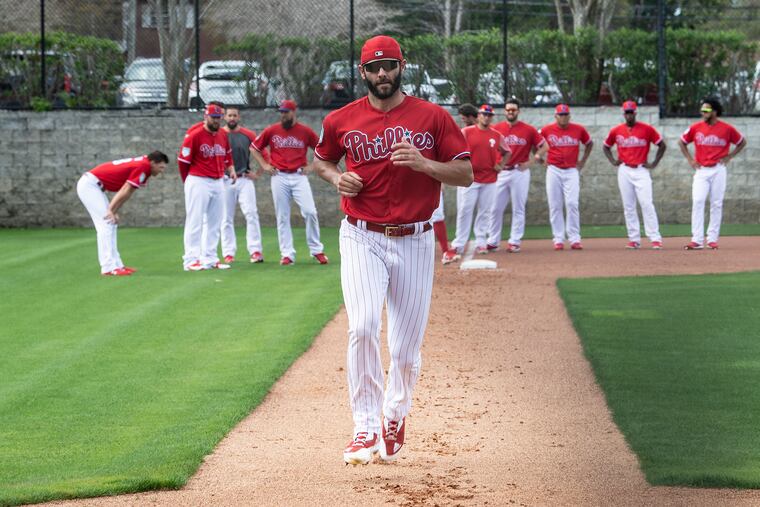
Jake Arrieta trudged away from the mound after the second inning last Sept. 22 in Atlanta. In a game that the Phillies needed to win to forestall the Braves’ clinching a division title, the former Cy Young Award winner turned in the shortest start of his career.
And for the next six months, wherever he went, he felt as if he was sucking on a lemon.
“The Braves doing what they did to us last year, not that there has to be a chip on our shoulder, but a lot of guys in here remember the way it shook down for us,” Arrieta said this past week. “The way the season finished, we don’t want that to happen again.”
There’s no better motivator than failure. And for as much as the not-ready-for-prime-time Phillies failed collectively during a miserable collapse last August and September, Arrieta stood out. He posted a 6.82 ERA and allowed 40 hits, nine home runs, and 15 walks in 34-1/3 innings over his final seven starts. The magnitude of his struggles was both profound and surprising.
Just the same, if the rebuilt Phillies are going to fulfill their lofty expectations in Year 1 of the Bryce Harper Era, Arrieta will be at the center of it all. It’s fitting, then, that he will make his first start Sunday night in a nationally televised game against the Braves. As the man on the mound, he will have a glare shining on him that will be entirely appropriate.
“Sunday Night Baseball is a big deal. The spotlight is going to be huge, the media attention is going to be huge,” manager Gabe Kapler said. “We feel like Jake is really good in that kind of an environment.”
The Phillies need Arrieta to be good in all environments, just as he was during a four-year peak with the Cubs in which he ranked among the best pitchers in baseball.
Four of the eight teams that qualified for the playoffs last season had at least two starting pitchers who worked at least 150 innings and ranked among the top 30 in earned-run average. The Indians had four, the Astros had three. The Phillies had only ace Aaron Nola.
Yet the starting rotation went untouched amid the Phillies’ offseason roster overhaul. They reasoned that none of the free-agent pitchers beyond lefty Patrick Corbin, including still-unsigned Dallas Keuchel, represented an upgrade over their incumbent starters. It was a calculated gamble.
Much of the rotation’s success hinges on the continuing development of young right-handers Nick Pivetta, Zach Eflin, and Vince Velasquez. But a resurgence from Arrieta might be even more important.
If the Phillies are shopping for pitching before the July 31 trade deadline, they will find the asking price for a solid No. 4 starter to be far more reasonable than for a No. 2.
"We're extremely confident in Jake," pitching coach Chris Young said as spring training dawned. "He's a guy who was one of the best pitchers in baseball. A two-month stretch where he doesn't pitch up to his consistent level of performance isn't going to steer us away from a guy that we're lucky to have."
It’s more than that, though. Since his Cy Young season in 2015, Arrieta’s numbers have declined. His ERA rose to 3.10 in 2016, 3.53 in 2017, and 3.96 last season after signing a three-year, $75 million contract with the Phillies. His walks/hits per inning pitched climbed from 1.084 in 2016 to 1.218 in 2017 and 1.286 last year, while his strikeouts per nine innings fell from 9.3 to 8.7 to 7.2.
But the Phillies cite two reasons for believing that Arrieta, at age 33, can halt his regression. They say he’s healthy after pitching the second half of last season with a meniscus tear in his left knee that necessitated minor surgery in January. He also has reverted to the mechanics that he used during his salad days in Chicago.
Arrieta didn’t realize anything had changed until late last season. In watching video of Arrieta with the Cubs, Phillies player information coordinator Sam Fuld discovered that the the right-hander altered his arm angle from the high three-quarter slot that he used previously. Arrieta suspects the change might have been a consequence of a truncated spring training after not signing with the Phillies until March.
“The majority of it was unintentional,” he said. “I just got into some bad habits. I struggled with it the majority of the year. It was something that I needed to reset, have the offseason, and understand the progression through my throwing program. It was one of the main things on my mind.”
So much so that Arrieta and Young met for lunch in January near the pitcher’s home in Austin, Texas, to discuss fixing it.
By lowering his arm slot, Arrieta said, he gets more downward movement, a critical component for a sinkerballer. In 2015, Arrieta had a 56.2 percent ground ball rate and got weak contact 22.8 percent of the time. Last year, his ground ball rate dipped to 51.6 percent, his weak-contact rate to 18.5 percent.
“There’s a healthier Jake, a more motivated Jake, a more focused Jake,” Kapler said. “Health always leads to confidence, and confidence leads to more motivation. You can see that kind of snowballing.”
It will help, too, that the Phillies should be better at turning balls in play into outs. They were the worst defensive team in baseball last season, and Arrieta even ripped their ineffective deployment of infield shifts after a June 3 start in San Francisco. But adding shortstop Jean Segura, moving Rhys Hoskins back to first base, putting Andrew McCutchen in left field, and hiring well-regarded infield coach Bobby Dickerson should help.
“There were times last year he tried maybe to outpitch what we weren’t doing behind him," Young said. "Knowing that [the defense] is going to be improved will greatly help Jake Arrieta.”
Arrieta had his moments. He had a 2.16 ERA through the end of May and punctuated a strong July by giving up one run in seven innings against the Red Sox at Fenway Park. In his first start of August, he shut out the Diamondbacks for eight innings.
But the ensuing starts are what stuck with Arrieta. Everything that has happened since has turned the Phillies into a playoff-caliber team, but only if the second-best starter does his part.
“The more Sunday night games you’re playing, it means the better your team is playing,” Arrieta said. “We look forward to having a lot of those this year, and if we take care of business, we feel like we will.”
Get unlimited access from first pitch through Game 162 (and maybe the playoffs?) by subscribing today: 77 cents a week for 13 weeks.