Phillies shrug off Tyler Spangler‘s injury concerns to select the shortstop in MLB draft’s first round
After a 10-pick penalty for exceeding the second luxury-tax threshold last year, the Phillies took Spangler, 18, who hails from De La Salle High School in Northern California.
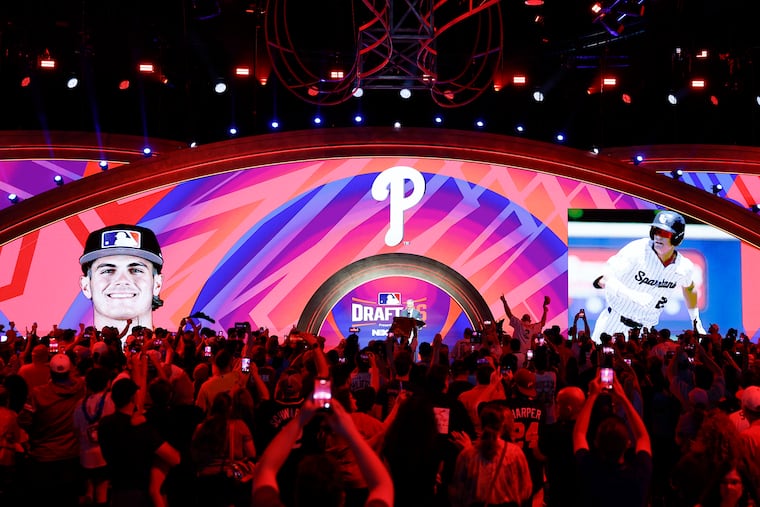
In 2023, the Phillies used their first-round pick on an infielder who graded highly among high school hitters but slipped in the draft because of an injury.
There were echoes of Aidan Miller again this year.
With the 36th overall selection — a 10-pick penalty for exceeding the second luxury-tax threshold last year — the Phillies took Tyler Spangler, an 18-year-old shortstop from De La Salle High School in Northern California who didn’t play at all this year because of a back injury.
» READ MORE: What makes Bryce Harper and Kyle Schwarber such unique stars? We asked each about the other.
“We have an extensive medical review on the player and just felt comfortable taking him,” scouting director Brian Barber said Saturday from the Phillies’ draft room in Citizens Bank Park. “We’ve looked at everything that there is to look at there and felt completely comfortable taking the player.”
Barber declined to discuss the nature of the back injury.
Spangler, a 6-foot-3 left-handed hitter, was projected in early mock drafts as a first-round pick, in which case he would’ve been off the board long before the Phillies picked. But he injured his back after a mid-January tournament that the Phillies attended, Barber said, and missed his senior season.
Teams were finally able to see Spangler hit last month at the MLB draft combine in Phoenix. The Phillies watched him again in a workout on June 30. Barber said he has been given “a clear return to action,” and the Phillies are “hoping to see him on the field in [minor-league] games at some point this season.”
That would suggest the Phillies are confident that they can sign Spangler, who committed to attend Stanford. It may require a bonus larger than the $2.76 million slot value assigned to the 36th pick. But without a pick in the first round, the Phillies are likely to meet Spangler’s price.
Clubs have until July 27 to sign their 2026 draft picks.
If Spangler’s injury saga sounds familiar, Miller slid to the Phillies at No. 27 overall three years ago because of a broken hamate bone in his left hand. He recovered from that injury and became the organization’s top prospect, but hasn’t played this season because of a lower back condition that necessitated a spinal procedure in June.
» READ MORE: Zack Wheeler turned down MLB’s offer to be added to the All-Star Game: ‘I’m not going to be disrespected’
In Spangler’s case, there’s also the matter of De La Salle suspending its varsity baseball team for the first five games this season for what the school described as “violations of school policy, team rules, and code of conduct.”
Barber said the Phillies interviewed Spangler at the combine and were confident that whatever happened (De La Salle officials didn’t specify the violations) “had nothing to do with Tyler.”
The Phillies drafted Spangler one pick before catcher Daniel Jackson went to the Rockies. Jackson won the Golden Spikes Award this year as the top collegiate player in the country.
Spangler is tall for a shortstop, prompting comparisons to lefty-hitting Corey Seager. Barber said the Phillies believe Spangler “probably moves a little bit better than, let’s say, Corey did at 18″ and that he won’t need to switch positions.
But it’s his bat that most impressed the Phillies.
Barber said Spangler showed “a little bit of rust and stiffness” at the combine. But when the Phillies saw him hit a week later, he appeared “more loose and free,” as they remembered when they scouted him as a junior.
“We think it’s just a really advanced 18-year-old swing,” Barber said. “The path is just perfect to be able to add to his power game, as well. It’s a hit-first with a really good feel for the power in the future.
“The opportunity to be at pick 36 and get this player that we identified going back two years, saw him play all throughout the summer and fall last year, we just think he’s a very good player.”
Here’s how the Phillies rounded out the first day of the draft:
Round 2
Caden Bogenpohl, OF, Missouri State
A few weeks ago, after the college season, the Phillies took the unusual step of inviting the 6-6 left-handed hitter to their facility in Clearwater for a one-on-one workout with farm director Luke Murton.
“Unfortunately, we did that before the Combine, where he was able to [go to] the Combine and put on an absolute show out there," Barber said, laughing. “But it did help us answer some of the questions about why the exit velocity was at the elite level, but the home runs didn’t go with it.”
Indeed, Bogenpohl broke Ryan Howard’s school record with 20 homers as a freshman, then hit only 19 over the last two years. But after their private workout, the Phillies believe they can unlock the power that has gone missing.
A farm system that lacks home-run hitters can use it.
» READ MORE: Bryce Harper is ‘grateful’ to be MLB commissioner’s All-Star pick. He’s also earned it.
Round 3
Ruger Riojas, RHP, Texas
After pitching as a reliever for two years at Texas-San Antonio, he transferred and became a starter. That’s how the Phillies plan to use him in the minors because of a five-pitch repertoire from multiple arm slots.
The 23-year-old righty is on the older side, but Barber believes he’s also more advanced than most draftees.
“It’s now stuff,” Barber said. “It’s now strikes. It’s now pitchability.”
Round 4
Deven Sheerin, RHP, LSU
Most relief pitchers get drafted as starters and move to the bullpen as they go through the minors. But Barber left no doubt about the 20-year-old righty’s future role.
“We see him as a high-upside leverage reliever,” he said.
Sheerin throws a slider and upper-90s fastball from a low-slot delivery, a combination that Barber described as “just completely loud stuff.”
Oh, and he grew up in Reading, home to the Phillies’ longstanding double-A club.
Jaxon Jelkin, RHP, Kentucky
A collegiate nomad, he left Nebraska as a freshman for junior college in Arizona, then transferred to Houston, where he had Tommy John elbow surgery before going to Kentucky. But he’s 6-5 with four pitches from a low three-quarters arm slot. At age 23, he could start at a more advanced level of the system than younger draftees.
» READ MORE: Phillies prospect Gage Wood will start in the MLB Futures Game at Citizens Bank Park
“It’s older, but we’re just not using a lot of projection there,” Barber said. “What we try to do with these [older college] guys is acclimate them to pro ball, get them on a professional routine, and then just try to optimize their pitch package a little bit more.”

Ryan Howard was a three-time All-Star and champion of the 2006 Home Run Derby in his legendary run with the Phillies. With the baseball world coming together in Philadelphia for the 96th All-Star Game, Howard sat down with Phillies Extra to discuss his All-Star memories, his expectations for a Home Run Derby at Citizens Bank Park, his outlook on the Phillies' season, Kyle Schwarber's chances of breaking his single-season franchise mark for homers, and more. Watch here.
You can also subscribe to the podcast version of Phillies Extra on Spotify or Apple Podcasts.
Previous episodes: Dan Baker | Ricky Bottalico | Preston Mattingly | Caleb Cotham | Larry Bowa | Joe Maddon | Rhys Hoskins | Terry Francona | Aaron Rowand
