The Phillies’ Trea Turner was still the fastest man in the league at 32. And it’s not due just to ‘genetics.’
What’s his secret? “I pay attention to a lot of little things,” says Turner, who hasn’t lost a step 10 years into his career. In fact, he may be a tick faster with no sign of slowing down.
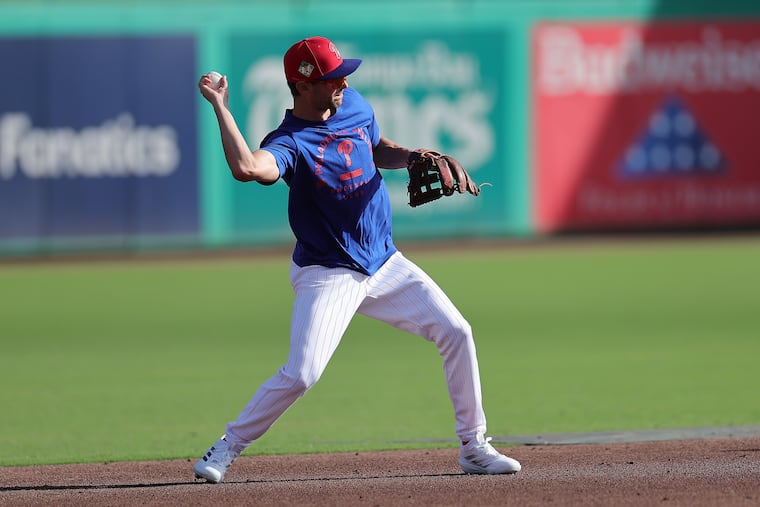
CLEARWATER, Fla. — The fastest man in the National League in 2015 still wears the crown, which seems impossible until Trea Turner shares his secret.
“I pay attention to a lot of little things,” the Phillies' star shortstop said Wednesday, “that maybe other guys don’t.”
OK, such as?
“Things that happen to all of us all the time,” Turner said. “I walk down my stairs and I’m like, ‘Oh, my knee’s kind of feeling weird today,’ or I wake up and sleep wrong. Then, I’ll get to the field and ask questions in the training room.
» READ MORE: With free agency looming next year, Alec Bohm is prepared to bat cleanup (again) for Kyle Schwarber or Bryce Harper
“Sometimes it might be annoying, where I just keep asking questions. But when something bothers me, I try to find out why so that, if it does happen again, I get rid of it real quick.
“Like I said, I pay attention more than probably other guys.”
And that, Turner said, explains how he hasn’t lost a step 10 years into his major league career. If anything, he may be a tick faster. As a 23-year-old rookie with the Nationals in 2016, he averaged 30 feet per second, according to Statcast. Last season, at age 32, he averaged 30.3.
Turner also led the majors last year with 117 bolts, defined by Statcast as any run above 30 feet per second. The only other player with more than 100 bolts: Royals 25-year-old star shortstop Bobby Witt Jr.
It’s as uncommon as it sounds. Of the 28 fastest players in baseball last season based on sprint speed, only three — Turner, Twins center fielder Byron Buxton, and Braves utility man Eli White — were in their 30s.
“I still feel young,” said Turner, who will turn 33 on June 30. “I don’t feel as old as I am, which, I don’t think I’m old. But I don’t feel as old as I am. Hopefully I can continue that for a while.”
As always, it will hinge on health. Turner did miss time in each of the last two seasons with hamstring strains. Ever curious, he sought the root of each injury. He believes last year’s injury, a mild strain of his right hamstring while running to first base Sept. 7 in Miami, was caused by dehydration.
Through the years, Turner has changed his nutritional habits. He cut out soda several years ago. He eats more carefully now, taking cues from Bryce Harper, Aaron Nola, and other teammates.
“Genetics, I’d say, is a big part of it,” said Brett Austin, Turner’s college teammate and close friend. “But I think his offseason program really allows him to optimize and maintain his speed.”
Indeed, the biggest reason Turner has remained in the fast lane is a training routine that he has followed since he was a teenager.
In high school, he met Ed Smith, a physical therapist and strength coach who worked with major leaguers at a facility in Wellington, Fla., near Turner’s hometown. Back then, Turner was 5-foot-4 and bony. He was taller but still skinny when he arrived on campus at North Carolina State, where coach Elliot Avent nicknamed him “Seabiscuit” after the famously undersized champion racehorse.
As a freshman, Turner led the nation with 57 stolen bases. But when he went home after the season, he asked Smith to help improve his running form.
“He hated the weight room. Hated it,” Austin said. “I’d go, ‘Dude, you need to get big. You need to get strong.’ He was like, ‘I don’t want to lose my speed.’ And he would go see Ed and do his explosion drills, his speed and agility, his laterals.
“They still work together every offseason. If I had to guess, that’s just allowed him to have the longevity and maintain his speed.”
Turner works out with Smith multiple times per week in the winter. During the season, he speaks by phone with Smith at least monthly and texts him more often with questions. He takes feedback from Smith and shares it with the Phillies’ staff, notably athletic trainer Paul Buchheit and strength coaches Morgan Gregory and Furey Leva.
» READ MORE: Bryce Harper says Dave Dombrowski’s ‘not elite’ comment is ‘kind of wild to me still’
Because as much pride as Turner takes in still being faster than most players, he focuses more on maintaining that speed. Since making his major-league debut, his average sprint speed has ranged from 30.6 feet per second in 2015 and 2021 to 29.6 in 2024. Only once has he not finished among the six fastest players in baseball.
“Some guys are fast for a year or two years, and then an injury pops up and they might not be the same again,” Turner said. “I don’t want that to happen. I’ve tried to become a complete player, so if I ever lose my speed, I want to be able to contribute. But it also would change who I am.
“If I lose a step, I lose a step. That’s OK. But if I’m running at 29 feet per second instead of 30, I can still impact the game. That’s still moving. But you’ve got to run correctly to do that.”
Turner will be challenged to remain in the pole position for the Phillies. Rookie center fielder Justin Crawford, 22, is a burner, with a top recorded speed of 31.1 feet per second in triple A last season. Johan Rojas, a candidate to make the team as a reserve outfielder, averaged 30.1 feet per second over the last two seasons.
But the fastest man in the league in 2015 was still at the top of the leader board in 2025, with no sign of slowing down.
“I’ve seen the numbers, and I’m proud of them,” Turner said. “Because when you look at those charts, you don’t see many 30-year-olds. And even if you do, it’s really low volume. I think it’s pretty cool. I take pride in it, and I think it’s cool for the people around me that help me do it. It’s something they should be proud of, too.”

Tim Mayza was among the best, most under-the-radar Phillies stories this year. And he's coming back for more after signing a new contract last week. The Lancaster County native joined Phillies Extra, The Inquirer's baseball podcast, to discuss his solid season, building a culture in the bullpen, the origin of his "Sheriff" nickname, and more. Watch here.
You can also subscribe to the podcast version of Phillies Extra on Spotify or Apple Podcasts.
Previous episodes: Aidan Miller | Scott Franzke | Larry Andersen | Matt Klentak | Jeff Francoeur | Luke Murton | Mike Hazen | Tony Gwynn Jr. | Kevin Stocker | Bobby Dickerson