
Partner Content
American Water and Essential Utilities Leaders on the Mission of Clean Water
Chris Franklin, the chairman and CEO of Essential Utilities, and John Griffith, the president and CEO of American Water, discuss legacy, infrastructure, and their upcoming merger.
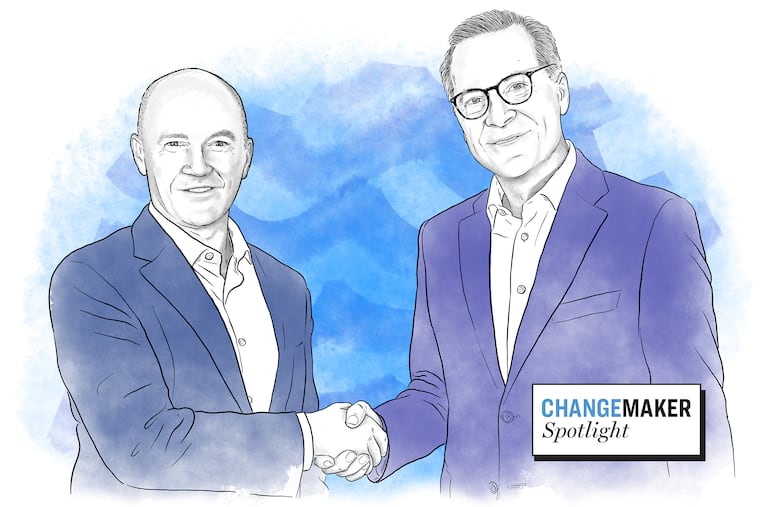
The recently announced merger of American Water and Essential Utilities, which is expected to close by the end of the first quarter of 2027, will create one of the nation’s leading regulated utilities. “One of the many reasons I like the idea of this merger is that the cultures of the two companies are so similar,” Chris Franklin, the chairman and CEO of Essential Utilities, said. “I am very confident that the company I’ve worked for and led for 33 years is agreeing to merge with a like-minded organization that values their customers and provides them with high-quality service.”
Headquartered in Camden, N.J., the combined company will serve approximately 4.7 million customers across 17 states, with the Greater Philadelphia region comprising nearly 20% of its customers. The combined organization plans to invest $28 billion in improvements over the next five years, including pipe replacements and upgrades to aging treatment facilities, that will help to support reliable service and positively impact local economies.
In a joint interview, Franklin and American Water president and CEO John Griffith discussed the pressures facing the nation’s water systems, the need for major infrastructure investment, and what the merger could mean for Pennsylvania and South Jersey. “I want families who are customers today to know that our commitment to service will not be compromised when we are serving them together,” Franklin said.
Chris, Essential Utilities traces its roots in Philadelphia and the region to 1886. What responsibility does that legacy create for you as a leader?
Franklin: Both Essential and American Water are 140 years old, and each has a rich history of leaders who have made investments and improvements with quality as a core value. Now, it’s our turn to address the challenges of our time. The current leaders of our companies are incredibly talented and dedicated people, and I am confident they will raise our service and quality to new levels.
Between New Jersey and Pennsylvania, what’s called the Philly metro area, will be nearly 20% of the customers of the combined company. We are focused on the Philly metro area. While we don’t serve inside the city, we do serve the areas all the way around it and see the city as an integral part of our community.
Was there a moment in each of your careers when you realized how critical water infrastructure was?
Franklin: It wasn’t until I arrived at Philadelphia Suburban Water Co. in 1992 that I really gave it much thought. Like so many people, I turned my faucet on and clean water appeared. It was immediately evident to me that the company was running big plants, processing enormous amounts of water, and doing it with a team that had great dedication to their work. Our people fill a very basic but important need — the delivery of safe, clean water. Most people never think about where it comes from or how it gets purified; they simply expect that when they turn on their faucet, pristine water arrives. It’s a huge responsibility that our people work to fulfill every hour of every day. Pretty quickly, I gained a healthy respect and appreciation for the company and its mission.
Griffith: Spending time in communities where we previously acquired systems that were so neglected. You look around, and it’s just not acceptable that people don’t have access to clean water and wastewater service.
“Our people fill a very basic but important need — the delivery of safe, clean water. Most people never think about where it comes from or how it gets purified; they simply expect that when they turn on their faucet, pristine water arrives. It’s a huge responsibility that our people work to fulfill every hour of every day.”
What keeps each of you in this business?
Franklin: Why do you stay at a company for 33 years? Because I truly believe in the company’s mission. I’m proud that we provide such high-quality water that nobody who drinks our water ever needs to doubt that their tap water is clean and safe enough to drink directly from the faucet. Additionally, we do the dirty work of treating wastewater and returning only clean, clear water back into the environment. It is very rewarding work!
Griffith: People at American Water, and I know it’s the same at Essential, feel an extraordinary amount of commitment to the mission in the work we do every day. I’m energized every morning by the work we do and the people I work with.
John, the country faces enormous water infrastructure challenges. How will this merger position the new company to address them more effectively?
Griffith: It’s difficult and expensive to replace water infrastructure. You’re digging up pipes under the ground, and you’re dealing with large-scale treatment operations. Because of these financial and operational challenges, it’s hard for municipal leadership to pull the trigger on needed capital investments, and these deferrals build up over decades. That’s especially true for small and midsize communities who don’t have a large customer base to spread the cost over. Eventually systems break down with very significant consequences. And that’s before you even talk about requirements like treating PFAS, the so-called “forever chemicals,” contamination, and cyber protection.
To do something as complex as delivering clean drinking water 24 hours a day, every day of the year, it takes a lot of operating and technical expertise. Having a large-scale operating platform is super helpful in this regard. It allows us to continue to invest in our people, training, and technology, and to procure equipment and supplies more cheaply. It also allows us to spread this cost over a bigger customer base, which benefits all of our customers. We want to be the leader in the country in delivering best-in-class water and wastewater service, and we believe the merger will help the company do that.
Chris, what would you want customers and families to understand about what this partnership means for them?
Franklin: I want customers to know that while we are operating the water company, we are also their neighbors, so we care about the quality of water and the quality of service they receive. We also work hard to deliver our service at an affordable price. Once our merger is complete, we will leverage the best of both companies to continuously improve our service. One of the many reasons I like the idea of this merger is that the cultures of the two companies are so similar. I am very confident that the company I’ve worked for and led for 33 years is agreeing to merge with a like-minded organization that values their customers and provides them with high-quality service.
Long-term, we’ll be tackling things like aging pipes and contaminants like PFAS. We provide solutions for communities that have struggled with these challenges, in some cases, for many years.
John, utilities are being asked to modernize infrastructure while keeping rates affordable. How do you do both?
Griffith: A big driver of the merger is economies of scale, which will lead to more efficient operations. Both of our companies have organizational structures that allow us to spread certain costs across all of our systems — functions like finance, legal, engineering, and procurement. You want corporate functions that can support a large number of communities instead of each system trying to do all of this on its own, which would be very expensive.
There’s a rule of thumb we use at American Water to think about this: If we can save $1 in operating expenses, that frees up the ability to invest about $8 in capital into infrastructure without raising customer rates. So, the more efficient we can become in terms of our operating expenses, the more we can invest in infrastructure for the benefit of our customers and do so affordably.
“People at American Water, and I know it’s the same at Essential, feel an extraordinary amount of commitment to the mission in the work we do every day.”
Chris, Essential has long emphasized its role as a community partner. How do you think about community investment?
Franklin: We live here, and being part of the fabric of the community is second nature. Both companies have corporate Foundations and provide annual support to our communities. In 2025, our two companies combined provided almost $20 million in assistance to various charitable and nonprofit organizations. We’ve focused on things like food banks and environmental groups that protect watersheds. That work is critically important. It’s part of our job description, if you will.
That involvement by our company and our employees, who volunteer and do so much community work, will only continue.
John, what kinds of infrastructure projects matter most to you personally, and how do customers benefit?
Griffith: When you think about our role in communities, a couple of things are critically important. First, you want to be there for people every hour of every day, including when they need you the most. We’ve all lived through storm events, power outages, and other infrastructure challenges. We want to be able to deliver service through all of these events.
The other big area is human health. New regulations have been put in place for PFAS compounds in the water. And, of course, we have been treating water for a while to remove these PFAS chemicals as they show up in the source water, but it is necessary to continue to invest in our systems to meet requirements as they become more stringent. Resiliency investing and human health investing are right in line with our mission of delivering safe, clean, reliable, and affordable water and wastewater service.
Chris, you led Essential’s 2020 acquisition of Peoples Natural Gas. What lessons did you glean from that experience?
Franklin: Mergers like the one we’re working on, as well as the Peoples Gas acquisition, are really about commitments. It’s about fulfilling the commitments we make to each other as companies, to our regulators, to the communities we serve, to our customers, and to our employees. What we demonstrated in the Peoples transaction is that we fulfilled all our commitments. Regulators were very complimentary of that work and the promises we kept. In the Peoples transaction, we committed that there would be no rate increases resulting from costs associated with the acquisition. We made commitments to address maintenance that had been deferred and to make the natural gas system safer and more environmentally friendly. Those commitments were all kept.
I also learned that integration is a marathon and not a sprint. It takes a long time.
What do you hope the future holds 10 years from now?
Franklin: I hope that 10 years from now, we feel great that we created a trusted company that performs as one of the best utilities in the United States, that provides quality service to customers at a price they can afford, and that grows and provides opportunities to employees as well as an appropriate return to shareholders.
Griffith: We intend to continue to grow, which is good for customers, employees, and shareholders. We are constantly replenishing and training our workforce. The world will change a lot, but we will be striving every day to serve our customers and fulfill our mission.
What advice would you give young professionals just starting out?
Franklin: Don’t focus on the money in the early part of your career. Gather as many career experiences as possible so that you know what you’re good at. If possible, find a mentor that you trust and has your best interest at heart.
Griffith: Keep investing in yourself. It’s hard to know where you’re going to be in 10 years, but if you keep investing in yourself, you leave a lot of doors open.
Chris, do you have a personal motto?
Franklin: Never give up. Life is tough. It’s a journey. It’s easy to be a winner. It’s when you fail that character is built. Never give up on your principles. Never give up on the work you’re doing. Never give up on people you care about.
PHILLY QUICK ROUND
Favorite Philly eatery?
Griffith: Angelo’s Pizza.
Franklin: Zahav.
What do you like to do on an off day in and around Philly?
Griffith: I like walking around the waterfront area.
Franklin: Merion Golf Club is a very special place to me. In 1981, my grandfather took me to the U.S. Open at Merion — an experience I’ll never forget! I’m very fortunate that it’s now my home golf club.
Greatest Philadelphian of all time?
Griffith: Rocky Balboa!
Franklin: Ben Franklin (no relation).
When do you feel the most like a Philadelphian?
Griffith: When I’m enjoying the restaurants on both sides of the Delaware River.
Franklin: When I stand at the Constitution Center, looking toward Independence Hall, I think about the leaders who stood there 250 years ago and their amazing contributions to our republic.
Lucy Danziger is a journalist, an author, and the former editor-in-chief of Self Magazine, Women’s Sports & Fitness, and The Beet.