
Partner Content
A Partnership for Food Security in Philadelphia
Evan Ehlers, founder of Sharing Excess, partnered with Bank of America’s Jim Dever to expand his hunger relief work. The result: redistributing 200 million pounds of food in Philly and beyond.
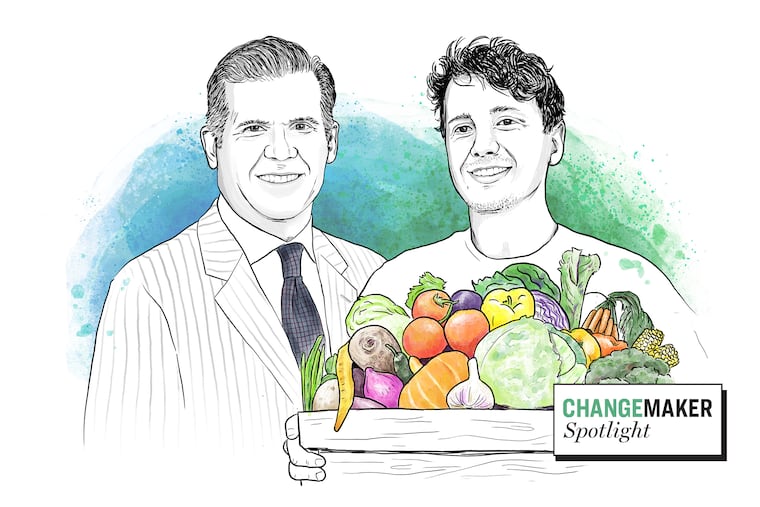
“As an undergrad at Drexel, I saw classmates and neighbors struggling with hunger every day,” Evan Ehlers, 29, said. Witnessing food insecurity up close inspired the college student to start Sharing Excess, in 2018, when Ehlers was a junior. Now, the nonprofit rescues and distributes more than two million pounds of food every week in partnership with grocers, wholesalers, and farmers. When Ehlers was still in college, he attended Satell Institute’s CEO conference where he met and greatly impressed Jim Dever, president of Bank of America Greater Philadelphia, who grew up in Broomall and graduated from St. Joseph’s University.
Today, Dever not only serves on the board of Sharing Excess, but has also helped strengthen the organization’s capacity through his network and Bank of America’s continued support. In 2024, Sharing Excess received Bank of America’s highly competitive Neighborhood Builder grant, which provides two years of flexible funding, leadership development for nonprofit executives and their staff, and access to a national network of nonprofit peers and experts. Through the program, which was launched in 2004, Bank of America has invested more than $346 million in grants to nearly 2,000 nonprofits across the U.S. and helped more than 4,000 nonprofit leaders strengthen their leadership skills. In this Q&A, Dever and Ehlers discuss how their collaboration is transforming food recovery, empowering communities, and inspiring others to think differently about waste and hunger.
Jim, you’ve spent more than three decades at Bank of America and have deep Philly roots. How has your personal journey influenced the way you give back?
Dever: I like to say I have two jobs, but my favorite is giving back; it’s what truly fulfills me. Every nonprofit I’ve worked with has inspired me, especially the passionate leaders driving real change. That motivation comes from my own family story. My mother was an orphan from childhood. Her strength and resilience taught me the importance of lifting others up whenever possible.
Evan, you started Sharing Excess as a college student. What inspired you?
Ehlers: My mom grew up in Colombia, South America, and experienced food insecurity firsthand. When she came to the U.S. at 18, she worked tirelessly to build a better life for our family, eventually building a career in IT and HR at major companies. Because of her and my dad, I never had to worry about where my next meal would come from.
As an undergrad at Drexel, I saw classmates and neighbors struggling with hunger every day. One semester, I had 50 unused meal swipes and decided to use them to buy food, load it into my car and hand it out in Center City. Within 30 minutes, everything was gone and a line had formed. That moment changed everything. It showed me how much need was right in front of us, and how easily we could make a difference by redistributing what we already have. That simple act became the seed for Sharing Excess.
We throw away over 150 billion pounds of food each year in this country. And in order to close the meal gap in America, you would need approximately 11 billion pounds of food. Not all of the 150 billion pounds of food that goes to waste can be saved, but if we save even 10% of it, then we can solve the problem of food insecurity. These are U.S. figures, but the same general percentages stand globally as well.
“If we can get to the moon, we can solve hunger.”
What unique strengths of your respective organizations do you bring to your collaboration?
Dever: At Bank of America, our focus is uplifting the communities where we live and work, not just through banking but addressing fundamental issues like food insecurity. Philadelphia continues to face deep poverty challenges, and access to food is a basic, critical need. Our commitment to sustainability and economic mobility aligns perfectly with Sharing Excess’ mission. With our local presence and national reach, we can help amplify Evan’s vision and support his efforts to scale impact across communities.
Ehlers: Sharing Excess brings fresh energy and innovation to solving long-standing problems like food waste and hunger. Our team approaches these challenges with creativity, urgency, and a belief that change is possible. We’re using technology, logistics, and new perspectives to rethink how surplus food can reach people in need. It’s that combination of purpose, resourcefulness, and modern problem-solving that we’re proud to contribute to this partnership.
Can you share a specific moment when you realized that teaming up could multiply your impact?
Dever: It was a couple of years in, when [Evan] finally told me that [he was] going to go outside the borders of Philly. When Evan set his sights on New York, my mind immediately went to: “This can be scalable.” Saving food and solving hunger is a national problem; it’s an international problem. I thought, if I can be a really great ambassador for Sharing Excess here [in Philadelphia], I’m pretty sure I can convince my peers around the country to see the impact of Sharing Excess’ model and do the same.
Ehlers: Since I started the organization in 2018, we’ve been able to scale from Philadelphia to New York City, and to Detroit, and most recently to Chicago. We also have operations that are just beginning in Los Angeles and in Texas.
We focus on upstream food waste, which is very high volume, very low cost, because we’re using trucks and vans and semitrucks. We want to expand our operations to the biggest sources of surplus around the country, which are aggregated in cold storage chain facilities and major agricultural growing sectors that include some of the largest farming areas in the United States.
Evan, your model shows that America has enough food, it’s just not accessible to those who need it. How is Sharing Excess working to close the gap at scale?
Ehlers: It’s important to acknowledge that we’re not the first ones to do this. There is an existing system that has worked for years, but it needs to be more effective and more impactful. It needs more scale and volume.
The hunger that we see in the United States is different than what we see in countries where people are actually starving. Food insecurity in the U.S. still impacts longevity, but it’s usually because of very unhealthy eating habits, eating highly processed food that is actually shortening your life. Between Strawberry Mansion and Old City, the ZIP codes are maybe two miles apart, but the life expectancy in Strawberry Mansion is 66 to 68 years, and in Old City it’s 86 to 88 years. And many of those social determinants of health are linked to access to fresh, healthy food, among other health-related behaviors.
Jim, why did Bank of America decide to invest in Sharing Excess?
Dever: Our partnership with Sharing Excess fits squarely within the work we’ve been doing to support the Philadelphia community for a number of years. The bank provides opportunities and support to nonprofits and leaders like Evan who have taken the initiative and made significant impact in our community. Sharing Excess is taking things to another level. It’s a new chapter.
What Evan is doing is remarkable. Our team at Bank of America took notice and named Sharing Excess as one of the recipients of our biggest community award last year, called Neighborhood Builders. I had the honor of presenting the award myself. Beyond the financial resources [the grant offers], which is $200,000 over two years to the organization, we connect him and one of his rising leaders with [a network] of up to 1,000 peer entrepreneurs and impactful individuals who will hopefully support him well into the future.
Bank of America has been committed to giving back to Philadelphia since we entered the market. Beyond Sharing Excess, we’ve fostered relationships with food organizations like Philabundance and the Food Bank of South Jersey as we understand that food is medicine!
“At Bank of America, our focus is on uplifting the communities where we live and work, not just through banking but addressing fundamental issues like food insecurity.”
What do you think Philadelphia can teach the rest of the country about tackling hunger and food waste?
Ehlers: Philadelphia is an ideal testing ground for food insecurity solutions. The city has high poverty rates, high food waste, and a high concentration of major food businesses. It’s also a collaborative city. People here are willing to come together, innovate, and say, “We can solve these problems.” We’re proud of our sports teams, and we should be equally proud of how we care for our communities.
Our approach is to grow solutions from within each community, not transplant a one-size-fits-all model. We provide energy, technology, and a platform, but local partners lead the work. In New York, we’ve hired our own team; in Detroit, we partnered with an existing nonprofit, and bolstered their network with new resources.
We also recognize that redistributing food alone doesn’t solve systemic inequities. Financial barriers, education gaps, and long-term economic mobility are critical. That’s why we partner with organizations like Mighty Writers, using food as a gateway to education, financial literacy, and opportunity.
Dever: In addition to support for food insecurity, the bank’s pillars focus on housing insecurity and workforce development. Once somebody has a job, they begin to gain the means to be able to put food on the table and support their family. Bank of America believes that having a steady income, a stable roof over your head, and reliable meals are the foundation to a strong financial future.
Is there one bold goal each of you has for this partnership, and for Philadelphia, in the fight against hunger?
Ehlers: Our bold goal is to provide one billion meals by 2030, and ideally sooner. We’re already redistributing nearly 200 million pounds of food, roughly 1.6 million meals each week. While most of our work is in the U.S., we’re also starting projects in Colombia, Guatemala, and Chile. After reaching one billion cumulative meals, our next goal is one billion meals annually. Using the Feeding America standard of 1.2 pounds per meal, we can measure both scale and impact, turning surplus food into meaningful nutrition.
We’re scaling through leadership, marketing, cost efficiency, and technology, the same innovations for-profit companies invest in. In fact, some for-profits even consult us to learn how we do it.
Dever: My ambitious goal is to bring Sharing Excess into every market where Bank of America operates and to inspire other companies of all sizes to join the mission. With about 100 markets across the country, each with multiple programs, the aim is to accelerate growth and broaden impact through direct and partnered efforts.
Ehlers: Imagine reaching those 100 markets, each redistributing five million pounds of food annually. That’s 500 million pounds. Increase that to 10 million per site, and we’re looking at a billion pounds each year. That would make Sharing Excess the largest independent hunger relief effort in the U.S.
When you do the math it adds up. It’s just about putting in the effort. If we can get to the moon, we can solve hunger.
PHILLY QUICK ROUND
Favorite Philly food splurge?
Dever: Pork provolone at Tony Luke’s.
Ehlers: Angelo’s cheesesteak with Cooper Sharp and fried onions.
Favorite restaurant?
Dever: Parc.
Ehlers: Kalaya, from Chef Nok [Suntaranon.]
Biggest misconception non-locals have about Philly?
Dever: People often think Philadelphia lacks resources, but the opposite is true. We have an abundance of community, affordability, great restaurants, arts, culture, nearby beaches, and easy airport access.
Ehlers: One of the biggest misconceptions about Philadelphia is that it’s dangerous. In reality, like any city, it has challenges, but many areas like West Philadelphia around Malcolm X Park are vibrant and welcoming.
Favorite sports team?
Dever: Philadelphia is an amazing sports town. I love the 76ers, Eagles, Flyers, and Phillies. I have a special place in my heart for tailgating with family and friends on my Eagles-themed bus at nearly every home game!
Ehlers: So Jim and I have never, never talked about this, but I also have an Eagles bus. Let me show it to you! [Phones come out.] My bus is different from yours. We put in a little kitchen and a little bed in the back. We built a roof deck on top so we could go up there. Wait, did you get that bus wrapped?
Dever: Yes! But it looks like they want another Super Bowl. So if they win, I’m going to have to get this one rewrapped.
Who is the greatest Philadelphian of all time?
Dever: Rocky. For me, he embodies the spirit of Philadelphia.
Ehlers: Ben Franklin. I admire his innovation and ingenuity, but also his sense of humor. He even wrote a book on flatulence.
Lucy Danziger is a journalist, an author, and the former editor-in-chief of Self Magazine, Women’s Sports & Fitness, and The Beet.