
Partner Content
Phil Laws’ Serendipitous Journey to Building, Transforming, and Running Arenas
The COO of Comcast Spectacor on calm leadership, constant reinvention, and why the arena business is really the happiness business.
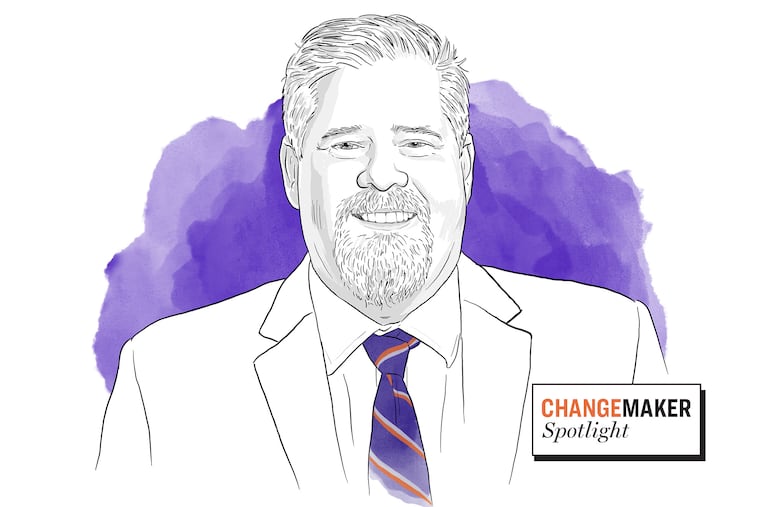
In a city that measures itself by big moments and passionate sports fandoms, Phil Laws, 51, the chief operating officer of Comcast Spectacor, has built a career of making the extraordinary look easy. Laws oversees all operations at Xfinity Mobile Arena, the home of the Flyers and the 76ers, as well as a cultural melting pot of the city: the venue hosts a huge diversity of performances, from gospel to comedy to K-pop. When fans and concertgoers show up, it’s his job to make sure everything goes smoothly: from hiring and security, to setting up ice and seats, to improving the sustainability of the entire system. It falls to him when something goes wrong, like the night in 2024 when the lights went out during a Flyers game. (The team went on to win 6-2.)
Laws has been in the entertainment and sports business for more than 25 years. He grew up in Hebron, Md., went on to open a soccer stadium in Kansas City, and moved to Philadelphia in 2013. He considers himself a “country kid” and spends his days off outside with his wife and daughter enjoying the Shore in the summer and hiking in the fall and spring. His approach to leadership is people-first: He believes leaders should hire good workers then support them by removing obstacles, and he believes that his work is ultimately about serving up joy. Watching families and friends on their way to or from a favorite event is his reward, Laws said.
What originally drew you into this industry?
It wasn’t exactly a whim, but it was a little bit of a whim. I went to the University of Maryland, and I spent a lot of time in Camden Yards. There was something about being in a ballpark: the sights, the smells, the people having fun at an event… just drew me in.
I didn’t study anything around sports or entertainment. I was a political science and economics major. But when I got out of school, I thought maybe I would like being around that environment.
Baseball was my original passion. I started off in minor league baseball working in all these little towns. I wanted to try something new, so I moved to Miami and worked in a concert venue at a convention center. It was just the next opportunity. Then I got to come to Philadelphia and work in an arena. Then I got to open a bunch of venues.
I never had a 10-year plan or even a five-year plan. I made a career of getting lost on little side quests and paths along the way. They gave me this diverse toolkit to draw from.
What has kept you energized over the long haul?
For me, it’s very instant gratification. If you make a product and it goes into the mail to somebody and they use it at home, that’s one thing. But we work on something where we actually get to see our customers interact with it. We can see them enjoying a live event. I think that’s always been the thing that’s kept me engaged and excited about being in this industry.
You oversee everything from security and guest services to maintenance and operations across multiple venues. How do you keep an eye on the big picture without getting pulled into every detail?
In a C-suite role, you’re trying not to handle all of the details. I’ll borrow a line from Ed Snider (the late founder and owner of the Flyers and the former chairman of Comcast Spectacor, who built a massive sports empire). He said many times: “You hire good people and you let them do their job.”
For me, part of being on a C-suite team is working to make sure the business is working and the executives are pulling in the same direction. You have to support the people who work for you. Your job is to make sure the barriers aren’t holding them back, that they’ve got the resources they need. You have to be able to take a step back and make sure they can do their jobs. In a lot of ways, you’re really working for them.
“I made a career of getting lost on little side quests and paths along the way. They gave me a diverse toolkit to draw from.”
You were recognized as a 2025 Philadelphia Business Journal Corporate Leadership Award honoree. What does leadership mean to you in an industry that depends on teamwork across hundreds or thousands of people?
For me, leadership is an everyday task. It’s an everyday assignment. It’s easy to be a leader when you’re passionate about something, or when things are going well. The real test is when you wake up on the wrong side of the bed: you’re tired, you’re exhausted, or you don’t love what you’re doing that day. You still have to be a leader then, too. Your team depends on you. Your organization depends on you.
Who inspired you early in your career?
I have had many great mentors along the way. At different stages of your career you need different things. It’s important to have people who take the time to bring you along and develop you.
What sticks with you is the obligation to do it for others. It’s like a debt you have to pay back, and it’s a cornerstone of your day. You have to take the time now to give those lessons back to the next generation of developing leaders and make sure that the people coming up behind you are even better than you are.
And you’re never too old to have mentors. Our chairman and CEO, Dan Hilferty, has really shown me what collaborative leadership can look like. It’s amazing how much you can accomplish when you bring people into the conversation and give them a real voice at the table.
How do you approach creating equitable job opportunities at the arena?
These venues are real economic engines for the communities they’re in. And part of living up to that means providing job opportunities at every level, including entry-level.
Our partnership with CARP (Carpenters’ Apprentice Ready Program) is a good example of how that happens. CARP is looking for minorities and female employees in particular, or people who’ve had trouble and experienced barriers when getting into the building trades.
The CARP program teaches basic job skills: how to show up to work on time, how to deal with the schedule, etc. All the things that an experienced worker knows and may take for granted. We have a lot of those jobs since we need the labor to help get the arena ready day in, day out.
So it’s a real win for us as an employer, and it’s a real win for those employees taking their first steps into the job market. And every time somebody comes to work, it’s their whole family that benefits.
What advice would you give someone early in their career?
I tell people: Work is a participation sport. Don’t be afraid to get involved and mixed up. You’re not being hired because they need someone to fill a chair. You’re being hired because they believe in you, that you can do the job.
For a younger worker, you’ve got to believe in yourself. The light bulb goes off at some point: I can really contribute here. I can really do something good for this organization. Getting over that hump is a key part of developing leaders.
You led a $400 million transformation of the Xfinity Mobile Arena, from 2016 to 2024. What was the most surprising or challenging aspect of that project?
The biggest surprise, of course, was COVID. That was right in the middle of all that, and it absolutely changed the world for live events.
Over the course of the (renovation), we never fully closed the arena. We broke the renovation into these mad sprints over the summers, to try and get a piece of the arena done in time for the next season. We were still running concerts and summer programming the whole time.
There were years where we didn’t have concession stands. We had temporary setups with ice tubs filled with beer everywhere. One summer we put artists in trailers because the locker rooms were being redone.
Looking back, I don’t know how we did it. I wouldn’t suggest anyone else tries to do it that way, but now it’s a badge of honor. I don’t think anybody has approached a major arena renovation that same way.
Comcast Spectacor and Harris Blitzer Sports & Entertainment have joined forces to build a new arena in the South Philadelphia Sports Complex that will be the new home of the Philadelphia 76ers and Philadelphia Flyers. It is slated to open in 2030. What excites you most about this project?
Two-team arenas like this don’t come along very often. Detroit was the last one, and that was back in 2014 or something like that. So they don’t happen very often. We’re excited to be a part of it.
There were a lot of things in the transformation project that ended up on the cutting room floor. With a new building, we can do things we just couldn’t do with (an existing structure), such as better products for fans and better team spaces.
We’re going to have a WNBA locker room. Fans will notice things like the aisles and the seating are all designed for comfort. You can add those things into a truly modern facility when you start from scratch. It’s going to be a wonderful experience for Philadelphia fans and music patrons for many decades to come.
The arena recently became the first sports and entertainment venue to earn LEED Gold certification under the latest O+M standard, the newest version of the green building rating system. What does that mean?
There are two levels of LEED certification: one is for construction, based on sourcing, equipment, and materials you put in the building. The other, which is what we achieved, is the O+M standard, which is about operations and the performance of the actual building.
It’s about how the building is performing day-to-day. It goes back to the renovation, updated technology, and mechanical systems. It’s things like our recycling programs and what fans and employees do every day to make the building operate sustainably.
We were the first sports venue across the country to achieve this rating. It was a big achievement for operations. They did a lot of unglamorous work to get us across the finish line.
What is it like for you to attend an event at the arena?
I love walking the concourse of the building. I love seeing the families, and the couples, and the friends coming together. These buildings play a big role in communities. And being that focal point that brings people together, that’s what I love about this work.
When things go wrong, what’s your guiding principle or mantra?
Don’t panic. We never panic. It absolutely will not help us.
There are very few perfect events. There are some that go really sideways. Staying calm in that moment comes with experience. You’ve been there before, and you have to work the problem. No matter how bad it is, we take one step at a time on our way out of this thing together.
How do you decompress when the arena empties?
I’ve always liked a longish drive home — sometimes, I’ll take the long way around. It’s a good chance to unpack the day, put it away in a different box, and not take it all home. A lot of times it was music. These days I’m really fond of audiobooks. It’s a borderline addiction. If I don’t have one going in the car, I feel it. I love nonfiction and history. Right now it’s The Devil in the White City by Erik Larson. It’s about the World’s Fair of 1893 in Chicago, mixed with a thriller.
PHILLY QUICK ROUND
Favorite Philly food splurge: Oysters and an Old Fashioned at Vernick Fish.
You don’t know Philly until… you tailgate at the sports complex. And, until you’ve figured out that when someone asks you what school you went to, they’re asking about your high school.
When do you feel most like a Philadelphian? When I’m landing at PHL. The glide path over the river, when you see the city, the neighborhoods spread out, the sports complex, the towers in Center City.
What do you wish people knew about the folks who call Philly home? Our civic pride. This is a city that is constantly reinventing itself.
Lucy Danziger is a journalist, an author, and the former editor-in-chief of Self Magazine, Women’s Sports & Fitness, and The Beet.