
Partner Content
Drexel’s New President Believes Education and Experience Go Hand-In-Hand
Political economist Antonio Merlo explains how Drexel equips students with real-world skills to navigate an unpredictable future.
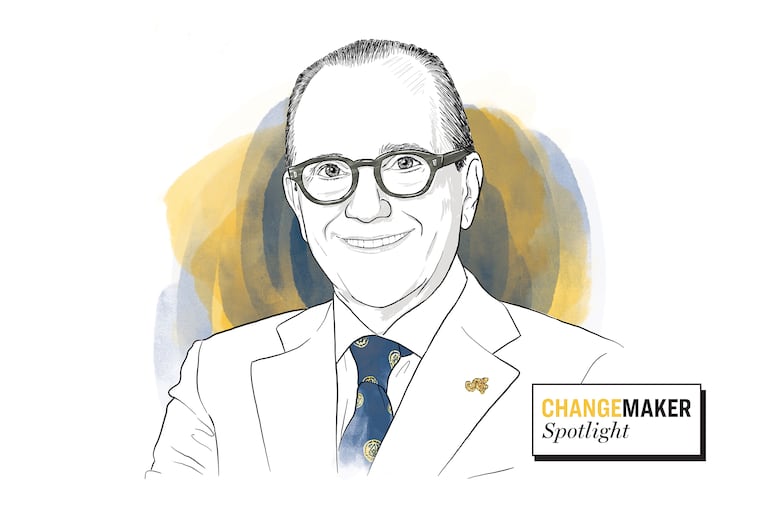
Antonio Merlo, the new president of Drexel University, grew up in a working-class household in Italy, where he was the first to attend college. “At home, the focus was always on work,” he said. His entrepreneurial grandfather inspired Merlo’s curiosity about the intersection of work and education. Eventually, Merlo pursued a Ph.D. in political economy. At Drexel, Merlo sees the power of connecting scholarship with professional work. The university’s emphasis on experiential education, offering real-world applications of classroom skills, is its hallmark. Here, Merlo discusses how his academic path has led him to adopt a philosophy that closely aligns with university founder Anthony J. Drexel’s vision for the institution: An education should not only be good, but also good for something.
Where are you from in Italy?
I was born and raised in Legnano, a small working-class town just outside Milan, near Milan Malpensa Airport. I lived there until I came to the United States at 24 to continue my studies.
What made you want to come to America?
I needed to leave Italy to pursue my Ph.D., which is something my parents didn’t really understand at first. I’m a first-generation college student. Neither of my parents even went to high school. At home, the focus was always on work. Still, my parents respected education.
How did your family shape your worldview?
My entrepreneurial curiosity traces back to my family, especially my grandfather, who was born in 1889 and lived to 93. He never attended school but taught himself countless skills. At 14, he left Italy for Argentina to work as a bricklayer, then became a banjo player in a traveling band, and eventually managed the Grand Hotel in Buenos Aires. Called back to Italy when his father died, he went on to fight in World War I and later built businesses: a movie theater, a bar, a dance hall. His resourcefulness and resilience, despite no formal education, deeply shaped my view of work, learning, and opportunity.
You’re a scholar of political economy. What drew you to that field?
From the beginning, I was fascinated by the intersection of politics and economics. In Italy, coalition governments made it clear that you couldn’t understand one without the other. My research has focused on institutions: why some succeed, why others fail, and how incentives shape outcomes.
Traditional bargaining models imagine two people splitting a fixed dollar. But in reality, negotiations are rarely static and bilateral. Values shift, interests multiply, and coalitions must be built. That complexity drew me in, especially in environments where outcomes depend on changing economic and political conditions.
Over time, I’ve continued to study these dynamics, collaborating with co-authors and students. Scholarship is never definitive. You publish your best understanding at a given moment, then refine it as the field evolves. That process shaped my life as a scholar, right up until I moved into academic administration.
Now, you’re the president of Drexel. How have your previous experiences informed your new role?
At the core, my work has always been about understanding how people and organizations perform at their best. As a scholar, I studied how incentives and structures shape outcomes. As an administrator, I apply that same lens: How do you design an institution so it thrives?
Teaching taught me the power of communication: meeting people where they are, sparking curiosity, and helping them make knowledge their own. Coaching water polo reinforced that leadership is never a title; it’s about bringing people together around a shared mission. Like in water polo, success comes when every player knows their role and feels valued, not just the goal scorers. The same is true in any organization: progress depends on teamwork.
You’ve been called an “academic entrepreneur.” How do you get others on your team to embrace change?
Change starts at the top. As an academic entrepreneur, I think outside the box, but I also focus on bringing people along. Leadership is about earning trust through courage, consistency, compassion, conviction, clear communication, and transparency.
Drexel embodies the entrepreneurial spirit I value. The university has a long history of adapting as the world changes, ensuring a Drexel education is meaningful and impactful. My role is to harness the talents of the community, like a coach, and put everyone in a position to thrive, advancing the mission together. Drexel aims to provide an education that’s not just good, but meaningful, preparing students for life and careers.
What is experiential education, and how does Drexel’s commitment to this model set it apart from other institutions of higher education?
Experiential education bridges the gap between theory and practice. Students receive a top-tier academic foundation, and from day one, they apply what they’re learning, through our co-op program, research, community engagement, global experiences, and project-based learning.
Drexel is an institution that stands apart within the higher education sector because experiential education has been at its core since the school was founded in 1891. Because of this, Drexel is one of a small number of schools leading the way as the sector shifts to focus on return on investment and other positive student outcomes that experiential education has shown to provide.
What makes Drexel different from other schools is that from the moment students set foot on campus, they are exposed to real-world learning experiences that are integrated into their classroom learning.
Experiential education is more than just working while studying. For example, students in a social science class don’t just read theory; they also see how it applies to real communities. Law students don’t just study ethics; they confront dilemmas that require thoughtful choices firsthand. Our engineering students are in the field addressing some of the biggest challenges facing our city, our region, and the nation, and then bringing the lessons they’ve learned on the job back to the classroom to enrich the learning experience for their classmates as well.
We see that this hands-on approach makes learning last and prepares students not just for their first job, but for a lifetime of navigating complex challenges. Giving students a strong base of learning and work experience prepares them for a rapidly shifting job market. While there are many future jobs that don’t even exist yet, the skills students develop at Drexel will equip them to recognize and seize these opportunities. Experiential learning is central to this approach: meaningful work experiences, co-ops, and projects allow students to discover what they enjoy, what challenges them, and how to apply their skills in real-world settings. Drexel students graduate incredibly prepared and sought after by employers. We deliver on the promise of higher education to play a transformational role in students’ lives.
“My role is to harness the talents of our community, like a coach, and put everyone in a position to thrive, advancing our mission together.”
Drexel’s co-op program offers students career-related work experiences. How do you measure their success or know whether this experiential approach is working?
While we closely track student success in our co-op program, the outcomes speak for themselves. About 95% of students participate in co-ops or other experiential learning, and our graduates rank in the top 3% nationwide for lifetime earnings. Last year, the average graduate’s starting salary was $71,000, 11% above the national average, and 96% of graduates are employed or in further education within a year.
We also regularly survey co-op employers to evaluate the program and ensure a strong and mutually beneficial partnership. Employers consistently report that Drexel students are well-prepared, skilled, and ready to contribute. And about half of co-op students receive job offers from their co-op employers after graduation.
A student’s co-op experience typically starts in their sophomore year. They spend six months on the job and have the opportunity to do this a total of three times during their academic career. Students work for companies across the U.S. and abroad and then bring those experiences back into the classroom when they return to campus the next term. Some coursework can occur simultaneously while students are on a co-op cycle, but the emphasis is on meaningful, immersive work in a job setting.
How is the university working to optimize the co-op and on-campus experience for students?
As part of our “Academic Transformation” initiative, we are reimagining our institution’s future through the integration of programs and schools and a redesign of curriculum around core competencies. Drexel is also transitioning to a semester system. This shift will provide students with even greater flexibility as they pursue co-op and experiential learning opportunities.
A semester system better supports global experiences and partnerships with other universities, ensuring students are synchronized with the academic calendar used worldwide. This alignment expands opportunities, from studying abroad, to joining consortia where students can access specialized courses, to building a broader community of learners. Overall, semesters give students more time to engage deeply, explore, and take full advantage of all the educational resources available.
I am a firm believer that this is Drexel’s moment. Drexel has never been afraid to rethink what higher education can and should be. We’re taking bold steps to reimagine our academic model, making it more flexible, more interdisciplinary, and more deeply rooted in what makes Drexel distinct: experiential learning, innovation, and societal impact.
That means we’re streamlining our structures, so students have a clearer, more supportive experience. We’re investing in new ways of teaching and learning, ensuring every student has access to hands-on opportunities while doubling down on the things that truly set us apart: our experiential education program, our research impact, and our ability to connect learning with the needs of the world.
You’re wearing a pin of a dragon, Drexel’s mascot. What does it mean to you?
Drexel is unique, and the dragon symbolizes that. We’re the only Division I university nicknamed the “dragons,” which immediately sets us apart. When people see the dragon, they know it’s Drexel. It’s a symbol of our identity and our bold, distinctive spirit.
How do you like to spend your free time?
I love to cook. Wherever I go for vacation, one of the first destinations I go to is the local market. I’ll go to the fish market and realize I have never seen this variety [of fish]. It’s experiencing the life that a place offers. I also swim. I love water. Water is my element.
Do you speak Italian or English at home?
English. I write and speak English all day long. But I miss speaking Italian. Before my father passed, we used to have a weekly phone call. And we would just talk, and that was my use of Italian. It’s interesting, though, sometimes I catch myself dreaming in Italian.
Do you have a mantra you live by?
I try to live my life in the most genuine and authentic way I can. It’s served me well through my life. Being yourself and staying true to your value system is a lot easier.
PHILLY QUICK ROUND
What’s your favorite Philly food splurge? A bagel with lox at Famous 4th Street Delicatessen.
Best Italian restaurant in Philly? My home.
What sports team do you root for? Inter Milan, my Italian soccer team, and the Eagles.
Who is the greatest Philadelphian of all time? Benjamin Franklin.
I feel most like a Philadelphian … when I walk the streets of University City, and I know how to pronounce “Schuylkill.”
Lucy Danziger is a journalist, an author, and the former editor-in-chief of Self Magazine, Women’s Sports & Fitness, and The Beet.