
Partner Content
How Highmark is Transforming Care Across Greater Philadelphia
A conversation with Market President Dan Tropeano on how Highmark Blue Shield is improving health care access and affordability, and partnering with nonprofits on food and prescription needs.
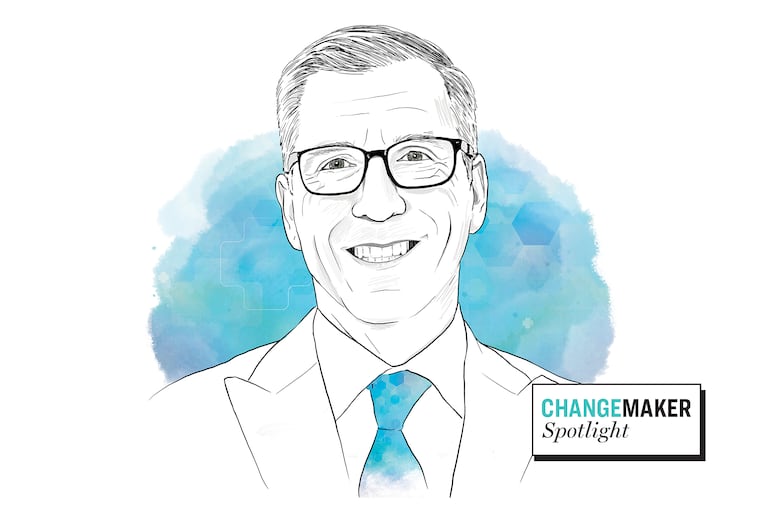
As a second-generation Italian American, Dan Tropeano, 55, saw what it took to build a successful business. His father immigrated to the United States from Italy in 1959 at the age of 19, without knowing anyone in his new country and with limited English. He supported himself by sweeping floors in an auto body shop. Later, he built two successful businesses, supported his growing family, and sent his son to college. His father’s example inspired Tropeano to believe that anything is possible when you set your mind to it. He has set his sights making health care more affordable and accessible by reducing the friction patients experience when seeking provider care and insurance coverage. To meet these goals, Highmark has invested in the community through programs like Bright Blue Futures, which tackles health inequities by fighting food insecurity and expanding health care access for all. Below, Tropeano discusses what drives him to expand life-saving care to those who need it most.
Ben Franklin once said, “An ounce of prevention is worth a pound of cure.” How do you wish your members would practice an ounce (or more) of prevention?
It’s the simple things that we’re trying to get people to do. If I could get everyone to do one thing, it would be to see their primary care physician once a year. And then, we want you to take his or her advice. The doctor will tell you, “Here’s what you need to do.” Once we know what you need, Highmark can help. So, if the doctor says, “You need to lower your blood pressure, but you don’t need medication,” then we have programs that can help you get healthier by lowering your blood pressure.
These lifestyle changes are not the big, splashy things people think of when they think of life-saving treatments. For a big percentage of our membership, it’s making the little lifestyle changes that are vital to staying healthy.
We want to make getting healthy achievable. But first, you need to know, and we need to know, what the doctor orders. Then we can get to work together.
Obtaining prior authorization can be challenging for consumers. How is Highmark addressing this?
It’s going well but it’s never fast enough. If we could flip a switch to ease this concern, we would. The entire industry has come together to try to solve this problem in a variety of ways.
It starts with honoring existing prior authorizations. When a new member comes to us, we maintain the pre-authorization that they have for another 90 days. And we are working to enhance overall communication. Believe it or not, faxes are still the main way authorizations come to us. We’re trying to connect directly with providers’ electronic medical record systems to make it faster.
We’re also working toward real-time responses, meaning a response to the provider’s office at point of submission. We’re leveraging AI to help us accomplish this. We also have gold-card providers who have a track record of producing positive patient outcomes. When our data shows this, we can expedite treatment without prior authorization.
Data shows that drug costs account for one-third of all consumer healthcare spending. How is Highmark working to make prescription drugs more affordable?
We’ve launched several programs in the last 18 months that are making a difference. Most of this work is through partners that we’ve supported:
CivicaScript is a nonprofit generic [drug] manufacturer launched in 2020 that is gaining traction. It launched its first generic oncology medication in the fall of 2023, and to date, that one medication has saved patients $90 a month, on average. Across our membership, it has saved more than $6 million. We’re looking to support the continued expansion of this type of generic drug manufacturing, with additional products this year, including generic medications for multiple sclerosis and other chronic, complex, and high-cost health conditions.
Highmark also utilizes Free Market Health, a platform that facilitates competitive bidding among specialty pharmacies. Because certain high-cost specialty drugs are subject to dynamic pricing and can be fulfilled by multiple quality pharmacies, this resource can help our members receive the most competitive pricing available at that time. The platform can also expedite order fulfillment compared to traditional approaches as well as lead to improved medication adherence.
Lastly, Synergie is a purchasing consortium that we launched with other Blues plans across the country. It covers more than 100 million members, so we’re able to purchase drugs as a collective. These drugs are typically high-priced treatments that are administered by medical professionals in clinical settings. This scaling helps lower cost, equating to savings we can pass onto our members.
“By getting people in quicker, we’re diagnosing them faster, and that ends up shortening the time to remission.”
How are you increasing access to care and resources to improve health outcomes across the communities you serve?
We contract with 98% of the providers within greater Philadelphia, so that’s basically all the hospitals and health care systems in the area. Our network provides massive access by itself, but beyond that, we also offer telehealth. It has become a big part of the industry, and we approach it in a couple of ways, combining telehealth with in-person visits.
For example, we offer Virtual Joint Health, Thrive by Sword, a virtual physical therapy program. We send the patient a tablet, and as they’re doing their exercises, a physical care specialist can evaluate how they’re doing and correct their form. After completing the program, more than two-thirds of participants who initially struggled with moderate-to-severe pain reported a significant improvement from their baseline. That’s one way we’re trying to make access easier, more effective, and more affordable.
Another resource we offer is Mental Well-Being Powered by Spring Health, a virtual mental wellness program, which offers both virtual and in-person components for behavioral health. The program has expanded our provider listing and is serving more than 79,000 members across our entire footprint. More importantly, it has improved [health care] access, decreasing the wait time for a provider from more than two weeks to less than two days, on average.
By getting people in the door or online quicker, we’re diagnosing them faster, and that ends up shortening the time to remission. Instead of more than four months to remission, we’re seeing members with moderate-to-severe anxiety or depression treated to remission in fewer than six sessions, on average.
So those are examples of how we’re trying to work locally and across our entire footprint.
Given Highmark’s role in the community and its corporate responsibility work, what’s the biggest challenge you face right now?
From a community engagement perspective, the challenge is that there is such great need in the community. There are never enough resources to do all the things we want to do, whether that be from a civic perspective or a nonprofit perspective. We have to prioritize, so we rely on our Highmark Bright Blue Futures strategy and our Community Affairs team members. They are our boots on the ground in our local communities and help identify where we should focus our dollars to have the greatest impact.
Highmark’s Bright Blue Futures Awards program focuses on community health and resilience. Is it a program you are committed to expanding?
We have a strong legacy of supporting our communities. In 2024, Highmark Health and its affiliates significantly expanded our steadfast commitment across our footprint, which includes southeastern Pennsylvania. In 2023, the Highmark Foundation started the Highmark Bright Blue Futures Awards as a way of recognizing organizations across our footprint for their great community health work.
There are several that have been recognized here in southeast Pennsylvania: The Food Trust, which provides nutrition security to those in need; the Phoenixville Community Health Foundation, which works to provide health and human services in its community; and the Maternity Care Coalition, which advances maternal and child health through early care and education.
Giving more people access to quality health care and healthy food are a high priority. Civic engagement and arts and culture are also top of mind for Highmark Blue Shield in the Philadelphia area.
Your work and philanthropy both focus on expanding health care access. What experiences or influences led you in that direction?
I’ve had four family members who have passed away prematurely from cancer, the oldest of whom was 58, and one was just 16. That’s always weighed on my mind in terms of trying to focus my charitable and volunteer efforts in the health care field. Just being in this field has expanded that passion because I know that there are solutions, treatments, and resources out there, but sometimes these treatments just need more support in order to scale.
What does it mean for you to partner with nonprofits? Why is this so important to you personally and professionally?
We believe it’s our duty to give back to the community that supports us. I realize how fortunate I am, and I think it’s incumbent on me to give back, not just in dollars, but also with my time.
It doesn’t have to be giving in big ways. It could be in simple ways, like bringing my kids to a volunteer event on MLK Day, showing up to pack food for families, or assembling hygiene packages for those in need. It’s my responsibility to show up and set an example.
What are you most proud of or most passionate about in your work right now?
I’m proud of the impact that we’re making in southeast Pennsylvania, in such a short time. You know, we’ve been here 18 months now. I think we’ve been able to positively impact the overall cost for members and clients in that short time, whether it’s by providing them with a more affordable option or by driving other insurers to price more competitively.
I’m proud of what we’ve done in the community, not only from our local perspective, but also what the larger Highmark [organization] has brought in terms of people, time, and effort. I’m also proud of the speed at which we’ve been able to do all that. We’re up to almost 200,000 members across the greater Philadelphia region in roughly a year and a half.
If you wanted to do one healthy thing in your own life starting today what would it be?
Eat more vegetables! Now that my kids are grown, I eat out a lot or I eat on the go, so that doesn’t usually offer the healthiest options. We all need to get more vegetables.
Dan Tropeano On Leadership
Who influenced you the most in business?
I learned my first business lessons from a leader and mentor named Kevin Hill. He had all these sayings. When I meet with young people today I still hear his voice in the back of my head: “I’m not going to spoon feed you. You have to go out and do it yourself. I can only teach you so much. The rest is up to you!” The point is, you have to be engaged enough and motivated enough to learn on your own. I think a lot of people expect to be taught. You learn from doing.
Who influenced you the most in your personal life?
My father. He was an Italian immigrant who came to this country in 1959 at the age of 19. He didn’t know the language, didn’t really know anybody, and started sweeping floors in an auto-body shop for his first job. Eventually, he was able to start a successful business, then have a second successful business in the construction industry. He’s retired now, but he supported a family and sent his son, me, to Villanova; and I was the first [of my family] to attend university here. He has had a successful life and family. It just shows what you can accomplish if you set your mind to it.
What is your healthiest habit?
Exercise! I walk fast and wear one of those weighted vests. I even like to go out when it’s hotter, just to get my sweat on. And I lift weights a couple of times a week. I try to do these things every day, and I typically get it done five to six days a week.
What do you do on weekends or when you have free time?
Right now I love going to the Shore. I’ll be heading out Friday afternoon and sitting in traffic with everybody else! My favorite thing is to get to the beach.
If you were not doing this job what would you be doing instead?
I’m not sure how much I would have liked it, but I probably would be working for my father, building.
If you were a pro athlete, what sport, team, or position would you play?
Center field for any baseball team that would pay me something: the Phillies, the Yankees, the Houston Astros, it wouldn’t matter.
PHILLY QUICK ROUND
It’s splurge time. Are you ordering a hoagie or a cheesesteak? It’s a cheesesteak.
What’s the biggest misconception non-locals have about Philly? I moved here 20 years ago from North Jersey, and I tell you, Philly gets a bad rap in terms of people. Even when you go to an Eagles game, they’re much nicer than the rest of the world thinks they are.
What sports team shirt do you wear most often? Definitely Phillies.
When you think of the great Philadelphians in history, who is your GOAT? It’s Ben Franklin, without a doubt. Just think about all the things he started: the first hospital, the first library, and the University of Pennsylvania. In my industry, how could I not think that everything he did makes him remarkable?
Complete the sentence: I feel most like a Philadelphian when … I’m in South Philly. Before or after a game, we try to go to this restaurant Popi’s, which is old-school Italian. Everything from the food to the people to the atmosphere, it’s authentic! When I’m down there, that’s when I feel Philadelphian. I love that.
Lucy Danziger is a journalist, an author, and the former editor-in-chief of Self Magazine, Women’s Sports & Fitness, and The Beet.