
Partner Content
From Practicing Family Medicine to Redefining Philadelphia’s Healthcare System
Dr. Richard Snyder, Independence Blue Cross Executive Vice President and Chief Operating Officer, is bringing hospitals, doctors, and communities together to improve health.
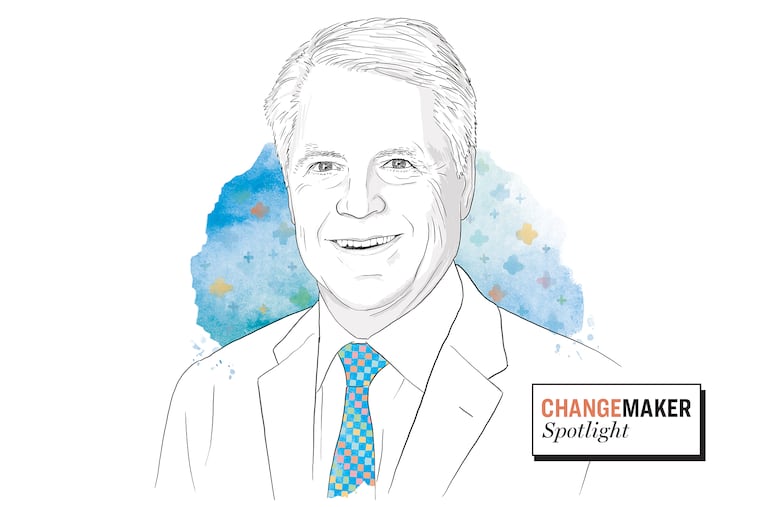
Growing up in a rural, largely Mennonite farming community in New Holland, in Lancaster County, Dr. Richard Snyder was fascinated by his family physician’s office and its “gadgets,” like the reflex hammer and the otoscope. Though his parents had dropped out of school before high school to work on their families’ farms, they encouraged their son’s interest in medicine, supporting his dream of becoming a doctor. “My parents didn’t experience college, but they wanted that for me, and they went to the end of the world to support me going to college,” Dr. Snyder said. “I lived at home but commuted to Franklin & Marshall and ultimately went to medical school.”
Dr. Snyder’s path from Lancaster County to his current post as Executive Vice President and Chief Operating Officer of Independence Blue Cross (IBX) in Philadelphia highlights his commitment to making healthcare accessible to all people, regardless of their community or demographic background. After earning his degree from the Medical College of Pennsylvania, he joined a family medicine practice in Elizabethtown that kept its doors open 365 days a year. “I delivered babies early in my career. I took care of kids, adults, and I performed house calls,” he said. “I believed the right way to practice primary care was to be available to your patients all the time.”
Dr. Snyder brought that same magnanimous approach to IBX when he joined the company almost 30 years ago as a senior medical director. His work at IBX has always been focused on the people of Philadelphia and its surrounding areas, making sure they have access to the quality care they need to improve their health and well-being. As he rose through the ranks, he was appointed by Gov. Ed Rendell to the State Chronic Care Commission, promoting better primary care practices. He advocated for expanding the company’s behavioral health offerings and value-based care work, an approach that focuses on improving patients’ outcomes while managing costs for consumers and customers. He also led the creation of partnerships with various organizations to address health issues throughout the area.
“We have grit here, and desire. We don’t want to come in last. We want to come in first. I’m optimistic that we can tackle the issues that we face. It will be a hard, uphill battle, but we can do it.”
What led you from being a practicing physician to your current role at IBX?
My passion has always been to help people. My intention was always to practice medicine. It wasn’t to become an insurance executive. But after being exposed to managed care through my practice, I realized that was one way I could impact a lot more people. At IBX, I had the opportunity to make decisions about medical policies and help close care gaps among large populations. Instead of trying to convince one patient at a time to get their preventive care, I could set up programs that reach more people and give them actionable ways to take control of their health. Programs that support cancer screening, like the colorectal cancer screening program that sends kits to all our members who don’t have evidence of having had a colonoscopy or a colorectal cancer screening, reach far more people, giving them an alternate way to stay on top of their health.
IBX has recently expanded its behavioral health offerings. What was the driving force behind that, and why do you think it’s so important for communities in Philly?
In my primary care practice, we had a psychiatrist, psychologist, and therapists, and it was a great way to practice medicine. It made me realize how beneficial it is to integrate physical and behavioral health. IBX, like most other payers, delegated management of behavioral health services to a vendor many years ago. That, of course, created an arbitrary division between physical and behavioral health that doesn’t exist in the human body. You’ve got a brain that experiences emotions, depression, and anxiety, and a body that responds to those emotions, right? So, we brought behavioral health services in-house, using the robust case and care management capabilities we have here at IBX on the physical health side. It was a successful three-year journey, involving the contracting of a behavioral health network and the insourcing and integration of functions previously performed by a vendor.
As a leader in one of the region’s leading health organizations and someone working to solve big challenges for health systems, especially for underserved communities, why is health equity so important in Philadelphia?
We need to remember that health equity isn’t just about fairness. It’s about creating healthier neighborhoods, improving outcomes, and ensuring that no one’s ZIP Code determines the health of its residents. In Philadelphia, the sixth-largest city in the nation, we are faring worse than every other county in Pennsylvania for health outcomes and worse than the average county nationwide. We have more medical schools and physicians, yet we’re coming in last. That’s unacceptable. As one of the region’s leading health insurers, we have the ability — and the responsibility — to address these challenges. We’ve made critical strides with the launch of Accelerate Health Equity and the Regional Coalition to Eliminate Race-Based Medicine, but there is still work to be done.
What are you most proud of regarding your efforts to create value-based care programs that have led to better outcomes and lower costs? What does that look like in action?
During my tenure at IBX, value-based care has evolved, and we have become a recognized leader in this space. We currently have agreements for value-based programs with 90% of the health systems and primary care providers in our network. Those agreements are supported by Joint Value Committees, comprised of people from IBX and the health systems and providers. They help us identify opportunities to improve access to care, coordination of care, patient experience, quality of care, and cost of care. One opportunity we discovered through this work was the Heart Safe Motherhood program, supported by IBX at Penn Medicine. It monitors women who leave the hospital after childbirth with high blood pressure and reports their blood pressure back to the doctor. It’s reduced readmissions for hypertension from 3% to 1%. We’ve asked other systems to use this, and we pay for it. We spread an idea across the region, so it impacts many people, not just one patient at a time.
You’ve worked closely with the American Heart Association. Why was this cause so important to you, and how is it making an impact here in Philly?
If you look at life expectancy, there’s about a 20-year difference between Society Hill and Strawberry Mansion. Part of that has to do with cardiovascular disease. Hypertension is prevalent in underserved communities, as are heart attacks and sudden death. When I joined the American Heart Association years ago as a board member, and I was asked during my tenure as Board Chair what project I wanted to support, it was to promote more CPR training. We advocated for legislation in Pennsylvania that requires all high school students to be trained in hands-only CPR upon graduation. Why? Because it creates a perpetual supply of people who know how to do CPR in the community. At IBX, we sponsor a mobile CPR initiative with Penn Medicine that has trained more than 10,000 people in primarily underserved communities in this region. We also sponsor a CPR training kiosk in the city that trains people to do hands-only CPR. That’s the kind of thing that keeps me engaged in this community.
“Health equity isn’t just about fairness. It’s about creating healthier neighborhoods.”
COVID-19 exposed both the strengths and gaps in our healthcare infrastructure. How did you help foster collaboration across health systems during the pandemic, and what parts of that collaboration are still alive today?
Healthcare providers did an outstanding job fighting the pandemic and caring for the people in our region. It was challenging, and many of them recognized the value of working together with partners like us to fight the common enemy. The pandemic opened up new lines of communication and we identified new opportunities to work together.
Among the initiatives we undertook at IBX was collaborating with lab vendors to enhance regional access to COVID-19 testing and launching a regional coalition of home care providers to develop standardized COVID-19 protocols and a shared capacity database. We also knew that providers were struggling to find personal protective equipment, so IBX acquired 500,000 personal protective masks and delivered them to physician practices in the region.
To support the community at large, we opened a vaccination site in collaboration with Vybe Urgent Care at Independence LIVE. More than 22,000 shots were administered at that site. We also launched a collaboration with a major pharmacy chain, Main Line Health, and the Philadelphia Department of Health to help vulnerable populations schedule vaccine appointments.
How have your health information sharing efforts impacted the community?
It’s important to have your medical records available wherever you receive care. When you end up in the emergency room, the physician doesn’t have your health records, and you can’t always recite your health history to the physician. People also get care from various health organizations that often don’t share information. To tackle this issue in the Philadelphia region, IBX convened a group of health systems to discuss establishing a health information exchange. We started the HealthShare Exchange (HSX) of Southeastern Pennsylvania. It’s a platform that allows health insurers and providers to share clinical records, making patient care more informed. Today, it contains medical records, also known as Clinical Care Documents (CCDs), for 11 million patients. It spans Philadelphia and five surrounding counties, southern New Jersey, and into Delaware. So, let’s say you’re cared for at Penn Medicine, and you are brought to the Jefferson ER — the doctors treating you can pull that information up and see what happened at Penn, know your allergies, and more. It makes for safer, more efficient, and more effective healthcare. It can also be used as a reunification service. For example, we have a few massive events coming up, like the FIFA World Cup and our country’s 250-year celebration, which will draw many people to Philadelphia. If families are separated from loved ones because an ambulance takes a patient to an unknown emergency room, HealthShare can help you locate them.
You’re involved with several regional organizations focused on critical health issues like health information sharing and educational equity. How do these initiatives shape your broader view of what community health means?
I’m an eternal optimist anyway, but the fact that we can motivate people to come together around common causes for the good of the community gives me a lot of hope for the future of Philadelphia. We have grit here, and desire. We don’t want to come in last. We want to come in first. I’m optimistic that we can tackle the issues that we face. It will be a hard, uphill battle, but we can do it. My dad used to say, ‘When the going gets tough, the tough get going.’ That was how he challenged me to keep doing what I do.
We know Philadelphia is a city of deep pride and resilience. What gives you hope about the direction of healthcare?
I have hope that we’re moving to equitable access to healthcare. We access care differently now. The internet has been great, but we can do even better with maximizing health information exchange, and we’re taking steps to address this throughout our area. For example, at IBX, we started using the Epic Payer Platform, a version of the electronic medical record system commonly used by hospitals in this region. It allows us to interact with providers in real-time, so we know when you have a gap in care or if you’ve run out of a medication and haven’t filled a prescription in a while. Your doctor can also inform IBX that you need a procedure or test and have it approved electronically in real-time. There’s a lot of change to come as technology improves.
As someone who’s worn many hats in healthcare — physician, executive, advocate — what’s one piece of leadership advice you like to give others?
Always look to do more than you have in the past — that’s how I get involved. Once I commit to something, I figure out how to do it. At one point, I even served on a school district’s strategic planning committee, and they put me in charge of the technology. That’s not my skill set, but it was fun, and I learned and became comfortable with the role. So I think it’s important to step out of your comfort zone and challenge your self-imposed limits on what you can achieve. We can all do more than we think we can.
PHILLY QUICK ROUND
Favorite Philly performing artist: The Roots.
Favorite Philly food: Cheesesteak from Dalessandro’s. That’ll probably tick off everybody else in town.
Favorite historical Philadelphian: Ben Franklin, just because he impacted so many areas of life. He dabbled in everything and couldn’t say no to anything. But in medicine, Benjamin Rush, the father of American medicine.
Favorite Philly pro athlete: If I didn’t say Saquon Barkley this year I would probably be in big trouble, right?
Favorite Philly small business: As a physician, I think one of the hardest small businesses to operate in this day and age is a primary care physician’'s office.
I wish people knew this about Philly: They don’t like us and we don’t care.
My favorite neighborhood to explore: Fairmount or the Parkway Museum District, just because I like art.
Why I love Philly and want to give back: Philadelphia gave me a lot. It gave me my education. It gave me a career. It gave me the ability to do things I never thought I would do. And so I love the people and the grit, and I want to give back.
Cristina Tudino is a writer, editor, and content brand marketer. Her work has appeared in Vogue, Self, Health, Oprah, Women’s Health, Forbes, Martha Stewart Living, and Glamour.