
Partner Content
How Thomas Jefferson University Prepares Students for the Future
We sat down with the institution’s president, Susan Aldridge, Ph.D., to talk about Jefferson’s legacy, her leadership, and preparing students for jobs and challenges that don’t even exist yet.
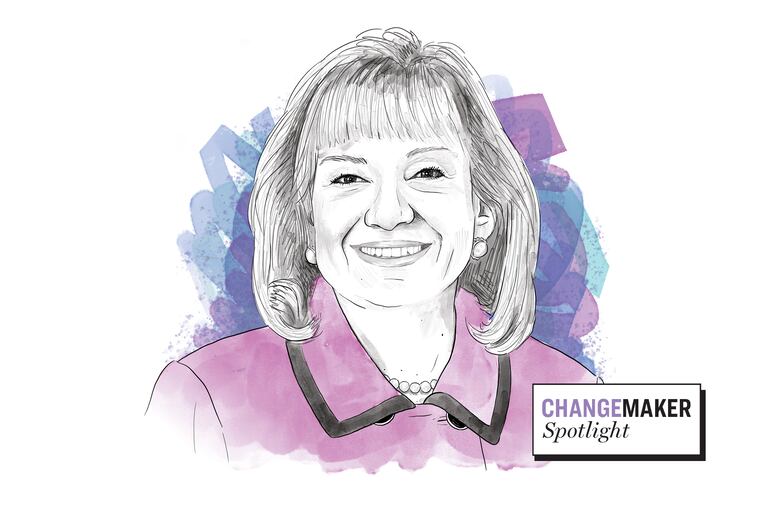
Susan Aldridge has long held the belief that the way to impact education is by creating a collaborative atmosphere that brings scientists, researchers, designers, and engineers together. In unison, these minds can solve problems and create opportunities, even as the next generation of challenges remains slightly out of view. In May 2024, Aldridge was appointed president of Thomas Jefferson University, which has become exceptionally forward-looking, thanks to her leadership. Her tenure comes at a time that Jefferson is growing. In fall 2025, the university admitted the largest freshman class in its 201-year history, while maintaining the excellence and quality Jefferson is known for. Here, she explains how she creates opportunities for students, educators, and administrators through cross-disciplinary programming and offers solutions today and for years to come.
Jefferson turned 200 last year, a remarkable milestone. What does the bicentennial mean to you?
It’s both a moment of reflection and a springboard. Jefferson began 200 years ago as the fifth medical school in the U.S., with $550 and a few visionary physicians. Today, we’re a nationally-ranked research university with more than 200 academic programs.
This anniversary is a chance to honor that extraordinary history while looking ahead to our third century. Jefferson has always been about excellence and innovation in health care education, clinical research, and experiential learning. Now, we get to build on that legacy for the future.
You’ve led institutions across the country. How has that experience shaped how you lead Jefferson?
My career has been about expanding access to education and preparing students for a global, dynamic, and uncertain future. Higher education can’t just respond to the future of work — we have to shape it.
That means teaching students to thrive in constant change, to think critically, to collaborate, and to be resilient. At Jefferson, I’ve been struck by our DNA: students consistently say, “My faculty care about me and my success.” That culture of support, paired with future-focused education, is powerful.
Jefferson has such a unique mix of disciplines: medicine, design, architecture, business. How do you foster collaboration across fields?
We call it “nexus learning.” It’s more than a philosophy; it’s built into the curriculum. Medical students work with industrial design students to create new health care products. Textile engineers collaborate with medical students to develop patient-safe fabrics. Business, architecture, and design students solve real-world problems together.
These experiences make students job-ready. That’s why 98% of Jefferson graduates are employed in their fields or pursuing advanced degrees. They leave here knowing how to work across disciplines— exactly what employers want.
Artificial intelligence is reshaping industries. What role do you see AI playing in higher education?
AI is already transforming how we learn and work. At Jefferson, we’re taking a proactive, thoughtful approach.
We’re launching free courses for students, faculty, and staff to understand AI basics and ethics. I’ve challenged every dean to integrate AI into their curricula, starting with the professions our students are entering. Radiology students, for example, are learning how AI can detect diseases faster, while fashion students use AI to visualize designs across body types.
But this isn’t about replacing human judgment. It’s about using AI as a tool: saving time, analyzing data, and freeing professionals to focus on patients, clients, and creativity.
Looking ahead, how do you prepare students for jobs that don’t exist yet?
By teaching them how to think, not just what to know. We put them in collaborative, interdisciplinary environments where they confront “wicked problems,” issues with no clear solutions.
That process develops creativity, decision making, and teamwork. Those are the skills that will serve them no matter what the future brings.
“By teaching students how to think, we put them in collaborative, interdisciplinary environments where they confront ʻwicked problems,’ issues with no clear solutions.”
What makes Jefferson unique?
Jefferson is what I call a “unicorn” because of its unique collaboration between disciplines. We are one of the rare institutions that combines a university, a health system with 32 hospitals, and a large health insurance plan. Together that enterprise employs 65,000 people. This gives our students unmatched opportunities, from clinical placements and research opportunities to working with the insurance arm. Think about it this way: Design students can come up with practical solutions such as reimagining smart and healthy cities that lead to real-world applications and translate to potential jobs and new products faster than if these disciplines didn’t overlap. Collaboration also strengthens our community service mission: last year alone, the Jefferson community contributed more than 200,000 hours of volunteer work. That sense of purpose is woven into everything we do.
How do you balance growth with academic quality?
Growth for its own sake doesn’t interest me. Jefferson’s growth is strategic — we expand in areas where we have strengths and where the job market is headed. That’s how we maintain a 98% placement rate.
We also work closely with employers, who sit on advisory boards and sponsor student projects. It ensures our programs are relevant, rigorous, and forward-looking.
What advice would you give aspiring leaders in higher education?
Now and in the future, education will matter more than ever. By 2030, 70% of jobs will require education beyond high school. So surround yourself with people who think differently: diversity of thought sharpens problem solving. And work hard. Say yes to opportunities, volunteer for committees, expose yourself to new challenges. Leadership is as much about resilience and curiosity as it is about vision.
What is an honor you’ve received that is especially meaningful?
Honestly, any recognition I’ve received reflects the teams I’ve worked with. None of us accomplishes anything alone. What I’m most proud of is the collective work and the faculty, staff, and students who make Jefferson what it is.
You co-wrote the book Wired for Success: Real-World Solutions for Transforming Higher Education, which is about technology-enhanced education. If you wrote a new chapter today, what would it cover?
I’d focus on two things: the rapid pace of technological change and the fact that students are learning differently. They want hands-on experiences and practical application. Long lectures aren’t effective anymore.
Our role is to give them knowledge and ways to apply it through case studies, real-world projects, and technological tools that bring learning to life.
You’ve worked in both health care and academic institutions. How is Jefferson handling the evolution of the intersection of education, research, and clinical care?
At Jefferson, we’re uniquely positioned to connect education, research, and clinical care. We apply discoveries directly through clinical trials, give students hands-on placements across our health system, and integrate fields like architecture and textiles into sustainability and design projects.
That’s why I call Jefferson a unicorn: few institutions can offer this breadth. Last year alone, we hired 920 of our own graduates. We’re building bridges and creating talent pipelines everyday.
How do you recharge outside of work?
Family, friends, and good food. Philadelphia has incredible restaurants, and I love exploring them. I also volunteer with the Philadelphia Orchestra, which has become a real joy. I enjoy opportunities to meet some of the musicians and just enjoy an evening at the orchestra.
What’s your personal ethos?
There’s a book I love called The Elegant Warrior. It’s about being strong in your profession while approaching challenges with grace. That balance — strength and elegance — is something I try to live by.
PHILLY QUICK ROUND
What’s the biggest misconception about Philadelphia? That the entire city is unsafe or unclean. Like any large city, there are challenges, but there’s also incredible vitality, pride, and community spirit.
Favorite sports team? I am the greatest fan of all 17 of our Thomas Jefferson University athletic teams.
Favorite small business? It’s called Jaccaranda Events. Jan DeMarzo is the owner.
When you have free time, how do you spend it? In Philly, it’s the orchestra, and when time allows, I still love to travel. I’ve visited over 100 countries.
What do you love about the people who call Philly home? Philadelphia pride: pride in the sports teams, and also the love of great food. Philadelphia has phenomenal restaurants. If anybody wants to know about Philadelphia, they need to come enjoy some of our great restaurants.
Favorite Philadelphian in history? Marian Anderson.
You don’t know Philly, until you’ve … visited the museums and eaten at the restaurants.
Lucy Danziger is a journalist, an author, and the former editor-in-chief of Self Magazine, Women’s Sports & Fitness, and The Beet.