
Partner Content
Meeting the Region’s Energy Needs Today and Tomorrow
PECO’s new CEO talks about the investments necessary to meet the region’s growing energy needs and what the company is doing to help its customers and communities manage costs.
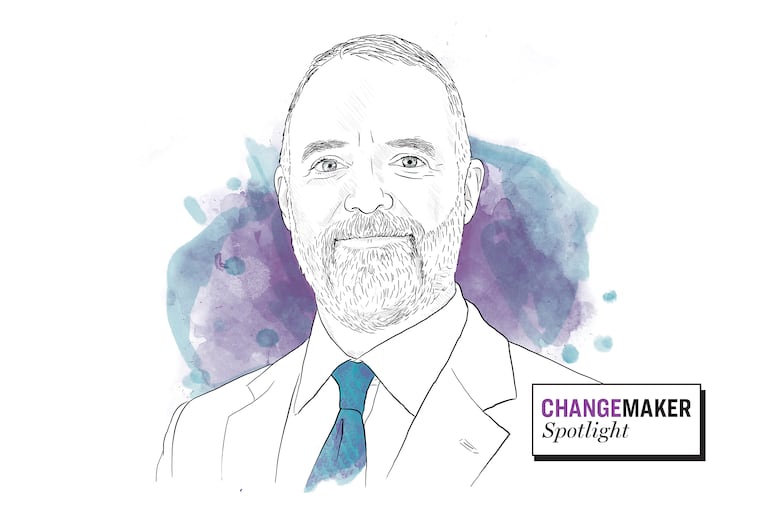
“I am what my youngest child lovingly calls ‘toxically positive,’” David Vahos, 53, the president and CEO of PECO, said. “I am just a glass-half-full kind of person. How that translates into business is that I believe if you put the right people in the room, you can solve any problem,” he said. Vahos has a long-time obsession with Legos, hence the mini-figures of Star Wars characters on his desk. He has books about Revolutionary War heroes on his shelves and a “pinch-me” gratitude for his position as head of the largest deliverer of energy in Pennsylvania. Vahos may be one of the most genial CEOs.
He grew up as the son of Colombian immigrants, who came to America before he was born. His father learned English, entered medical school, and eventually became chief of plastic surgery at a respected Maryland hospital. Because Spanish was the only language spoken in his home, Vahos didn’t speak English when he entered kindergarten. From these experiences, he learned the importance of helping others and to never take success for granted. Now he wants to earn the trust of every PECO customer by investing billions of dollars in the grid; prioritizing personal safety for the company’s 3,000 employees and its contractors and customers; and ensuring that when big storms hit, the power stays on.
PECO has committed to investing $10 billion into the local energy grid in the next five years. Specifically, what are you spending on and how will it work?
Customers get frustrated when the power’s out because of a storm or for any other reason. The work we are doing today and over the next five years is part of our effort to strengthen our infrastructure and build more redundancy into the system. Let’s go back to the June storm when more than 300,000 customers lost power. With newer technology, we will be able to keep the power on for more customers. In some instances, we are dividing up portions of the circuits that deliver electricity to homes and businesses. When there is damage, the system will automatically isolate the line where the damage is located. When that happens, a certain number of customers downstream may lose power. But our investments continue to reduce the number of customers who lose power.
The tree canopy accounts for about 40% of all outages experienced, and we need to maintain the vegetation to keep branches away from lines. We love our trees and we have beautiful trees! So rather than cut them down or lose them to a storm, we are trimming dangerous branches and only removing them when we absolutely must.
We’re also using innovation to help drive our future, like using drones for patrolling outages. When an outage happens, part of what takes time is getting a crew in a truck out to all the possible locations where damage has occurred. With drones, we can see the damage faster and deploy that crew to the right spot, quicker.
On the natural gas side of our business, we are replacing aging pipes with new plastic pipes, which are safer and more reliable. We’re also expanding natural gas service for new customers in areas we’ve never served before.
How will AI impact our energy needs in the future?
AI and the growth of data centers may change our energy needs, because AI requires tons of energy. Right now, data centers consume just about 4% of our energy load, but that is expected to increase to 7% to 12% by 2028. So, it could triple in the next three years. Back in June, Governor Shapiro and Amazon Web Services announced funding for two new data centers in Pennsylvania, one right here in Bucks County, which we look forward to serving. So that will bring more jobs and business to the region, but also a greater need for energy.
Who or what determines the price of utilities in southeast Pennsylvania?
In the state of Pennsylvania, consumers have the option to choose their energy supplier for both gas and electricity.
[At PECO,] we have an energy acquisition team whose job it is to go out and look for the best deal for you. They try to balance how much risk we take, because it can be a very volatile market. And they do a really good job of trying to insulate our customers from severe spikes in price. The energy market is just that; it’s a market that is based on supply and demand, just like any other commodity market. A customer’s bill is broken down into two primary parts: supply and distribution.
For PECO customers, when there is an increase in the cost of energy, that is purely a pass-through cost. There is no markup to the amount we pay and the price we charge. So, in that way it’s different from the gas station. They may mark up the price of gas at the pump a few cents, but we don’t. For us the mark up is zero.
The distribution side of a customer’s bill is what is charged by utilities, which covers the cost of poles, wires, pipe, etc. Those rates are regulated by the Pennsylvania Public Utility Commission.
“We are not just your utility company. We are your partner. We believe intrinsically in the value of strong and vibrant communities. That’s why you see us do so much outside of just delivering energy.”
Punishing heat waves have increased electricity bills this summer. What do you tell consumers who are challenged with increased cost of living, including energy costs?
We are committed to helping our customers get connected to the resources and the aid that is out there and particularly to the support we provide as a company. Last year, we helped 140,000 customers get connected to more than $170 million in energy-related support such as LIHEAP (Low Income Home Energy Assistance Program) and other programs. This assistance is helping customers in this time of higher prices, especially following the six summer heat waves we have experienced. We have support for every customer, from financial assistance to budget billing, a program that takes the seasonal spikes out of bills and makes them more predictable and manageable.
Our team is out in the community meeting directly with customers, helping them understand how they can apply for these assistance programs. Last year, they held more than 360 events.
But even so, we [have] recognized that more help is needed for moderate income households. Those customers who make just a little more than the income qualifications for most programs. Income eligibility for LIHEAP, for instance, is based on a maximum family income of $46,800 for a family of four, or 60% of the state median income, whichever is higher. If you earn a dollar more, you are not eligible for that program.
So, we launched the Customer Relief Fund, which is for customers who earn up to $96,450 for a family of four, for example, but who are still struggling to pay their electric or natural gas bill. We have committed $10 million to this fund for PECO customers who need help.
The Customer Relief Fund pays up to $500 in the form of a credit against your bill. On day one, we had more than 1,300 applications. That shows the need. We expect to disperse anywhere from 15,000 to 17,000 of these credits.
Does PECO have initiatives beyond delivering electricity and gas?
We are heavily involved in our communities, including workforce development programs that are reaching deep into the neighborhoods we serve, because we know we do a great job of training people and providing jobs that could transform a family. We are literally going out to the community to let people know about our workforce development programs. If they’re interested, they can come in and go through our program. If the work ends up to be something they like, then they have the chance to either join us or potentially work for one of our contractors.
How do you think about safety in your operations?
Safety at PECO has always been and always will be priority one. The first thing I said to people when I took this job is that if you are on a job and it’s not safe, I want you to stop the job. It may cost us a little bit more, but I don’t care. We have a complete focus on safety, and that extends to our customers. We are trying to educate people and help them understand some simple rules for safety: Avoid downed wires. If there’s a gas leak, get out and contact 911 and PECO. Don’t dig without calling us first. And never place a ladder near a powerline. If you are ever in doubt, call us.
What feels the most meaningful about your work with PECO?
I am so thrilled and humbled to be here, getting the chance to lead this 140-year-old organization that provides an essential service. We help Southeastern Pennsylvania businesses reach the next level of performance and increase economic development. We serve two million residential customers with electricity and natural gas. That’s millions of people in Southeastern Pennsylvania who depend on us 365 days a year 24/7.
What advice would you give a young person who admires your trajectory?
Stick with it. I moved from accounting to finance shortly after graduating college. I was a CPA for three years, then in 1998, I joined Baltimore Gas and Electric, which would later become part of Exelon. I worked my way up from that moment to today. So, my advice is: You don’t have to leave to get ahead. Keep learning and working hard in the job you have, and you’ll get more opportunities to grow.
When you have an extra free hour, what do you like to do?
My wife and I will walk for hours around Philly, sometimes up to nine miles. We always try to take new routes and see more new things each time.
What’s the first thing you do in the morning when you get to work?
I walk around and say, “Good morning” to everyone I can. Not to ask about work-related topics but just to check in with them. I just like to ask them, “How was your weekend?” or perhaps, “How’s your day?” I want people to be happy here. We spend a lot of time together. At least we can be civil, and be nice, and care about each other.
PHILLY QUICK ROUND
Hoagie vs. cheesesteak? Chicken cheesesteak!
What is the biggest misconception people have about Philly? Growing up in the Baltimore area, you think Philly is a much bigger city. But now, having lived here, I think it’s really more like a bunch of small towns. Walking around, you get the feeling that it’s a community.
What sports team jersey do you wear most often? The Eagles, of course, and right now, the Phillies!
When you think of great Philadelphians, who is your favorite? Benjamin Franklin. If you think about his contributions to Philly and the nation, it’s astounding.
What do you love about the people who call Philly home? How friendly and welcoming they are.
Lucy Danziger is a journalist, an author, and the former editor-in-chief of Self Magazine, Women’s Sports & Fitness, and The Beet.