
Partner Content
The CEO Shaping the Health of Greater Philadelphia
Kelly Munson, Independence Health Group’s first female CEO, is tackling health inequities and the rising cost of care across Greater Philadelphia.
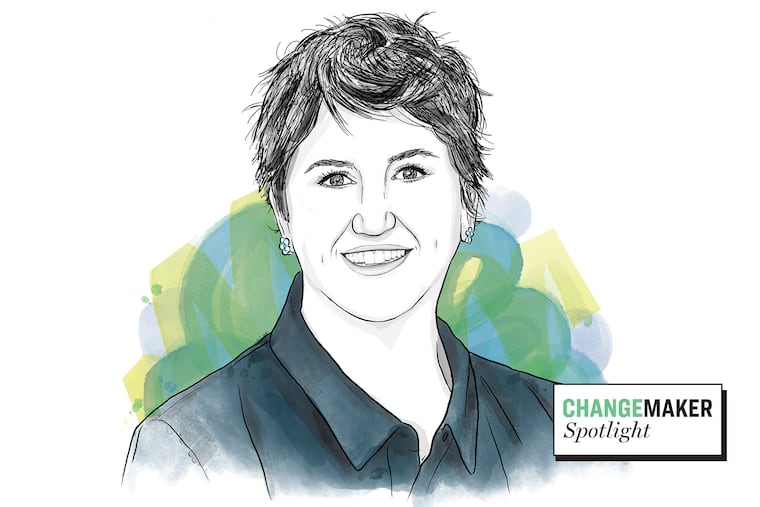
“I grew up admiring my father,” Kelly Munson, the president and CEO of Independence Health Group, parent company of Independence Blue Cross (IBX), said. Thurman Munson was a major league baseball star and captain of the New York Yankees in the 1970s, and Munson said he taught her the importance of hard work, humility, and giving back: “What I loved most was his resilience.”
Now, Munson is bringing those lessons to her own leadership position. This October, she became the first woman to lead Independence Health Group in its 87-year history. The organization, which has 14,000 employees and serves more than 7.1 million people across 32 states, including the District of Columbia, plays a vital role in shaping the health of communities across the region and nationally.
Previously, Munson served as president and CEO of AmeriHealth Caritas, an Independence Health Group company that provides national leadership for vulnerable populations. She was named CEO of the parent company after an extensive national search for the position. Here, she reflects on the moments that shaped her career, her admiration for Philadelphia, and her vision for the future of the company.
Why did you choose to dedicate your career to health care?
When I was in college, I was studying political science and happened to take a nutrition class. That’s where I learned that the [national] school lunch program was, at one point, counting ketchup as a fruit. I remember being stunned by that. Around the same time, I read an article about the impact of inadequate nutrition on schoolchildren, the way missing something as simple as breakfast could lower test scores and hold kids back.
It struck me deeply that through no fault of their own, children were starting the day at a disadvantage, unable to focus and thrive, simply because of what food they had access to. That realization lit a fire in me. I knew then that I wanted to dedicate my life to health care, to helping address these inequities.
What excites you most about being part of Philadelphia and its surrounding communities?
I’ve been here for two years now, and what’s struck me most is how misunderstood Philadelphia can be from the outside. People often see the passionate sports fans, or some of the stereotypes, and miss what the city is truly about. Once you’re here, you realize it’s one of the most soulful, passionate places you could imagine. There’s an energy and pride that runs through everything, from the sports teams to the neighborhoods to the people who call it home.
Independence Blue Cross has been woven into that fabric for generations. It’s not just an employer; it’s part of the lifeblood of the region, serving police officers, teachers, families, and communities across the area. In fact, IBX was the city of Philadelphia’s first health insurer! To lead an organization so deeply rooted here, in a city that’s so alive, is incredibly exciting.
Previously, you were CEO of AmeriHealth Caritas, a Medicaid health plan that is a subsidiary of Independence Health Group. When it comes to AmeriHealth Caritas, what are you the most proud of and what is your vision for the company’s future?
Honestly, what I’m most proud of are the associates at AmeriHealth Caritas. They are extraordinary: mission-driven, compassionate, and deeply committed to serving vulnerable populations. That mission is exactly why I joined the company. At our core, what we do is care for those who need it most.
All our teams go beyond traditional health care. They bring high-touch, community-centered support, with care management programs that truly change lives. For those at highest risk, we assign dedicated care managers who ensure people get the extra help they need. That hands-on approach translates directly into healthier outcomes.
“Health is rarely just one issue; it’s intertwined with many layers of social and medical needs.”
Is there a member story that has made a lasting impression?
There are a few that stay with me, but one comes to mind immediately. I received an email from a man thanking us because, for the first time in 15 years, his elderly mother was able to enjoy a family barbeque with his brother, who had been living with serious mental illness, and they got through the event without a behavioral episode. It was a simple moment, but it meant the world to them as a family.
Through our programs, we helped the man’s brother secure consistent therapy, proper medication management, safe housing, which he had not had, and even a job. Over the next two years, he was able to reconnect with his family, get engaged, and spend meaningful time with his mother. Sadly, he passed away from cancer two years later, but for the first time, he was healthier, happier, and able to be fully present with his loved ones.
That experience reminded me that when we help a member, we’re often impacting an entire family. Health is rarely just one issue; it’s intertwined with many layers of social and medical needs. We consider the whole person and their loved ones.
Independence Health Group has a history of community involvement, including employee volunteer work. How will you carry that forward in your role?
Community engagement is at the heart of who we are. Across IBX and the AmeriHealth brand, employees have contributed more than 122,000 volunteer hours, with hundreds of nonprofits nationwide, not only to support the communities we serve but also to build trust and strengthen the networks that help our members.
We help organizations with technology, infrastructure, and funding to ensure they can thrive. I’m committed to continuing this legacy and empowering our teams to make an even greater difference in the communities we serve.
How is Independence Health Group addressing disparities in social determinants of health?
Social and environmental factors often shape health outcomes even more than medical care itself, especially in Medicaid populations. Many of our members face multiple challenges at once: food insecurity, housing instability, utility needs, limited health literacy. Our goal is to identify those gaps early, connect members with the right resources, and measure whether those interventions truly make a difference. When social gaps are closed, members are up to 7% more likely to get preventive care, and hospitalizations can drop by a third. That’s powerful.
I’m especially proud of our partnerships driving equity at a systemic level. Through the Regional Coalition to Eliminate Race-Based Medicine, IBX worked with 12 health systems to remove bias from clinical algorithms, resulting in more than 1,100 patients moving onto or up the kidney transplant list. By the end of 2024, 188 received kidney transplants. Our Accelerate Health Equity initiative brings hospitals, insurers, and community organizations together to tackle inequities across Philadelphia.
Rising drug costs continue to be a concern for consumers. What strategies are effective for addressing affordability?
It’s a serious challenge. Pharmacy costs have risen more than 230% over the past two decades, driven largely by high-priced specialty drugs. Many of these medications bring real value to patients, but the costs can be overwhelming.
We’re focused on evidence-based strategies that maintain quality while improving affordability. That includes expanding access to biosimilar drugs, which offer the same effectiveness at a lower cost; ensuring members try proven, lower-cost options before moving to more expensive treatments; and helping members receive infusions or medications in lower-cost care settings when appropriate.
We also work closely with providers to ensure members understand their options, like choosing between generics and brand names depending on what’s clinically appropriate. It’s about empowering people with choices that protect both their health and their wallet, without compromising quality of care.
Who do you admire in your personal life or family?
I grew up admiring my father, Thurman Munson. He was captain of the New York Yankees in the ’70s; what I loved most was his resilience. He came from very humble beginnings. They were so poor growing up that sometimes he had to go without shoes or resources, but he performed at the highest level anyway. In high school and college, he would have to mow seven lawns before showing up at the ball park for practice. Yet he achieved something extraordinarily rare while staying grounded, valuing family, and teaching us the importance of hard work and humility.
And my mom was equally remarkable. When he passed [at the age of 32], she carried through those values. She picked right up with that same approach to raising us to be hard-working kids. Having both of them as role models shaped who I am, and I don’t take for granted the lessons they gave me about resilience, humility, and having an impact.
What do you do with a few free hours?
The number one way that I recharge is to do anything with any one of my kids, or all three and my husband, preferably. My favorite thing is to go hiking. So when I can, I get them to go hiking with me.
Do you have a mantra? Any words you live by, or sayings that resonate with you?
Actually I do. I was trying to make a big work decision one time, and I was struggling with it. A gentleman came by my office and he could tell that I had been struggling, and he just leaned in and shared a quote by Goethe: “Things that matter most must never be at the mercy of things that matter least.”
These words helped me decide. It really boils down to knowing what matters most to you.
PHILLY QUICK ROUND
Favorite food: Jim’s Steaks. It’s absolutely fantastic.
Which sports team’s shirt do you wear most often? The Yankees. I’m sorry, but no other baseball hat goes on my head. I’m the daughter of a former captain. It’s family.
What do you love about Philadelphia? Well, of course it’s the fans. You come here, and everyone is passionate, and it’s so much fun.
Who is the greatest Philadelphian of all time? Everyone who fought for freedom and human rights.
I feel most Philadelphian when …. I’m in a sports bar watching an Eagles game.
Lucy Danziger is a journalist, an author, and the former editor-in-chief of Self Magazine, Women’s Sports & Fitness, and The Beet.