
Partner Content
Repairing the World Through Compassionate Care
Robin Brandies, president and CEO of Jewish Family and Children’s Service of Greater Philadelphia, reflects on her path to a career in advocacy and a mission to help Philadelphians in need.
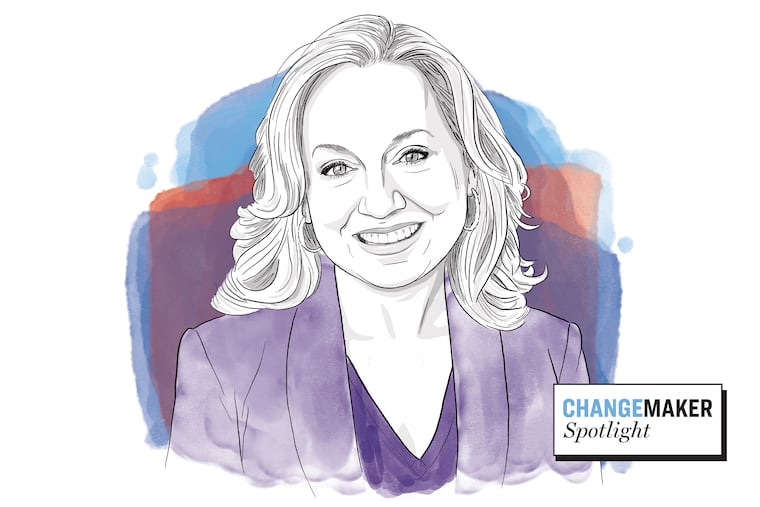
Robin Brandies, 56, left a career in international law more than 20 years ago to find purpose and meaning in work that would impact individuals’ lives. Now, as the CEO and president of Jewish Family and Children’s Service (JFCS), she is dedicated to ensuring that vulnerable Philadelphians facing challenges get the help they need with dignity and care. “JFCS is rooted in Jewish values, especially tikkun olam, which is the idea of repairing the world,” Brandies said. “Being a Jewish organization means leading with compassion, inclusion, and service for all.”
With decades of leadership experience in mission-driven organizations, including serving at St. Jude’s Children’s Research Hospital and guiding services at Abramson Senior Care, Brandies brings authenticity and pragmatism to her work. Under her stewardship, JFCS serves as a lifeline for individuals and families facing challenges. The organization offers counseling, care management, financial assistance, as well as food, clothing, housing, and social connectivity. JFCS is founded on Jewish values of giving and caring for others and is open to individuals of all faiths.
Here, Brandies shares the experiences that drew her to this work, the people who inspire her daily, and the stories that reveal how JFCS transforms everyday lives.
What experiences led you to dedicate your career to social services?
My background is actually in international law. I spent several years in Washington working at the intersection of law, human rights, and foreign policy. I was drawn to that world because I wanted to make an impact on a large scale. I believed the political realm was where real change could happen.
Over time, I realized that doing good in that context was often buried under layers of politics. I remember sitting in a law firm conference room surrounded by stacks of documents, representing the United Nations in a contract dispute, and thinking: This isn’t it. I wasn’t using the best parts of myself, which are my ability to connect with people, my propensity to build relationships, and to care deeply and personally.
That realization sparked a lot of soul searching. I came to understand that meaningful change doesn’t always have to happen on a global scale. Sometimes it’s just as powerful, maybe even more so, to make a difference close to home. That’s what ultimately led me to this work.
How did you find your way to the organization?
Before joining JFCS, I was the President and Executive Director of Abramson Senior Care, another mission-driven nonprofit that had served low-income seniors for more than 160 years. The former CEO of JFCS and I began discussing the idea of a merger between our two organizations, something that could truly strengthen services for older adults in our community.
I knew pursuing that merger might ultimately mean talking myself out of a job, but I believed it was the right thing to do for the people we serve. A few months into those discussions, [then JFCS’s CEO] Paula Goldstein, announced her retirement from JFCS. The organization launched a national search, and I decided to throw my hat in the ring.
How has your own family, faith, or upbringing influenced the way you lead and serve?
I’ve had close family members face a range of challenges, from LGBTQ+ discrimination to mental health struggles, addiction, and developmental disabilities. Watching people I love navigate such complex systems gave me a very personal understanding of what it means to feel unseen or unsupported.
That perspective has deeply shaped how I lead. It reinforced my belief in the importance of dignity, empathy, and access — the idea that everyone deserves to be met with compassion and respect. Even back in law school, before I knew where my career would lead, I wrote my law review paper on gay adoption. Looking back, the thread of advocacy and inclusion has always been there.
When the work feels heavy, what keeps you grounded and motivated?
It might sound simple, but my family, meditation, and time in nature keep me centered. Being in nature helps me recharge and reminds me of the bigger picture.
What personal values guide your decision-making as a leader?
Authenticity is a big one for me. I’d much rather work with someone who’s direct and real than someone who’s polished but insincere. I also deeply value courage. In past leadership roles, I’ve had to make tough, often unpopular decisions that required doing what was right rather than what was easy. I admire and try to be the kind of leader who leads with both honesty and bravery.
Who are the people who inspire you most?
I’ve been fortunate to have mentors who encouraged me to find my own path. Early in my career, I wasn’t loving my work in international securities law, and my boss — former SEC Chairman Harvey Pitt — gave me incredible support. He allowed me to spend a couple of afternoons a week exploring other interests while keeping up with my responsibilities. That generosity and trust taught me the value of caring mentorship and the courage to explore new directions.
Later, Carol Irvine, the former CEO at Abramson Senior Care, inspired me in a different way. After stepping away from work for several years to focus on my family, I returned to a vice president role. Carol saw my potential and supported me without judgment, valuing commitment and authenticity over my time away. Both of them modeled courage, integrity, and belief in people, values I carry into my own leadership.
How do you define success in your role, for the organization and for yourself?
For me, success has a few dimensions. Professionally, I hope to grow more leaders. True leaders don’t create followers; they create more leaders. I also measure success by how well the organization embraces collaboration and partnership within the community, making the most of limited resources. And finally, I define success by ensuring long-term sustainability, setting JFCS up to serve generations to come.
“While we provide a safety net for vulnerable members of the Jewish community, we serve everyone.”
What does JFCS provide for families in need that they can’t easily find elsewhere?
JFCS serves as a gateway to a wide range of integrated services, many under one roof. We address mental health, food insecurity, housing, parenting support, school-based programs, and robust older adult services. Often, a client’s challenge isn’t just one thing — it’s interconnected. Our ability to see the full picture and coordinate care in a holistic way is what truly sets us apart. Human beings are complex, and we acknowledge that and take care of their needs in an integrated way.
Can you share a story that captures the spirit or impact of JFCS’s work?
A few weeks ago, I visited JFCS’ mobile basic needs program, Our Closet In Your Neighborhood. What began as a clothing distribution service has grown to offer food and social work support. At each pop-up shop, clients can select clothing in a respectful, dignified way, while a social worker is on hand to address other needs: housing, health care, or guidance. That seamless integration of care really captures what makes JFCS unique.
How does JFCS balance honoring Jewish values with serving a diverse community?
JFCS is rooted in Jewish values, especially tikkun olam, which is the idea of repairing the world. It serves as a call to action, encouraging individuals to address social and economic inequality, and other injustices through acts of kindness and service. But we see that as a universal human value. While we provide a safety net for vulnerable members of the Jewish community, we serve everyone, regardless of belief or background. Being a Jewish organization means leading with compassion, inclusion, and service for all.
What are you most proud of when you look at JFCS today?
I’m proud that JFCS is a trusted gateway organization, a safety net for people in need with a long history of service. I also admire how nimble we’ve been, adapting to changing community needs. Whether facing food insecurity, benefit disruptions, or other challenges, I’m confident this organization will continue to find solutions and support those who rely on us.
What is the biggest challenge on your desk? What is the biggest opportunity?
The biggest challenge is navigating strategic and financial planning in an uncertain funding environment. The biggest opportunity is the JFCS-Abramson merger. By combining our expertise, we can offer a full spectrum of health care, social services, and community support, creating something truly transformative for seniors in need.
What do you wish people understood better about the families and children you serve?
These families aren’t so different from anyone else. They’re just facing different challenges. No one is free of challenges at one time or another. Anyone can find themselves in a tough situation. What matters is how we respond, and the resilience and courage I see every day in the people we serve is remarkable.
When you think about the future, what do you hope your legacy — and JFCS’s legacy — will be?
I hope my legacy is setting JFCS up for longevity and sustainability so the organization can keep helping people for decades to come. I also want to build lasting partnerships and foster a sense that social services transcend political divides. No matter our opinions on politics or policy, almost everyone agrees we should help people in need. That belief that helping others can unite us is really important to me, and I hope it becomes a defining part of JFCS’s identity.
What have you read recently that has been impactful in your thinking?
I recently read David and Goliath: Underdogs, Misfits, and the Art of Battling Giants, by Malcolm Gladwell, and it really stuck with me. I loved how it highlights the strength and grit people develop when they face challenges. It reminded me that overcoming obstacles can be a source of resilience, and that underdogs often have hidden advantages. It’s a powerful reminder not to underestimate anyone based on appearances or circumstances.
Do you have a mantra you live by?
I’m inspired by Billy Joel’s song, “Vienna.” The idea is simple: Go for what you want, give it your all, and make the most of life’s experiences. But I also love the idea that it’s good to just be here today.
Of course it’s good to strive, to grow, and to have goals. But also balance that with a real appreciation and enjoyment of where you are right now.
PHILLY QUICK ROUND
What’s your favorite Philly food splurge? Philly pizza! And Philly water ice, especially root beer and vanilla.
Biggest misconception non-locals have about Philly? That it’s all toughness and no softness.
What sports team shirt do you wear most often? The Phillies.
Favorite Philly restaurant? I love the Israeli restaurant Zahav. Especially their hummus!
Favorite Philadelphia-born artist? I am a huge Walt Whitman fan.
When you think of the great Philadelphians in history, who is your GOAT? The signers of the Declaration of Independence.
I feel most like a Philadelphian when… I’m at the Phillies game.
Lucy Danziger is a journalist, an author, and the former editor-in-chief of Self Magazine, Women’s Sports & Fitness, and The Beet.