
Partner Content
How Share Food Program is Leveling the Playing Field
Share Food Program’s executive director George Matysik talks about the challenges and opportunities of fighting food insecurity in the greater Philadelphia region.
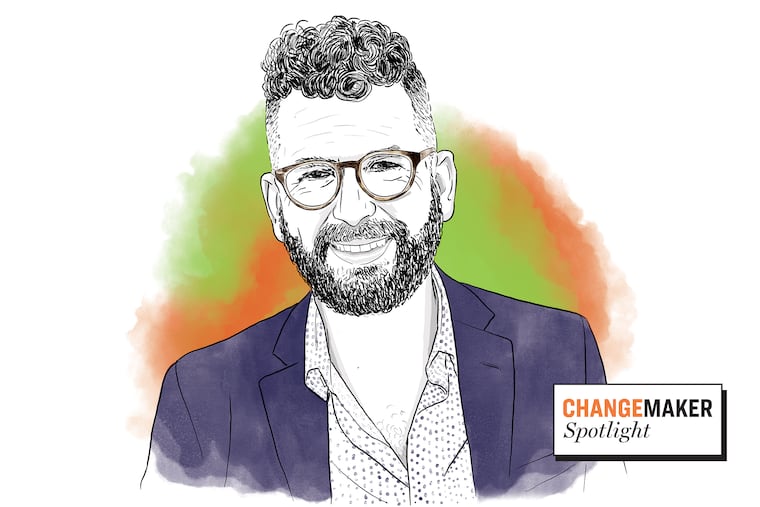
George Matysik, executive director of Share Food Program, paced behind a standing desk in his North Philadelphia office. In the background, the hunger relief program’s warehouse was visible through a window. “There are two slogans that we have around here. One is that food is a human right, and the other is that hunger is solvable,” he said. “It should not be a political question whether or not to feed the hungry.”
Founded nearly 40 years ago, Share Food Program provides access to food, education, and advocacy through a partner network of community-based organizations and school districts. A native and current resident of North Philadelphia, Matysik has a long history of service in the area. Here, he talks about his roots in the city, being part of a community, and being called to service.
Walk me through your career journey from Philabundance to the Philadelphia Parks Alliance and now, Share Food Program. What connects all of these roles for you?
As a high school student [at Mercy Career and Technical High School], I would come over and volunteer here at Share Food, and that’s where I got to know my predecessor, Steveanna Wynn. When I graduated with a degree to be an electrician, I also graduated with a much deeper understanding of service.
After graduation, I ended up getting a job at University of Pennsylvania as a janitor. Once I got there, I found out that I could go to school in the evenings … and get my degree in urban studies. I wanted to learn more about how cities work, what nonprofits do in that space, and politics — all of that blending together.
After a chance meeting while cleaning a professor’s office at 6 a.m., I went to work on a congressional campaign [for Joe Sestak]. I worked for him for a couple years when he was a congressman. From there, I met the then-CEO of Philabundance and I started their government affairs department.
I was doing that up through 2014 and then went to work at the Philadelphia Parks Alliance until my predecessor here at Share Food (a mentor from my childhood days) announced that, after 31 years, she was going to be retiring. My first [thought] when I found out was, “God bless a sucker that tries to fill her shoes.” But as I thought more about what Share Food Program means to the community, I [felt] invested in making sure it was able to move forward in an important way. [I] ended up reaching out and getting the job.
How did these experiences shape how you approach food insecurity and your work at Share Food Program?
I’d say I come at this work with the lens of, “How do we alleviate poverty in our city?” But using food as the gateway to be able to do that. It was so important to me to figure out how we, in the richest country in the history of the world, help relieve the poverty that we have. Not only here in Philadelphia, but across the country.
Is it easier to bring people to the political table through food?
Yes, but I would say that it’s bigger than that. It’s about equity and how we can close the gaps between the haves and the have nots. There are so many societal challenges that we deal with — addiction or crime or things like that — where there isn’t one single easy answer. But with our work, it’s actually really easy, and that’s the frustrating part. It’s literally just getting the resources and food to the folks who need it, and that should be an easy thing to do.
But sadly, we are living in a time where the incredible greed within this country has prevented that from happening. And so we have this widening gulf between the haves and the have nots.
Food is one of the great uniters of cultures and people. It’s also a gateway to communicate all of the other services we can use to help pull people out of poverty. So with many of the organizations that we provide our food to, it’s not just, “Here’s your bag of food, see you next week.” It’s more like, “Here’s your bag of food, and here’s an array of other services, education, programming.”
Since you took over in March 2019, Share Food’s staff and cold-storage capacity has grown five-fold. What made that possible?
It wouldn’t have happened without the foundation that my predecessors built here and within the city. In the time that I’ve been here, it’s really been about engaging the broader Share Food community, whether that’s our volunteers, our board, or our staff, who have been the ones to lead all of this. My goal is to bring some of the resources together so that we can do all of that work, but they’re the ones who really have been able to execute it.
There have been setbacks along the way. Some of those have been external threats, like the pandemic or what we’re seeing right now with the federal government pulling resources away from aid organizations.
“When people are using the working class as a political football, ultimately that means that our fellow humans aren’t getting food.”
Talk to me about how the pandemic changed the way Share helped the community.
The food insecurity rate just exploded in that early part of the pandemic. There were many folks who wouldn’t present as food insecure but felt that way for the first time in their lives because they went to the grocery store and they couldn’t get exactly what they wanted. So many of the folks that we serve live that life every day. The food might be on the shelves, but they can’t afford what’s there.
We were fortunate here at Share. We’d done a $1.5 million food buy in late February in preparation for the pandemic. So while some folks were going to the grocery store and finding empty shelves, our warehouse was bursting at the seams.
And we were really able to quickly react to all of the logistical challenges. In normal times we served about 7,000 seniors in senior centers or senior-only high rises, but by March 2020, many of them closed their doors to the public. So we called those seniors at home, and we said, “Hey, what if we got you a home delivery?” We had our volunteers step forward and start delivering groceries. It grew so much in such a short period of time that we eventually brought DoorDash in as a partner. Now our location here at Share Food is the largest single DoorDash distribution location in the country. That really rapid scaling happened with government support.
How did you see government support evolve?
Throughout the early part of the shutdown, Washington started to handle the health and economic crisis in a bipartisan way: extending unemployment benefits, additional SNAP benefits, and the child tax credit. It was an inspiring example of what can happen when government and nonprofits work together toward the common goal of helping to close that gap again between the haves and the have nots. You had all of these resources go to the folks who we serve and folks that need it the most. By late 2020 and early 2021, we saw the biggest one-year reduction in poverty since 1964, when Lyndon B. Johnson launched the war on poverty.
Sadly, just as this bipartisan unity was helping us get to the root of hunger, it was clear that the economic crisis was staying with us. Washington pulled back so many of those resources. By January 2022, we started to see [poverty] pick up again. It was maybe just a percentage or two [increase] in the first month, but now we’ve seen about 120% increase from 2022 to 2025, because many of those resources have been pulled from folks.
And now on top of that, this year has brought additional cuts to our organization and by extension, the folks we serve. We had about $8.5 million of food and funding eliminated in March from our organization by the USDA under the Trump administration. On top of that, the so-called One Big Beautiful Bill pulled additional resources from SNAP benefits, Medicaid, and other programs. And [the] government shutdown [earlier this year] impacted WIC and SNAP. All of those compounding challenges are really what keep us from being able to do the work in the way that we know it needs to be done. And that’s why we rely so heavily on our community, on our donors to step forward to help fill those gaps at a time when the government’s investment in the working class is receding.
Is there anything you wish people would take away from this collective experience?
When people are using the working class as a political football, ultimately that means that our fellow humans aren’t getting food. And I do wish that we didn’t look at folks as red voters or blue voters, but as human beings. So many in every political spectrum need basic assistance to put food on their table, to put a roof over their heads.
What do you find important about living in the community you serve?
I live within a mile of Share Food. For me, the work that I do here in this neighborhood is all about this community and my home. It matters when one community can come together and show other communities how it can be done.
Change doesn’t happen in Washington — it comes to Washington: it comes from Selma, it comes from Stonewall, it comes from Ferguson, it comes from small communities that folks might not have even known about until they organized.
PHILLY QUICK ROUND
What’s your favorite Philly food splurge, and where do you get it? Georgian Bread up in the Northeast. When I go there, I order everything on the menu.
Favorite Philly small business? Uncle Bobbie’s is the bookshop that I frequent the most.
What sports team do you root for? I would say the Sixers are my “live and die.” The Phillies are a very close second.
What do you wish people knew about the people who call Philly home? I think we get a rap for being a little tough; we are actually, deep down, kindhearted people that care.
Who’s the greatest Philadelphian of all time? I’m reading a lot about the Reconstruction Era in Philadelphia right now, and Octavius Cato was a young Black man who was an incredible athlete and political organizer who was murdered on Election Day in mid-October 1871 for [his] organizing work.
Who is your favorite Philadelphia born artist or performer? Ram Squad was my [favorite] hip hop group growing up. They were North Philly, and that was just raw ’90s Philly hip hop, and I loved them.
What do you do for fun around Philly? I eat a lot of food and then I try to run off the calories.
Do you have a mental health run recommendation? Forbidden Drive in Wissahickon Trail.
What is one place in or around Philadelphia you wish everyone would visit at least once? Independence Hall. I’m going to get emotional if I elaborate too much. I think that the two founding documents that were written in Independence Hall are more important now than they ever have been. And I think it is a wonderful opportunity for a reminder for all Americans of what this country truly was founded on.