
Partner Content
An Infrastructure for Empowerment
Rev. Luis Cortés Jr., the founder and CEO of Esperanza, discusses his path to service and his passion for supporting North Philadelphia Latino communities.
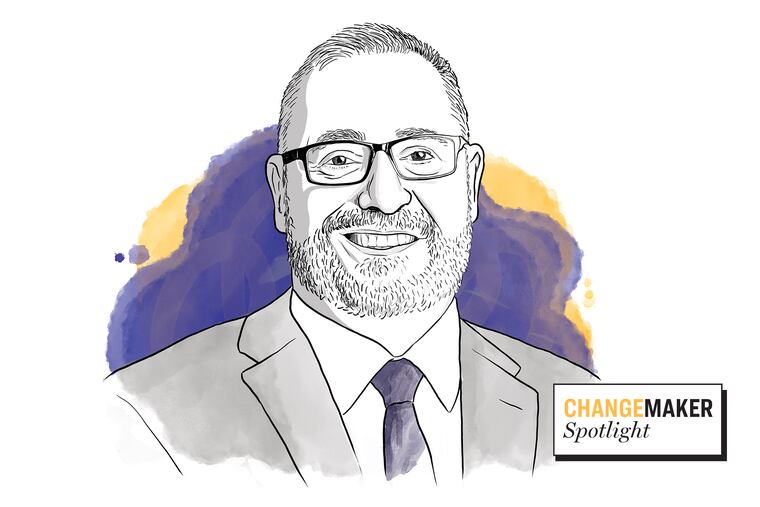
A 2019 recipient of the Philadelphia Award, the Rev. Luis Cortés Jr., 67, has come a long way from working after school at his father’s grocery store, known as a “bodega” in East Harlem. The bodega is where he learned the impact of social connection. “I’ve never seen sociology papers written from the bodega perspective, but there can be,” Cortés said.
Those early observations informed Cortés’ belief that perseverance and financial literacy can help close the gap for Latino communities. In 1986, Cortés founded the nonprofit Esperanza, which means “hope” in Spanish. The faith-based organization is guided by Jesus’ mandate in Matthew 25:40 to serve and advocate for “the least of these” around us.
Known simply as “Rev” by members of the wider Philadelphia community, Cortés is proud of the breadth of services Esperanza offers. The organization improves the lives of those in North Philadelphia through education, housing stability, work training, civic empowerment, and the arts. Over the last 40 years, Esperanza has grown to serve more than 30,000 families annually. Cortés aspires to do more, still.
How did your upbringing in New York City influence you?
The first 10 years of my life were in Spanish Harlem, then we moved to Black Harlem and I attended New York City public schools. My father ran a grocery store, a bodega in the neighborhood, and I worked at the store. Working at the store teaches you a lot about life. You get to know the customers. You get to know their families. You get to know their hopes, aspirations, fears, and you begin to become part of the fabric of their lives. You learn about things that are happening in people’s lives that are very real and painful.
It’s always the same things: the desire to have safety, and also long-term aspirations, [like to] be able to provide for their family.
What experiences in your life or background led you to dedicate your career to social services and community support?
I decided to go into the ministry because I could work on behalf of communities. I went from “I’m going to be a lawyer to help people,” to being a minister to help people. I became immersed in civil rights, both in my theological training as well as [in] my ministerial pursuit.
I worked for a group called IFCO [Interreligious Foundation for Community Organization], based out of the Abyssinian Church under Rev. Lucius Walker. We [supported] self-determination for Puerto Rico. We [supported] civil rights in the U.S., [and] the National Anti-Klan Network. I’m willing to persevere for the greater good of the community. I realized I’m better at civil rights work and community development work.
“The fact is, all human beings are equal and all human beings need to be loved and respected.”
If someone were to ask you about entering the clergy today, what would you advise?
I think that entering the clergy allows you to get into the most theoretical, philosophical, theological thoughts in the history of humankind. All areas of inquiry are open to you.
Esperanza is a faith-based organization. How is faith woven into all that Esperanza does?
The fact is, all human beings are equal and all human beings need to be loved and respected.
That’s our theological and our epistemological premise. Every individual has something to share, both for the growth of their family and for the whole. If you start there, everything [is] about opportunity. Money should not inhibit your growth and your ability to serve others. At Esperanza the religious aspects will always be present as long as we maintain the theoretical framework that all human beings are created by God. And all human beings are equal, regardless of who they are in the present day, because that will not define who you will be tomorrow.
Economics is a touchstone for you and for Esparanza. What’s behind your focus on financial literacy?
I learned early that money is a tool. And no matter how much money you have, it is still a tool, and an important one. How do we learn to use and apply that tool?
The example I use is this: When I worked at my family’s store, I would always take a Snickers bar and a Pepsi. The fact that I wasn’t thinking about it irritated my father. So one day he asks me four basic questions: How many are in a box? How many do I have to sell to break even? How long is the box there? And why is the box there?
He wasn’t upset that I was eating a Snickers bar. He was upset that I didn’t know what [it] meant to the overall economics of the store, and that I was taking that tool [of money and economics] for granted. Money is a tool no matter how little you have. And you need to understand the tool and how you apply the tool.
We need to find ways to educate people about money, about status, immediate gratification versus long-term gratification. You cannot just live for tomorrow, but you should not just live for today. That’s my philosophy.
Is there a division of Esperanza that you hold a soft spot for?
In our art gallery, Galéria Esperanza, we highlight Latino artists from Philadelphia who don’t get a shot anywhere else. There are great composers, [musicians, dancers, and other Latino artists] in history. And so Esperanza Art Center melds [the performing arts, including theater, film, music, and dance, to feature those artists]. And then [another] important [piece] is access: [kids] 18 and under and college students [can attend for] free, and senior citizens are free.
We need to thank the philanthropic community because they made that access possible. We built and paid for our theater, the Teatro Esperanza. I convinced the performing groups, including Philadelphia Ballet, Philadanco and Opera Philadelphia, to come, but I still needed a way to help finance those groups.
We have a library, which is now a community library. The businesses use it in the evenings. It’s reserved for our high school juniors, seniors, and college students during the day. It’s wonderful. We don’t get any government funding for that, but we need it. We hold community school meetings here at Esperanza as well.
Can you share a recent success story?
It is the opening of Esperanza Academy Charter School‘s elementary building in September. It took us almost 12 years to gain permission, raise the money to build, and open our elementary school. Once we finally got permission we had to raise money. It took five years to raise $40 million for the construction. We have a state-of-the-art facility. It is a physically beautiful space for our children. The parents see it and cry.
There have been a lot of recent changes politically on the local, state, and national levels. How has Esperanza had to shift its focus?
Civic rights, civic engagement have become a larger focus in the more recent months. We have an immigration division, so we put out training sessions to know your rights.
We also have explained to staff what their rights are. We’ve explained to business owners [and] clergy. A lot of clergy thought that ICE cannot come into their church. The law is clear. ICE can walk into your church on a Sunday morning while you’re preaching. They cannot go into any space that’s private. So put “private” on every door.
Learning the rules of engagement is important, even though the rules of engagement are not always followed by the government these days. But knowing them is important because they will affect your case as you move forward.
We’re proceeding with our work. People need housing. People need food. People need education. Nothing changes. We have to continue to let people know that this political climate is abnormal. But you need to understand that while it’s abnormal, it may be legal. And if it is legal, you need to understand what your rights are. You need to understand where you must comply.
What is the biggest challenge for Esperanza in the coming year?
The biggest challenges include programming for senior citizens around heat mitigation, cuts to our college (a Hispanic-serving institution), and reductions in community development funding. We had to make tough decisions. The loss of funding meant we couldn’t hire a group of people, and hard-working people had to be let go.
These are fundamental issues about being humane and they’re very important. I see a lot of inhumaneness by governmental structures these days.
Esperanza turns 40 years old in 2026. Are there any special events in the works?
We will be celebrating our 40th anniversary in April with a sponsored event. And then, we also are celebrating the 25th anniversary of [Esperanza Academy Charter School] and the 25th anniversary of [Esperanza College of Eastern University].
We’ll be holding an event the day before our 40th anniversary event [that is] a musical celebration with a jazz orchestra band for the community [celebrating] 250 years of Latin music. We’ll have big-band-style performers with Pablo Batista heading it up. Pablo was this year’s Grand Marshal for the Puerto Rican parade. He’s one of the top percussionists and a global icon who’s been living in [Philadelphia] for his whole life.
What do you want your legacy to be?
That’s easy: to build Esperanza College into one of our major universities in Philly. And the institution will compete and become the mechanism by which people can become empowered.
PHILLY QUICK ROUND
What’s your favorite Philly food splurge? I have two: the Tres Leches cake from Vickie’s Sweets and the homemade ice cream from Helados Chupi Chupi.
Favorite Philly restaurant? Tierra Colombiana. You can get the best Latin food in the city.
Favorite Philly small business? Cafe Tinto and Amy’s Pastelillos, both in North Philly.
Which sports teams do you root for? I was a Sixers fan before I came to Philadelphia. All the other teams I became a fan of after I moved to Philadelphia. They grow on you. The Flyers, Phillies, the Eagles are in a renaissance period right now.
Favorite Philly artist, performer, musician and/or band? Percussionist Pablo Batista and the band Low Cut Connie.
What elements of Philly remind you of your childhood neighborhood of East Harlem in NYC? Any time I walk into a bodega and I can talk in Spanish, it’s like a time warp.
What’s one place in or around Philadelphia everyone should visit at least once? Teatro Esperanza.
What do you wish people knew about the people who call Philly home? We always get up. We get knocked down, but we always get up. It’s part of that Rocky theme. There’s a lot of persistence in Philadelphia. It makes our city more dynamic.