
Partner Content
Meet Project HOME’s New President and CEO
Strawberry Mansion resident Donna Bullock doesn’t believe in just overcoming challenges. She believes in embracing them and making them part of a narrative for change.
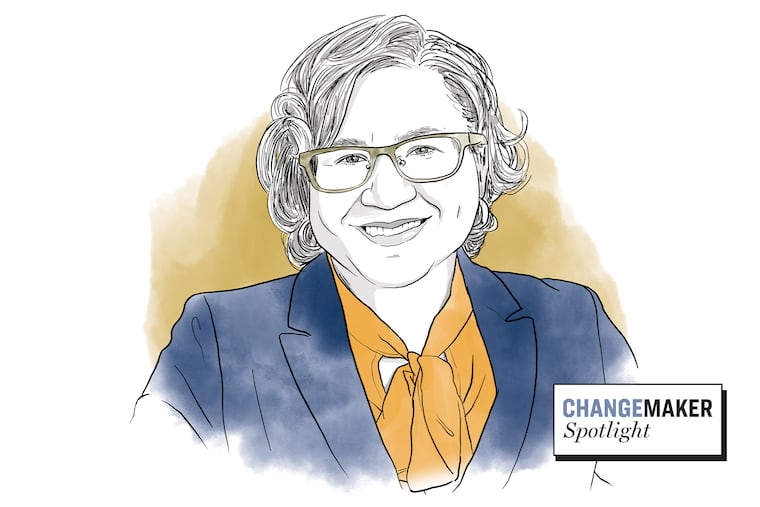
The former state representative, lawyer, and longtime community advocate Donna Bullock is now leading one of Philadelphia’s most respected nonprofit organizations, Project HOME. Named its president and CEO in July 2024, Bullock brings lived experience and a deep sense of justice to the organization’s mission of eradicating homelessness. The child of a single mother, she grew up relying on the network of local church soup kitchens in New Brunswick, N.J. “But my mom and grandmother taught me something powerful there, not just how to receive help, but how to give back,” she said. “I may have gone there for a meal, but I also had to wash dishes, help a senior. That sense of community responsibility has always stayed with me.”
Founded in 1989, Project HOME has built more than 1,000 units of supportive housing, manages more than $150 million in net assets, and has become a national model for holistic solutions to homelessness. In this conversation, Bullock reflects on the legacy she has inherited, the systems she hopes to shift, and the very personal stories that shape her leadership.
Project HOME was founded in 1989. How is the landscape different than it was 36 years ago? What does the cause of ending homelessness look like now?
We remain true to the founding vision of our co-founders [Sister Mary Scullion and Joan Dawson McConnon]: none of us are home until all of us are home. When we look at that statement, it’s really this commitment that we have to our fellow human beings, to see them as our brothers, and sisters, and neighbors, and fellow Philadelphians. Our work doesn’t end until we can really say that everybody is home and that we all have a role in the work it takes to solve homelessness.
That also remains true: we still believe we can solve homelessness. We can do that. It will require everyone to play their part.
The founders of Project HOME and the folks doing this work 20, 30, 40 years ago really believed we could achieve functional zero homelessness in Philadelphia. They were on track to doing that. But what they could not expect was a pandemic. They could not expect the opioid crisis. And they could not expect the scale of the affordable housing crisis. These three national, if not global, issues have deeply impacted housing and homelessness here and across the country.
In the 1990s, Project HOME fought a four-year legal battle that culminated in a landmark Fair Housing victory, securing the right to build supportive housing at 1515 Fairmount. Over the years, the organization has also built a holistic model of care. How will the organization’s legacy continue under your leadership?
Sister Mary and Joan, our founders, built this amazing organization with a deep understanding: to address homelessness at its roots, we have to address housing, employment opportunities, medical care, and education. We will continue that. We will continue to build supportive housing, provide services, and support individuals on their journeys, through recovery and into stability.
We’ve also always remained on the front lines. We’ve always been an advocate, and we’ll continue to be one. I believe the skillset I bring as a legislator and as a lawyer, with experience in both city council and Harrisburg, will only amplify and support the legacy I’ve inherited. That means being a voice for those in our care, those at the core of our mission, especially now as we navigate policies from the federal government, HUD, and the Department of Health, that will impact the people we serve on a very personal level.
“We still believe we can solve homelessness. … It will require everyone to play their part.”
You were raised by a single mom. You’ve experienced some of the very issues you’re now helping others navigate. How did your upbringing shape your worldview?
Those lived experiences absolutely shaped my sense of justice and community obligation.
My family relied on resources like the local soup kitchen in New Brunswick. I watched that soup kitchen evolve too. It was once just different churches offering meals on different days. But in the ’80s, around the same time Project HOME was founded, they came together, formed a nonprofit, created a central location, coordinated the schedule, and started offering meals seven days a week. That showed me the power of nonprofits when they work together in the best interests of the people they serve.
And that’s what I want to carry forward. No matter where we go next, we keep the people we serve at the center of our decisions.
You studied criminal justice at Rutgers and earned your law degree at Temple. You could have taken different paths. Why law?
Honestly, I was a very naive young person who wanted to change the world. I thought, law school is how I’ll do that.
And I did well: I got good grades in tax law, property law. But I took a class called “Law and Community,” and one of my classmates worked at Project HOME. We talked about their work in the 19121 ZIP code. I was planning to move into that same community.
When I graduated, I asked myself, “How am I going to change the world with corporate law?” That’s when I found my niche supporting nonprofits and small businesses as a legal services attorney. I helped make sure they stayed compliant and stable, because they were providing critical resources to the community. It was a way for me to give back what I always believed didn’t belong to me: my law degree belonged to the community.
That work exposed me to leaders like [Philadelphia city] council president [Darrell] Clarke and others, and it led me into public service. Eventually I was working with organizations like Project HOME from the outside. Now I get to work with them, and lead them, from the inside.
In a past interview you said you “took the leap” in 2015, and ran for political office, eventually winning a special election to represent Pennsylvania’s 195th district in the state House of Representatives. What compelled you to leap?
I’ve always answered the call to service. Did I plan to run for office? No.
But a few people came to me and said: “You should consider this. You’re the right fit.” I gave it a lot of thought. I had been hosting a women of color leadership breakfast at my house every year, encouraging other women to run. When this opportunity came up, many of them looked at me and said, “Donna… it’s your turn.”
What is it like to run for and hold office?
It’s a vulnerable position to be in. But because I was led by service, it didn’t feel like I was putting myself in the spotlight. It was a shift, of course — personally for family, and professionally for my career — because it wasn’t the direction I was going. But it was an amazing detour. I was able to bring in my skillset as a lawyer and as an advocate into this legislative space, see the issues that I was passionate about on a statewide level, and advocate for those issues with folks who weren’t as aligned. Being on that stage in Harrisburg really helps you to become a stronger advocate for issues that are really important for you. You have to work a little harder to see where other folks are coming from and try to reframe those same issues so you can get buy-in.
Yes, it becomes about consensus building.
Yes. I spent time across the state meeting folks in their district. “What does this legislation look like in your district? Well, now I understand why you don’t support it. Let me show you what it looks like in my district, and maybe we can find a way to get to the middle.” That coalition building is so important, and I think has helped already in the work that I’m doing here at Project HOME.
You’ve said, “There are many challenges, but you don’t overcome them. You accept them, embrace them, and use them to effectuate change.” That’s a powerful reframing. What’s a moment in your career where that philosophy took hold?
There was a moment in Harrisburg when there had been a series of shootings in my district. Young people had lost their lives to gun violence. I stood on the House floor and talked about it, not just as a legislator, but as a mother of two Black boys in North Philadelphia.
I talked about what it meant to walk my children past blocks with candles and teddy bears. I didn’t want to just argue the policy; I wanted them to understand the experience. My colleagues had met my boys. I wanted them to understand that these weren’t abstract lives; these were our kids. While it didn’t move the legislation, it did bring more people to the table to say, “I need to understand this.” There were a couple of colleagues who met with me separately. With one in particular, we started having regular coffee meetings to talk about the differences in our districts and in the things that our constituents wanted.
And that’s the power of storytelling. Whether it’s on the House floor of the state capitol, through the media, social media, in a small group, or just a conversation that one of our residents may have with somebody else, storytelling can really move people. It can move legislation, policy, and resources.
PHILLY QUICK ROUND
Favorite Philly food indulgence: It’s got to be water ice, right? My favorite water ice is the neighborhood spot called King’s in Strawberry Mansion.
Favorite Philly small business: Everybody needs a spa day. My favorite is a Black woman-owned spa in Brewerytown called Remedy Spa & Wellness. I’ve been going to [owner Cari Young’s] spa for years. Back when I was a state representative, she would host Black women’s business roundtables there. Even when I didn’t have a spa appointment, she would let me just sit in the space. Even her lobby had that sense of relaxation, Zen, and getaway, and I always appreciated that.
Sports teams you love or root for: I’m at Project HOME, so it’s got to be the Phillies. [The Phillies are a Project HOME partner.]
Greatest Philadelphian of all time: Marian Anderson. Just for what she stood for at the time. Standing firm in her art form, but also in advocacy and what she meant to the community, and her grace and beauty in doing it.
What do you wish people knew about the folks who call Philly home? We got grit. But we are also just a loving group of folks. Everybody’s welcome. What I love about Philly is once you become family, they just welcome you with open arms. We may be a little aggressive with the love. But it’s love.