
Partner Content
Empowering Philadelphia’s Latino Communities
Jannette Diaz, the president and CEO of Congreso de Latinos Unidos, reflects on her upbringing and discusses the nonprofit’s human-centered design approach.
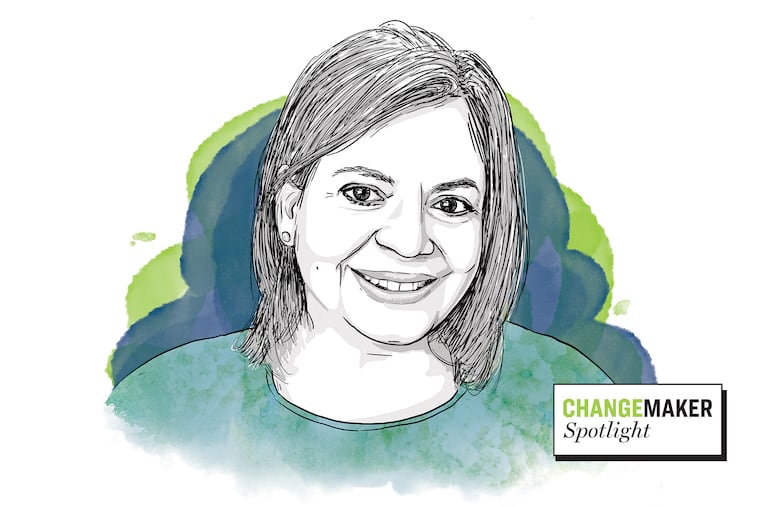
The youngest of seven children, Jannette Diaz, 59, grew up a few blocks from Congreso de Latinos Unidos, whose mission is “to enable individuals and families in predominantly Latino neighborhoods to achieve economic self-sufficiency and well-being.” Her professional journey within Congreso spans more than a decade. Before her promotion to chief executive in March 2023, she served for two years as chief experience officer, a role created “to boost the organization’s culture.” Diaz also led the organization’s Health Promotion & Wellness division from 2015 to 2021, overseeing the Congreso Health Center, Esfuerzo HIV/AIDS Program, Latina Domestic Violence Program, East Division Crime Victims Services, and Breastfeeding Program.
Diaz leans into the words “Mi casa es su casa” that appear on a mural near the front door of the nonprofit’s office. “We want folks who come in to feel like they’re coming home,” she said. Her forward-thinking leadership of Congreso’s 200-plus staffers is evident in the organization’s achievements. In the past year, the nonprofit has served nearly 14,000 individuals across education, health, workplace, housing, and parenting and family services. Congreso has been recognized with a Top Workplace Award for seven years running.
Diaz recently served on Gov. Josh Shapiro’s Advisory Commission on Women, where she helped identify and advance solutions for aging with dignity across the Commonwealth. Here, Diaz discusses her upbringing and her advice for young leaders.
What experiences led you to dedicate your career to social services?
Growing up, I was always surrounded by family … the essence of learning what community is, the values of giving back, being compassionate — that all shaped me. I got a degree in sociology with a concentration in juvenile and criminal justice.
I have a soft spot for youth, especially those who are challenged or are either in a dependent or delinquent stream in the court system. That sparked my work. It ties back to leading with heart and knowing I’m helping someone else along the way.
How has your upbringing influenced the way you lead Congreso?
I’m the youngest of seven. There was a lot of love in our home, a lot of resilience. Sometimes it was challenging for my parents, but my father was really good at budgeting and ensuring that he tapped into any available services that were in the community if we needed support.
Education was first and foremost, for all of us. This was a requirement. We didn’t know if we could afford college. We had this saying in Spanish, “Todo se resuelve.” We resolve everything. I was able to learn about opportunities to go to school, and I ended up going to college.
I’m still working in the very community we grew up in. Congreso has been around for 48 years. My father knew that he could tap into whatever Congreso was offering for services, but he was also really good at being a connector. In the community, [if] someone came into the grocery store [where he worked] and needed something, he would say, “Hey, there’s that program where they offer this. Hey, go down here — they’ll offer you assistance with your LIHEAP [Low Income Home Energy Assistance].” Those are some of the things I learned from him just by listening to the conversations.
What qualities do you admire in your staffers?
They’re caring individuals. It doesn’t matter where they sit in the organization. They want to help, whether it’s direct services [to clients] or their colleagues. I work really hard with our executive team to create spaces where they feel they have a voice of influence, that we are all leaders in our own right.
We host resource seminars, and sometimes those are just [about] understanding ourselves and [learning about] self-care, [and] psychological safety. The work they do is really heavy. Sometimes it could be triggering. We do hire people from our community. There are folks in the community who know [the] people who are coming in to get service. So we try to be mindful and make sure that we invest in them.
I say to new hires, “Thank you for saying yes to Congreso.”
“We’re here for the community; the community is not here for us.”
Are there particular areas you’re hoping to address in the coming years?
Economic self-sufficiency [and] mobility [are] key for all of us. When we designed our services we wanted to make sure that we took a holistic approach. We have five core pillars [for] programming: education, workforce development, family parenting services, health, and housing.
In the housing space, the team supports individuals with preventing [the] loss of homes, like foreclosures, and also supports them in [what] we call “vital living.” [For instance,] we have a tax support site, and we help bring in over a million dollars back [in refunds] into the community almost every year. [The service] is free for folks on the tax site. We also support folks who want to become first-time homebuyers. We take them through counseling and credit building, and we partner with mortgage lenders and banks. Last year, we had 100 individuals purchase a home for the first time here in Philadelphia — and it’s amazing.
We want to make sure that we are designing and integrating services for greater impact that [will then] scale. Well-being and mental health, we need to explore that. And we don’t have to recreate the wheel; it’s [about] collaboration and partnerships. We have the partnership with PHMC [Public Health Management Corporation]. So what else can we do? We want to strengthen our relationships, and then we want to scale up those programs.
How are you addressing health and education?
One of the greatest assets Congreso has instituted in the past couple of years is to bring a health center on site that we operate in partnership with PHMC that serves over 3,000 patients a year in general medical care [and] preventive care. [We] do it in a way where it’s built into the community, where we’re a trusted partner, and it’s really helpful for folks to get care. We have a small panel of pediatricians, and I would like to expand that, but we’re able to provide [care for everyone] from children to adults.
In education, we provide OST [out-of-school time] services. It’s not just, “Let’s play basketball.” There’s a bit of that, but we have STEM curriculums. We also provide their home tutoring.
The William Penn Foundation supports our work with two schools where we are [supporting] kindergartners through the third grade with Read by 4th, a program that encourages families to read together. We’re [also] going to be [supporting] the students through a homegrown model that we call Éxito, whose goal is to reduce high school dropout rates and increase graduation rates. The data says that when a child is on track by fourth grade, the chances are better for them to succeed in school [longterm].
Federal cuts have meant that many nonprofit organizations are losing funding. Has this affected Congreso?
At this juncture, we are leaning into our reserves. We are heavily government-funded. So we are feeling this every day, compounded by the other [cuts] that are happening nationally with Medicaid and SNAP benefits. This is why it’s so critical to have the ability to fundraise for flexible funding that you can put in reserves and be really fiscally prudent. We did implement a hiring freeze for some roles.
We have some funding from some of our city contracts and feel confident that as long as we are still getting paid by the city, our runway will take us through this calendar year. But we are still looking at different scenarios should this go into 2026, and I’m sure that we’re not the only nonprofit that will be making some really tough decisions at that point.
In 2018 Congreso updated its mission, with outcomes tied to its “womb-to-work” service model. Explain the evolution of its mission since its founding 48 years ago.
It is important that organizations remain agile, remain relevant to their community. We’re here for the community; the community is not here for us. In 2018, we took a look at our mission and a hard look at our data. At that time, we were serving over 17,000 individuals with over 30 programs, and yet only between 10-12% were accessing another service within Congreso. We went on what we now call our “Mission to Impact.” It’s focused on program design, integration, and data, because we need that data to let us know if this is truly working.
The motivation was [someone] needing a service but having to go to five different places. That’s exhausting. We also took a look at who we were serving and how we wanted to make an impact. That’s when we started saying we need to start from [the] “womb to work” [i.e., offer a range of support to people from pre-infancy to adulthood].
Explain Congreso’s human-centered design approach. How has it helped transform program outcomes?
We’re working on becoming a learning institution around innovation. We brought in a consultant who taught us human-centered design [HCD] work. HCD is a problem-solving approach that prioritizes people’s needs, behaviors, and contexts. Congreso applies the technique, called “mapping,” to many of its processes, including intake. We all learned how to map problems. When there’s an issue, we start mapping.
We’ve developed our own Congreso Human Service Design Toolkit to design our services. We use that to facilitate conversations [with] clients to ensure that what they need aligns with what we can provide. We are really, really intentional now about what we say yes to as an organization.
For example, we have multiple workforce development programs and what we’re seeing is folks want to get a certification but sometimes what’s happening in their lives prevents them from doing that. We can have case management services support [them] … so that [they] can then focus on working to get that certification.
What is your greatest wish for the next generation of leaders serving the Latino communities in Philly?
There’s a lot of pressure, now more than ever. Always be rooted in your purpose, even through the most challenging times. It’s okay to adapt, but you don’t have to assimilate.
PHILLY QUICK ROUND
Favorite Philly restaurant? My Philly cheesesteak [place] is Steve’s and my food [place] is Tierra Colombiana.
You don’t know Philly until you’ve… experienced a live Mummers Parade [on New Year’s Day] and had a real Philly cheesesteak.
What do you wish people knew about the people who call Philly home? Behind our grit, we have a lot of heart and resilience, and we show up for one another.
Favorite Philly artist, performer, musician and/or band? Boyz II Men. “A Song for Mama” was the mother-son dance at my son’s wedding.
What’s one place in Philadelphia everyone should visit? Go up and down North Philadelphia Fifth Street on El Centro de Oro, [the] Golden Block. You will feel and hear (and if you want, taste) the richness of Puerto Rican culture.
You grew up in the North Philadelphia area. What has changed the most and what is still the same? When I look out my window here, I’ll look to one side and see gentrification: the new buildings. When I look to the other side, I see my childhood. I see the bodegas, I hear the honking and the music. I see that richness of community.