
Partner Content
How the Philadelphia Flyers are Making Hockey Accessible to Everyone
The organization is diversifying hockey and expanding the sport by renovating rinks, organizing free hockey clinics, and more.
Sticks. Full-body pads. Ice skates. Helmets. Masks. Seventeen thousand square feet of ice.
It takes courage, curiosity, and no small amount of resources for a kid to step onto the ice and try hockey for the first time — and even more of each to stick with it once they’re hooked on the thrill of the game.
But in Philadelphia, the Flyers are working hard to change that. Their goal: to make the sport universally accessible.
“Our mission is to make sure hockey isn’t just a game for the few. It’s a game for everyone,” Cindy Stutman, the SVP of community relations and executive director of Flyers Charities, said.
The team’s efforts to diversify the sport and grow participation are paying off. Flyers programs like Learn to Play, led by the NHL, and Girls Try Hockey for Free clinics, are helping newcomers get on the ice. Recognizing that access to ice is a major barrier, Flyers Charities has invested in rink revitalizations to make the sport more available. As a result, hundreds of new players have laced up and joined in.
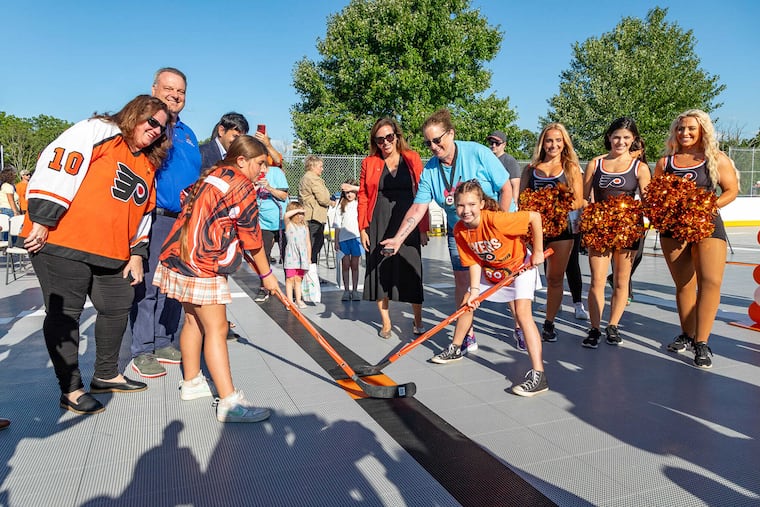
They’re also expanding ball hockey — an ice-free, gear-light version of the game played on foot. It’s cheaper, more accessible, and a powerful entry point for kids who might not otherwise have the chance to try the sport. The hope is that these grassroots efforts will ignite a movement — growing the game and building a new generation of lifelong fans.
The Flyers efforts to diversify and expand the sport run parallel to the national campaign launched by the NHL in 2018 that aims to grow the sport through grassroots programs. The latest data shows that it’s working: 10% of players in this year’s NHL draft were of Black, Indigenous, Asian, and Latin American heritage — the most diverse draft in the league’s history.
Making Hockey for Everyone
At the center of the Flyers’ efforts to make hockey more accessible for players is the sport’s costly financial barrier to entry. The organization has committed resources to a slate of initiatives designed to expand the sport to those who haven’t traditionally been able to afford to play, especially underserved young people from communities in and around Philly. “Suiting up can cost upwards of $1,000 if you count skates, helmet, stick, protective padding, and ice time,” Rob Baer, the Flyers’ senior director of community relations and hockey development, said.
The organization is slashing barriers and opening doors — stick by stick and rink by rink — by offering scholarships to hockey programs and by partnering with community groups that offer free equipment, among other strategies. One such organization is Ed Snider Youth Hockey & Education, which, in addition to hockey training, offers academic support, mentoring, and life skills development to help students succeed on and off the ice.
“The hope is that every kid who wants to hold a stick and learn to skate or play ball hockey can make that goal a reality,” Baer said. “It’s important to find ways to overcome those financial hurdles upfront. It’s an expensive sport, and if people are involved in it for a long time, they’re going to be spending some money. But we don’t want to discourage them with costs right at the outset.”
The Flyers’ Learn to Play program, which has introduced kids across Philadelphia to hockey, is one way the Flyers are lowering the financial threshold to the sport. The program ensures that children in the greater Philadelphia region have the chance to experience the thrill of lacing up skates and taking a shot on goal by providing free or low-cost gear and instruction. Flyers Charities also provides Learn to Play scholarships to individual families across the Philadelphia area that cover the full cost of the program.
“The program really does give them that jump start,” Julia Dougherty, the vice president of Flyers Charities, said. “In 2023 it was a pilot program, but last year we were able to get it out there to all the rinks — and we saw an over 700% increase in participation year-over-year.” Dougherty went on to note that the goal is not just to introduce kids to the sport, but to support them through an entire hockey career.
Feedback from families inspired a Flyers Charities investment that allows Philadelphians to donate gently-used gear that can be used by other players. “We now have a partner — Leveling the Playing Field (LPF) — with a warehouse and the infrastructure to store it. When people drop off gear in good condition, it can be sorted to make sure that kids who need it, get it,” Dougherty said. “It’s a great program, because instead of having it just sit in someone’s garage, now someone can use it and play hockey.”
Another way that the organization is increasing access to hockey is through their Rink Revive program, which refurbishes local ice and ball hockey rinks throughout greater Philadelphia, including underserved communities. Rink Revive is funded in partnership with Flyers Charities and in partnership with the NHL.
One of the program’s first projects was a rink in New Hanover, which was preserved when then-11-year-old ball-hockey players Natalie Van Druff and Lilly Walter advocated to save the space from conversion into pickleball courts. The renovation cost $200,000 and was funded by Flyers Charities.
Growing the Game for Girls
The Flyers are also investing in getting more girls interested in hockey. While women’s hockey has grown rapidly in recent years, opportunities for girls to play competitively remain limited. The organization is building a strong pipeline for future players through initiatives like mentorships with female players and spotlighting female athletes.
Other examples of Flyers’ programs that encourage girls to enter the sport include partnerships with organizations like the Philadelphia Liberties Girls Program, which trains girls to play hockey. The organization also hosts dedicated girls-focused clinics at community rinks that are safe, welcoming spaces for first-time players, and Girls Hockey Weekend events, where young athletes can meet role models and build their confidence in the sport.
“The hope is that every kid who wants to hold a stick and learn to skate or play ball hockey can make that goal a reality.”
“We’ve made a very concerted effort, especially over the last few years, to get more girls into hockey. Over the past three years, we’ve started a Girls Learn to Play program, so young girls, ages five to nine, can learn the sport alongside other girls and not feel intimidated,” Baer said. “For girls who haven’t even decided whether or not learning to play is something they want to do, we started a Girls Try Hockey for Free event. It’s just one day, and we give them all the gear. We’re bringing out an all-female coaching staff, so we help them feel comfortable. We want them to have fun,” Baer said. Last year, 200 girls were introduced to the ice by these two programs, Baer said, and the Flyers are hoping for more this coming season.
These programs offer young women the chance to play and the confidence gained from excelling at a male-dominated sport. Further, when girls interact with women role models — from youth coaches to professionals — they can better envision their futures in the sport.
The efforts to expand interest in hockey do not stop at girls — the Flyers Charities and community relations teams have numerous efforts that focus on growing the game for all youth, including programming in elementary schools and summer camp programs.
A Place for Military Veterans
The Flyers are also introducing military veterans to the sport. The Flyers Warriors is a hockey program for disabled U.S. military vets that started in 2019 with 20 military veterans who wanted to play hockey. They won a national championship their first season and have now grown to 150 players.
“We view the Warriors as an extension of our brand,” Baer said. “Anytime there’s a Charities event, or the Carnival, or the Gritty 5K, they show up in huge numbers to volunteer. They’re such great partners. The Flyers Warrior program is one we’re really proud of.”
The Flyers have also partnered with USO to provide on-ice experiences that link active-duty service members to Flyers players and coaches. “Our main focus in these military programs is to give back to those who have served, and just to be able to say, ‘Thank you,’” Baer said.
Inspiring Inclusion
For the Flyers, giving people access to gear and time on the ice is just the tip of the iceberg. “For many, hockey becomes more than just a sport. It’s a gateway to opportunities, to learn teamwork, and to have a sense of belonging,” Dougherty said.
Their efforts prove that expanding hockey and focusing on inclusion isn’t just good for the sport’s image — it’s essential for its future. “We want to change the way people connect with hockey, not just as a sport, but as a community and a way of life,” Baer said.
This impact isn’t limited to the Delaware Valley. The Flyers model for community-based hockey development is drawing attention across the NHL as teams look for ways to break down barriers and grow the sport that so many already love.
LUCY DANZIGER is a journalist, an author, and the former editor-in-chief of Self Magazine, Women’s Sports & Fitness, and The Beet.