
Partner Content
Plugging into Support
How PECO and United Way of Greater Philadelphia and Southern New Jersey are supporting Philadelphians as they manage rising energy costs.
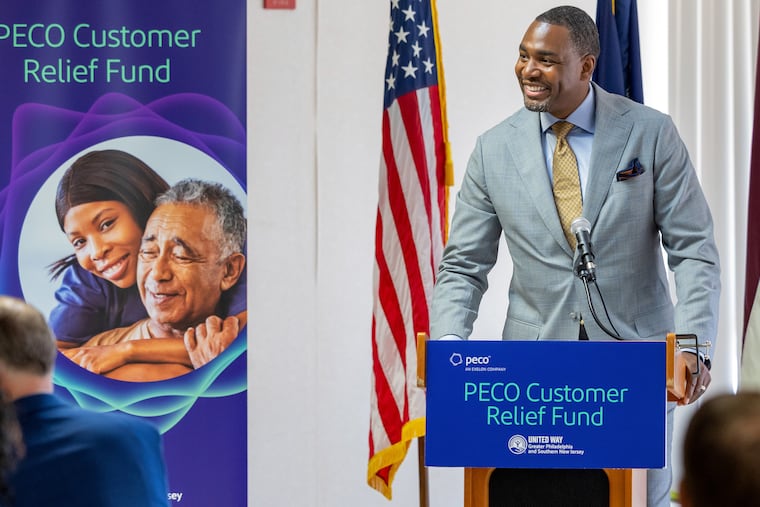
Do you feel like pretty much everything has gotten more expensive? You’re not imagining it. Food, electronics, housing, transportation, and utilities are just a few of the many things that cost more than they did a year ago. And just when it felt like egg prices were leveling out and grocery costs were becoming more predictable, utility bills have gone up nationwide, including in the Philadelphia area. For people living paycheck to paycheck, any change in month-to-month expenses can be an unwelcome surprise. Relief is on the way. This month, PECO and United Way of Greater Philadelphia and Southern New Jersey expanded an initiative to provide support to the Philadelphians who need it the most.
Providing relief
According to the American Council for an Energy-Efficient Economy, a quarter of low-income households across the country spend 15.2% of their annual income on energy bills, exceeding the 10% threshold typically used to define severe energy burden.
To help address the growing energy burden of low-income Philadelphians, PECO recently launched an expansion of its 2025 Customer Relief Fund in collaboration with the United Way affiliate. The program adds an additional $2.5 million of support for low-income customers across Southeastern Pennsylvania. The funding comes from Exelon, PECO’s parent company, and will be provided to eligible customers in the form of one-time grants of $750. The total grants offered will increase the amount of customer assistance provided through the PECO Customer Relief Fund to $12.5 million. The program is part of a larger, comprehensive, customer-first strategy called “The Exelon Promise,” which is focused on delivering immediate customer relief, strong protections amid growing demand, and long-term solutions to address the root causes driving higher costs.
“If the problems are vast, the solutions need to be vast.”
The 2025 Customer Relief Fund grants were designed to help customers with incomes between 151% and 301% of the Federal Poverty Level (FPL) (roughly $48,503 to $96,450 per year for a family of four), an oft-overlooked population. “Typically, when we talk about the federal poverty level, a lot of programs are designed to serve people who fall within [a] lower income range,” Carniesha Kwashie, PECO’s director of corporate community impact, said. Support programs traditionally focus on populations with household incomes between 0% and 150% of the FPL (those who make less than $48,503 for a family of four), she said. This leaves a crucial gap in support. “You have this customer base that needs help but may not know how to ask for help because support has not been available to them,” she said. With more than 9,000 households benefiting from the 2025 program so far, this year’s March 2 expansion addresses the needs of customers with household incomes between 0% and 150% of the FPL.
Low-income Philadelphians spend around three times as much of their income on energy as middle-income neighbors do, making recent increases in energy bills disproportionately impactful. As a result, PECO’s one-time grants can make a marked difference for the people who need it most. “A great number of times, a one-time shot in the arm can send you into a better direction,” Bill Golderer, the president and CEO of the United Way affiliate, said. “I think if you can just reach stability, then you can build for the future.”
Systemic challenges
The rising cost of powering, heating, and cooling our homes and businesses is fueled by infrastructure and demand. Summer peak demand is now forecast to grow around 3.6% per year over the next decade — about 12 times the 0.3% annual growth rate projected in 2021. That ultimately translates to higher electricity bills for consumers. “There are two main factors we’re watching [that contribute to higher bills],” Kwashie said. First, critical updates that PECO is making to its infrastructure to maintain and strengthen the local grid. And broader market conditions that utility companies treat as a pass-through cost drive bills up. “The energy supply prices that make up about half of a customer’s bill have been steadily increasing on the supply portion, which we do not control,” she said.
PJM Interconnection, the regional transmission organization (RTO) that coordinates how and when electricity moves across 13 states and the District of Columbia, runs auctions that determine the price of power and secures commitments for energy capacity from power plants up to three years in advance. The goal of the auctions is to guarantee that the grid will have enough resources on standby to meet peak demand — during heatwaves, for instance, or severe cold snaps.
As more energy-intensive devices are plugged into the grid — data centers, for instance — capacity prices and the cost of power have surged. This increased demand, paired with retiring electric generators and less generation being built, has led to a supply-demand imbalance. Supply costs on the average residential bill have increased by as much as 80% or more over the past several years, meaning customers are paying more for less as demand outpaces supply. These increases are ultimately passed on to consumers, which is why energy bills have shot up as of late.
And though data centers drive the bulk of the headlines about power consumption, they only eat up around 25% of the nation’s energy demand. One study found that the remaining 75% of demand is driven by reshoring manufacturing to create a more resilient domestic supply chain. In those cases, new facilities are constructed to produce semiconductors, EV batteries, and pharmaceuticals in states after decades of globalization.
Scaled problems require scaled solutions
This confluence of conditions has spurred PECO to implement an “all-of-the-above” strategy for meeting energy demand, through advocacy and on-the-ground support for its customers. “We’re working very closely with regulators and policy makers to ensure that the right frameworks are in place to support the energy transition,” Kwashie said. This includes supporting legislation to expand access to renewable energy for underserved populations, investing nearly $10 billion over the next five years to upgrade Southeastern Pennsylvania’s energy grid and build more energy capacity. PECO is also pushing for structural changes to the capacity markets that are driving up bills. Still, the rising costs continue to hit Philadelphia households hard. With the 2025-2026 Low-Income Home Energy Assistance Program (LIHEAP) in Pennsylvania expected to close April 10, 2026, PECO has tapped community partners to help provide support after that date.
It all started with a phone call from PECO to Golderer. “They said, ‘We have this storm coming, which is that the demand for energy is going to be dramatically increasing. Supply is decreasing; that means cost increases,’” Golderer said.
With that, the United Way affiliate began working with PECO to set up a process to distribute the one-time grants of the 2025 Customer Relief Fund, allocated by Exelon. “We try to align interests, to align capital, to drive impact. That’s what we do,” Golderer said.
But a straightforward form can still be a barrier to entry. To ensure PECO was reaching as many potential grantees as possible, the United Way affiliate tapped into eight trusted community organizations in areas that would be most impacted by energy rate increases. “Person-to-person contact is really important: making sure that we had on-the-ground support, a door you could walk through, and someone there to help you, especially if asking for help in this way is new to you,” Kwashie said.
Customers can learn more about the PECO Customer Relief Fund and apply through PECO’s website. These one-time grants supplement PECO’s existing initiatives, like the Customer Assistance Program (CAP), which allows customers to pay a percentage of their total household income as their monthly PECO bill, and the Matching Energy Assistance Fund (MEAF), which provides relief for customers facing a temporary hardship.
“If the problems are vast, the solutions need to be vast,” Golderer said. “If the problems are scaled, the solutions need to be scaled.” The challenges facing America’s energy grid are complex but not intractable. By partnering with federal, state, and local organizations, and working with local policymakers, PECO is working to meet those challenges where they land hardest — on the households and the communities that make up the region it serves.