
Partner Content
Born in Philly, Built for the World
Temple’s campuses in Rome and Japan are entering a new era of growth and shaping the university’s next chapter.
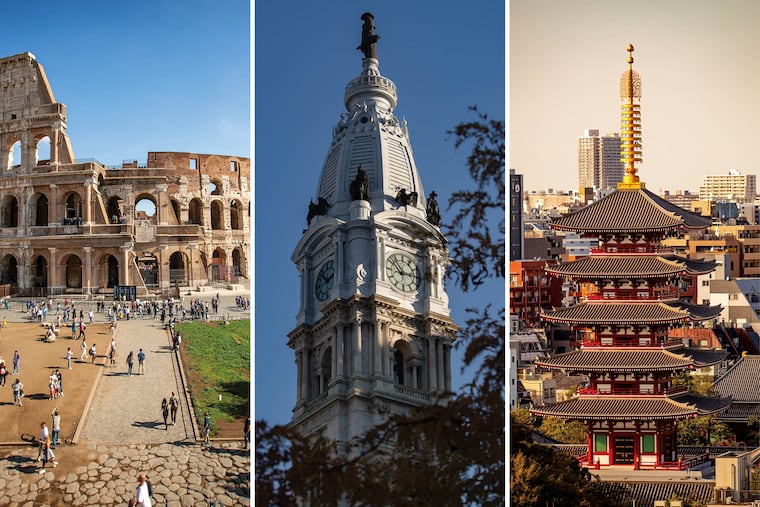
Ayushi Chaudhary started her Temple degree not in North Philadelphia, but in Europe, at the university’s Rome campus. By her junior year, the international business major was itching to go abroad again, this time to Temple’s campuses in Kyoto and Tokyo, Japan.
“There aren’t many universities that have multiple international campuses, so I thought to myself, ‘When else am I going to be able to study internationally with such ease?’” she said.
When Chaudhary graduates at next spring’s Commencement ceremony in the Liacouras Center, her college journey will have spanned four Temple campuses on three continents.
“Students today understand that the world is more connected than ever before, and they want an education that is equally connected,” said Temple University President John Fry. “Our campuses in Rome and Japan allow students the opportunity to immerse themselves in other cultures while working toward their four-year degrees, and that’s an experience very few universities can offer.”
“Our rapidly growing international presence is one of Temple’s greatest strengths.”
Chaudhary’s college journey is indeed unique. Temple is one of just a handful of American universities to have two or more international campuses. Even fewer offer four-year degrees at their international campuses, as Temple Rome and Temple Japan do.
“Our rapidly growing international presence is one of our greatest strengths,” Fry said. “Our campuses in Rome and Japan are thriving, dynamic learning environments that prepare our students to succeed in an increasingly interconnected world. Their momentum reflects the growing demand for a global education.”
Building on 60 years
Temple Rome recently celebrated its 60th anniversary, a milestone that offered an opportunity to reflect on its history while also looking forward to its next chapter.
This fall, the campus began offering four-year bachelor’s degree programs in disciplines like business, communications, computer science, and biology. It already has plans to add five more programs in fall 2027.
“Expanding our international campuses is imperative, but we must expand thoughtfully,” Fry said. “Adding four-year degrees was the natural next step for Temple Rome. Students have been asking for the opportunity to complete their degrees there. We know that more students will come to Temple Rome because of these degrees, and we are prepared to accommodate that growth.”
Temple Rome enrolled 318 study abroad students in spring 2026, and 23 full-time students pursuing four-year degrees there this fall. Fry believes total enrollment at the Rome campus could double in the coming years.
The addition of four-year degrees builds on Temple Rome’s longstanding reputation as a study abroad destination for Temple students and students from 78 colleges and universities across the United States. It also comes after the campus relocated to its new home near Piazza di Spagna in 2024.
The new campus sits in the heart of Rome, a short distance from UNESCO World Heritage sites such as the Spanish Steps, the Pantheon, and the Colosseum. This historic setting gives Temple students unique access to the people, places, and artifacts they study in class.
One of those students was Kareena Kumar, a 2026 graduate of the Fox School of Business, who analyzed the ancient Italian sculpture Apollo and Daphne for her art history final project. She gave her presentation in the shadow of the sculpture itself, inside Rome’s Galleria Borghese.
“Students learn better when they experience the subjects they are studying firsthand — something they get to do at our international campuses,” said Fry.
A model for the future
As Temple Rome looks forward to its next chapter, Temple Japan offers a glimpse of what the future could hold. Temple Japan has offered four-year undergraduate degrees since it opened in 1982. It is the oldest and largest English-speaking university in Japan, and its enrollment continues to soar.
Temple Japan has experienced 270% undergraduate enrollment growth over the past 10 years. This fall, it welcomed more than 1,000 new students, bringing total enrollment above 4,000 for the first time.
In response to the growing demand, Temple Japan opened a second campus in Kyoto in January 2025.
Unlike its bustling location in Tokyo, the world’s most populated city, the Kyoto campus is in a smaller, more rural setting known for its blend of ancient traditions and modern innovation. Kyoto is home to 17 UNESCO World Heritage Sites, as well as the headquarters of companies like Nintendo and Kyocera.
It has also quickly become a popular destination for Temple Japan students. Kyoto enrollment has grown rapidly since it opened, surpassing 300 students in the spring 2026 semester and exceeding 450 students this fall.
And Temple Japan expanded once again this fall with the opening of its Hillside Center in Tokyo. The eight-story, 75,000-square-foot facility is just a short distance from the university’s city campus, and between 800 and 1,000 students are expected to take courses there each semester.
Much like Temple Rome, students are coming to Temple Japan for an educational experience they can’t get anywhere else.
During a trip with Temple Japan’s International Business Society, Chaudhary learned about manufacturing and logistics from Tokyo’s Chronogate facility, a hub for international commerce operations.
Later, she went to the Kyoto campus for a yearlong research project that examined the effects of tourism on the city.
With stops in Rome, Japan, and Philadelphia, Chaudhary got the global education she came to Temple to find.
“Students like Ayushi show what’s possible when a university truly commits to its global vision,” Fry said. “Stories like hers shouldn’t be reserved for a few fortunate students. We want that experience to be an integral part of a Temple education, and we’ve built a global presence to reflect that.”
Discover more of Temple’s global story.