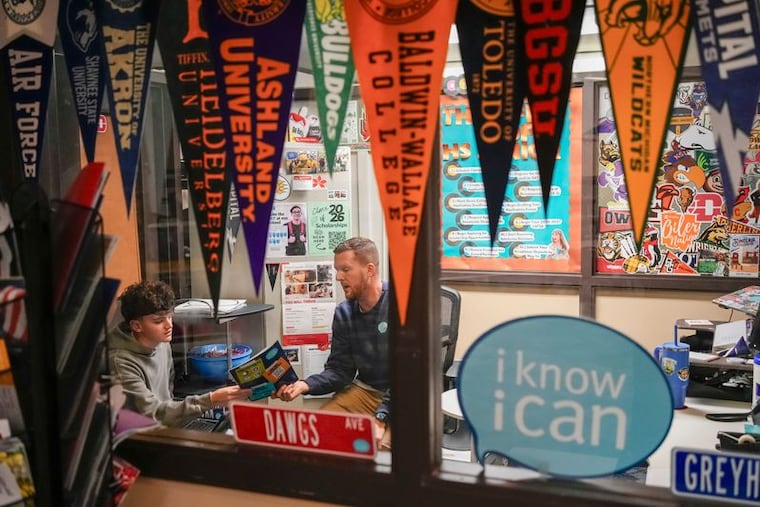
We reported today on Rowan College at Burlington County's decision to cancel college transfer fairs and remove four-year colleges' materials from campus, limiting their campus outreach. The community college is minimizing four-year schools' on-campus presence in order to promote its new partnership with Rowan University.
Many four-year colleges' presidents and administrators are upset by the moves, which come at a time when colleges are competing more than ever for a dwindling pool of traditional college students. The RCBC president says his community college is now acting as a hybrid of two-year and four-year school, and that his school is now competing with four-year colleges and universities.
To report the story, I sat down with Paul Drayton, the president of RCBC, for a 90-minute interview.
I also reached out to several colleges and related groups. We could not include full statements or comments in the story, so they are published below.
RCBC is one of TCNJ's top five feeder schools for transfer students. This fall, 63 RCBC students applied to TCNJ and 23 transferred.
Tom Beaver, a spokesman for TCNJ, sent the following statement:
We're concerned about the effect that this change will have on the articulation agreement we have in place with Rowan College at Burlington County, which is supposed to encourage qualifying community college students to take advantage of the statewide transfer program.
How can TCNJ and other four-year colleges provide prospective transfer students with information about all of the options available to them if we're prohibited from any marketing and outreach activities on campus?
—
John Fink, a research associate at the Community College Research Center at Teachers College, Columbia University, said by phone that he was interested in seeing the long-term impact of RCBC's decisions.
For many community colleges, Fink noted, most students transfer to a handful of schools. Community colleges that have done well supporting transfer of students, he said, have focused on guiding students through the process of choosing a program, enrolling in the right courses, and transferring credits.
What these really effective partnerships were doing was investing in really clear programmatic pathways for students who wanted to transfer to a particular school, in a particular major. They're really having faculty get together … in some places, big urban centers for instance, where there are tons of potential destinations, that can sometimes layer on another layer of complexity for students in trying to decide, they don't have to just decide what their major is going to be, they have to decide this unique combination of major and institution. … That can be very difficult, which is why the colleges trying to do this are trying to identify their key partners.
RCBC and Rowan University administrators often frame their partnership as about access in that way: Aligning curriculum, easing transfer obstacles, and guiding students into the appropriate program. I asked Fink about whether those benefits — focused on one university — could negatively affect those students who want to transfer to another school, or might have gone elsewhere.
That's a really important question to ask, and I don't know for sure what's happening. But all I can really kind of say is we've done this research where we've gone to these successful partnerships and in some ways they were helping students actively explore what they're interested in and then showing them, 'Here are the well-trodden paths that other students have gone on and it's worked out for them … and we didn't see any case where it was just kind of like, where community colleges were exclusively working with universities. Sometimes that happened just by nature of where they're located. … This is an interesting case.
NJ Association of State Colleges and Universities
The New Jersey Association of State Colleges and Universities represents public four-year colleges and universities except for Rutgers University and New Jersey Institute of Technology. Rowan University was a member of the ASCU until it became a state-designated research university in 2012, at which point Rowan became an affiliated member, voluntarily remaining part of the ASCU.
Michael Klein, CEO of the ASCU, sent the following statement Friday morning, after the story was published:
One of the strengths of New Jersey's higher education network is the array choices available to students in terms of academic programming and geographic location. This diversity is a particular benefit for students transferring from New Jersey's county colleges. The implementation of the Comprehensive Statewide Transfer Agreement in 2009 significantly improved the ability of students from our county colleges to transfer to the public four-year institutions. In fact, the number of transfer students from the county colleges to the senior public colleges and universities increased 47.5 percent between 2006 and 2014. We should continue to find ways to expand choices for county college students and to build more bridges toward their educational goals.
NJ Council of County Colleges
The New Jersey Council of County Colleges represents all 19 schools and is largely an advisory and advocacy group; it does not have regulatory jurisdiction over the schools. Jake Farbman, a spokesman for the council, spoke with me by phone Thursday.
I can certainly see both sides of this, but again, we don't play a role in this. I know it is creating some — a lot of talk between and among the four-year colleges, I know it's something that's very different from what the other community colleges have done for the past 50 years of their existence, but this is the choice that RCBC has made and that's the choice that they're going to have to see how that plays out as far as students transferring to Rowan University.
Farbman said he would be interested in seeing the results of the partnership over the years.
We'll have to see how it plays out and does that create a stronger pipeline for students who start at that community college? And if they choose to transfer to Rowan University, does it create a stronger pathway? Does it improve retention, number one, does it improve graduation rates, does it ultimately improve degree attainment both at the two-year and four-year level? If the answers to all of those questions over a longitudinal period of time is yes, then it was the right decision.
James O'Hara, vice president for enrollment management at Rider University, sent the following statement:
Rider University has been notified by Burlington County College that their November transfer fair was cancelled and that the individual recruitment visits that Rider scheduled for this fall were also cancelled. It was shared with our transfer counselor that Rowan College at Burlington County was no longer allowing four-year institutions to recruit on their campus.
This communication was a surprise and disappointing. We have had a strong relationship with Burlington, welcoming around 30 students a year to the Rider campus as transfers.
This new decision by Burlington's leadership limits opportunities for its students. Rider is working with other colleges and universities in the state to see how we can get Burlington to reconsider this policy. If they do not, we will pursue other options with our colleagues in the state to find a way to connect with Burlington students.
—
RCBC's partnership is modeled off Rowan College at Gloucester County, which first partnered with Rowan University a year before RCBC. Frederick Keating, the president of the Gloucester County school, said in a phone interview that his school would continue to hold transfer fairs and allow on-campus materials from four-year colleges.
We practice that we want to give our students open ideas, open access to any and all opportunities. We think the premier opportunity is just that, it's the premier relationship.
We do hold out a premier relationship. … But it is just that — a premier relationship, not an exclusive one. I'm not going to say that I can agree with that kind of approach.
—
Keating said one reason not to restrict promotion of other programs is that the Rowan University programs' merits — including convenience of remaining on campus and lower cost — would be clear to students.
We don't see any jeopardy, we don' t see any risk, we don' t see any kind of reason to be more restrictive in promoting opportunity. We' re here for them. So you put everything out, we give them everything we can give them, they will make the choice. As we say, they will vote with their feet, and it's their choice. It's their choice and their money.
Paul Drayton, the RCBC president, said the decisions regarding branding and promotion were made by him. Joe Cardona, a spokesman for Rowan University, said the university had no involvement with the decisions.
I don't think it limits students' access at all. They still have agreements with other institutions, plus it doesn't limit any access.
A lot of community college students … are geographically bound, so their choices are, if they're geographically bound, really your choices are Rutgers-Camden and us, so this doesn't limit a student from transferring to Rutgers-Camden by no stretch of the imagination.
It's a testament — it's a compliment, obviously — it's a testament to the quality of the education that we provide. And they feel our partnership is so strong and it's their choice to do so, so we'll continue with our partnership with both RCBC and GC and let students decide where they want to transfer to. Now, by no means are we standing in the way of students transferring anywhere.
—
Mike Sepanic, spokesman for Rutgers-Camden, sent the following statement:
Burlington County families are no different than anyone else: they want for their children to have as many opportunities for, and pathways to, success as possible. South Jersey families and employers need more, not fewer, routes to the careers offered by a bachelor's degree.
In fall 2015, 7.7 percent of Stockton's new transfer students attended RCBC at some point prior to enrolling at Stockton; in fall 2016, 5.7 percent of Stockton's new transfer students had attended RCBC. Overall, RCBC students in the past two years have represented about three percent of Stockton's total undergraduate student population.
Harvey Kesselman, the president of Stockton University, sent the following statement:
We were surprised to learn of the ban, but are confident that Rowan College of Burlington County will change this new practice. Stockton University has a long-standing and productive relationship with RCBC and hopes to continue this in the future. RCBC students have always been an important part of the Stockton community.
Karin W. Mormando, director of undergraduate admissions at Temple University, spoke by phone about RCBC's decision.
I was certainly disappointed at first read. We have a really strong relationship with RCBC, in fact they're our only New Jersey community college where we have a guaranteed admissions agreement, so we just have a longstanding history of being responsive to their students, so I was certainly disappointed to not have the opportunity to be on their campus.
I know that good students will find us, no doubt, here at Temple, through our Transfer Tuesday programs and other initiatives, but I was definitely disappointed.
—
I asked Mormando about the importance of on-campus outreach.
There's something to be said for being able to make on-campus connections, it certainly makes it easier for the student who is running from class to work to commuting … it makes it a little bit easier for them to immediately connect while on that campus to whatever the next step might be. … Transfer fairs really give that opportunity to really make those connections.
Mormando said she believed potential transfer students will still be able to find information on Temple University, but that the student now has to "raise their hand" by visiting RCBC's transfer center or contacting Temple directly.
Having an option of one isn't a strong option. … I have no doubt that their counselors will continue to refer students to additional opportunities, but without a doubt they will be pushing very strongly the newest agreement.
Wilmington is one of RCBC's "on-site partners" to teach courses on the RCBC campus. That partnership remains in place. A spokeswoman said the university has already removed its signs and promotional materials from RCBC.
Peter A. Bailey, the university's vice president of external affairs and international admissions, said in a statement:
We will continue to maintain our presence on the RCBC campus while offering students quality alternative degree completion programs.