Americans lack skills for digital world jobs
In the wireless world, Marc Andreesen sees "profound" opportunity that Americans are poorly prepared to exploit
"Software is eating the world," says Marc Andreessen, who has parlayed his early investment in onetime Web browser leader Netscape into a career as a leading U.S. tech investor.
In this Wall St Journal article, Andreessen seeks to tie such seemingly disparate phenomena as the LinkedIn-Groupon IPO bubble, Hewlett-Packard's dislocation under ex-SAP boss Leo Apotheker, and Google's much-debated plan to buy Motorola Mobility, into a coherent, profitable story, which sounds on balance like good news for the U.S., except there's one big problem. Excerpts:
Last week, "Hewlett-Packard (where I am on the board) announced that it is exploring jettisoning its struggling PC business in favor of investing more heavily in software, where it sees better potential for growth. Meanwhile, Google plans to buy up the cellphone handset maker Motorola Mobility.
"Both moves surprised the tech world. But both moves are also in line with a trend I've observed, one that makes me optimistic about the future growth of the American and world economies, despite the recent turmoil in the stock market." Andreessen says, the massive dislocation of US business into the digital-wireless world is just heating up:
In this Wall St Journal article, Andreessen seeks to tie such seemingly disparate phenomena as the LinkedIn-Groupon IPO bubble, Hewlett-Packard's dislocation under ex-SAP boss Leo Apotheker, and Google's much-debated plan to buy Motorola Mobility, into a coherent, profitable story, which sounds on balance like good news for the U.S., except there's one big problem. Excerpts:
Last week, "Hewlett-Packard (where I am on the board) announced that it is exploring jettisoning its struggling PC business in favor of investing more heavily in software, where it sees better potential for growth. Meanwhile, Google plans to buy up the cellphone handset maker Motorola Mobility.
"Both moves surprised the tech world. But both moves are also in line with a trend I've observed, one that makes me optimistic about the future growth of the American and world economies, despite the recent turmoil in the stock market." Andreessen says, the massive dislocation of US business into the digital-wireless world is just heating up:
"In some industries, particularly those with a heavy real-world component such as oil and gas, the software revolution is primarily an opportunity for" dominant companies like ExxonMobil and Shell, which have bought up PA gasfields.
"But in many industries, new software ideas will result in the rise of new Silicon Valley-style start-ups that invade existing industries with impunity. Over the next 10 years, the battles between incumbents and software-powered insurgents will be epic..."
"But in many industries, new software ideas will result in the rise of new Silicon Valley-style start-ups that invade existing industries with impunity. Over the next 10 years, the battles between incumbents and software-powered insurgents will be epic..."
Despite the stock market's spin-out, "this is a profoundly positive story for the American economy, in particular," Andreessen insists. "It's not an accident that many of the biggest recent technology companies—including Google, Amazon, eBay and more—are American companies. Our combination of great research universities, a pro-risk business culture, deep pools of innovation-seeking equity capital and reliable business and contract law is unprecedented and unparalleled in the world."
But: "Many people in the U.S. and around the world lack the education and skills required to participate in the great new companies coming out of the software revolution." Americans aren't encouraged to study software. Companies rely on imported engineers and techs, even salespeople:
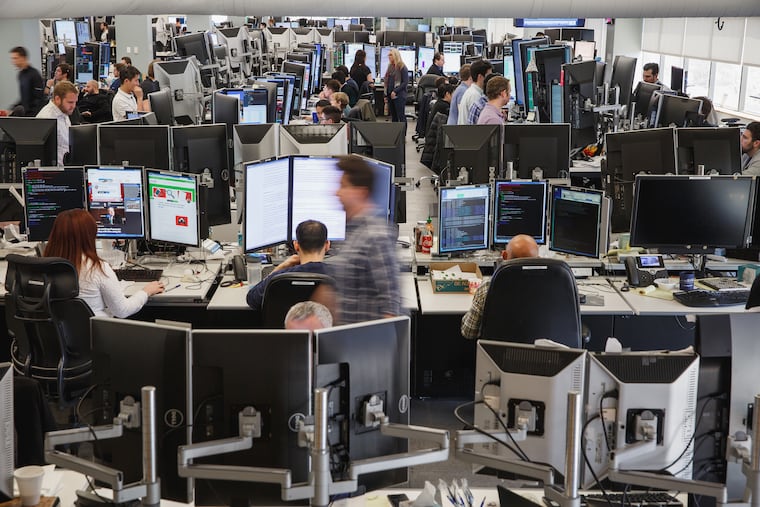
"Every company I work with is absolutely starved for talent. Qualified software engineers, managers, marketers and salespeople in Silicon Valley can rack up dozens of high-paying, high-upside job offers any time they want, while national unemployment and underemployment is sky high.
"This problem is even worse than it looks because many workers in existing industries will be stranded on the wrong side of software-based disruption and may never be able to work in their fields again. There's no way through this problem other than education, and we have a long way to go." Read what Conshohocken-based Josh Kopelman of early-stage tech investor First Round Capital said about the same problem here.
But: "Many people in the U.S. and around the world lack the education and skills required to participate in the great new companies coming out of the software revolution." Americans aren't encouraged to study software. Companies rely on imported engineers and techs, even salespeople:
"Every company I work with is absolutely starved for talent. Qualified software engineers, managers, marketers and salespeople in Silicon Valley can rack up dozens of high-paying, high-upside job offers any time they want, while national unemployment and underemployment is sky high.
"This problem is even worse than it looks because many workers in existing industries will be stranded on the wrong side of software-based disruption and may never be able to work in their fields again. There's no way through this problem other than education, and we have a long way to go." Read what Conshohocken-based Josh Kopelman of early-stage tech investor First Round Capital said about the same problem here.


Joseph N. DiStefano | Columnist

Joseph N. DiStefano | Columnist

Joseph N. DiStefano | Columnist



Joseph N. DiStefano | Columnist


Joseph N. DiStefano | Columnist


Joseph N. DiStefano | Columnist

Joseph N. DiStefano | Columnist