Unisys at 30: Selling cybersecurity, cloud service to its old hardware customers (Update)
Stealth, ClearPath, outsourcing
Unisys, which claims direct descent from the first modern computer and was founded to challenge IBM for global tech leadership, marked 30 years since its founding Thursday, with an ice cream party at its Blue Bell headquarters.
That's a homey style appropriate to a company that, with 21,000 mostly overseas employees and $3 billion in yearly sales, is best known these days for selling computer-security systems, cloud-systems management, and outsourcing for banking and governments.
The company in 2016 "is focused on differentiation with cutting-edge cybersecurity and advanced algorithms that we've created over the past few years," sais Inder M. Singh, chief strategy and marketing officer.
"Our Stealth security product has achieved NSA certification and global recognition for securing networks. Unisys serves enterprises and governments in over 100 countries, and offers solutions that range from securing borders to serving the world's top airlines with our AirCore and Logistics products."
In many cases, Unisys is updating its old hardware customers for the cloud remote-servers era: "While the brand is 30 years old, our products are anything but. Many of our clients have been with us for decades, and we are now migrating them to the cloud to help secure their futures," Singh concluded.
Sales dropped from over $10 billion in 1987, its first full year in business, to under $7 billion in 1997, under $6 billion in 2007, and half that now. Unisys' net profit margin has been under 5 percent in the past five years, compared to 15-20 percent at its greatly enlarged old rival IBM.
What went wrong? Writes Hammond Ecks in a comment to this post: "While I can't speak to whether Sperry had problems that contributed to Unisys' many stumbles, as someone who worked with Burroughs equipment in the years right before the merger I feel they should be a case study in how to squander talent and opportunity.
"They were as good as - and often ahead of - IBM technologically but seemed to believe that offering good equipment was enough by itself to ensure success. Unlike IBM, customer service was often an afterthought... I consulted for a firm that was a major Burroughs customer; following a system failure it took almost two days for the local support office to send an investigation team.
"They also misread many emerging trends, leaving them behind the curve as markets changed.
"I particularly remember that they developed a PC-like computer in the early 1980s. We ran it side by side with IBM's competitor and found the Burroughs machine to be superior in many respects. Several months later Burroughs abandoned the project because, to quote one rep, management felt that having processors on every desktop would be 'unwieldy and impractical'."
Unisys still counts 90 of the Fortune Global 500 as clients, 18 of the top 25 airlines, "more than half" the 25 largest banks. A Unisys "integrated software solution" enables Philadelphia's Philly 311 citizens' complaint system. Washington State's social-services department uses Unisys ClearPath Forward for cloud infrastructure and appliations management.
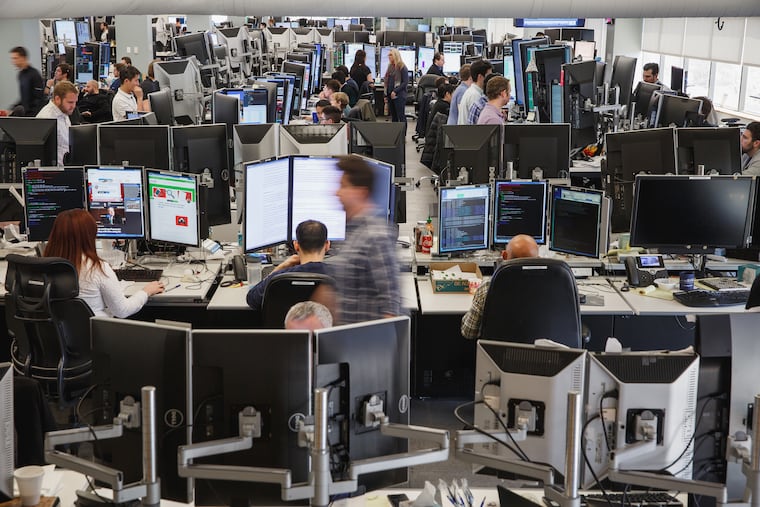
Cash flow has lately been negative; a cost-cutting program is "on track" to reduce expenses by $200 million next year, notes New York-based software analyst James E. Friedman, in a recent reports to clients of Susquehanna Financial Group, the big Bala Cynwyd-based investment traders.
Shares have been trading below $10, vs. $15-35 for most of 2008-15. Analyst Friedman thinks the stock is a bargain at this level: He sees "strong' sales of ClearPath Forward cloud-server management systems, and Unisys digital and mobile banking products, which are popular among Asian customers. He sees good potential in Unisys' Stealth-brand NSA-approved security systems.
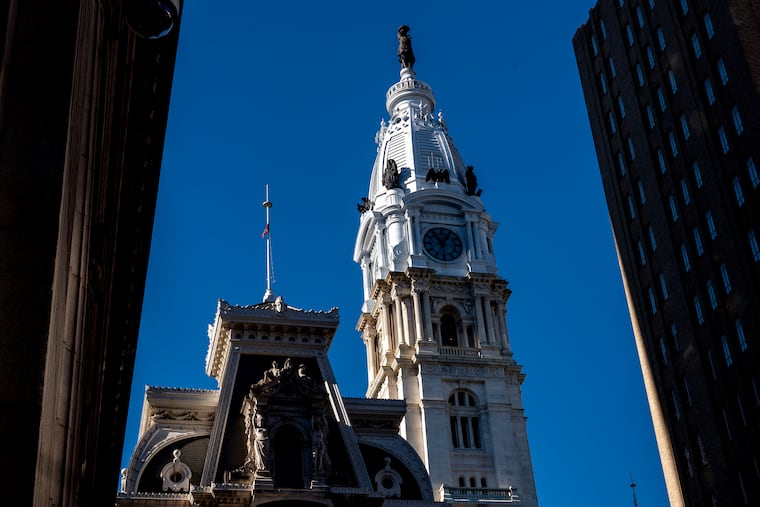
Around 500 work in the Philadelphia area, half at its Malvern engineering and research center, half at the streamlined Blue Bell offices, which the company considered moving to Center City a few years back, but stopped after neighbors objected to the company putting its name on a Liberty Place tower.