Snow: Why on Earth measure it at the airport!?
New York does it in Central Park; why not use Fairmount Park?
Philadelphia and New York have long-standing rivalries, but in at least one area, New York has an indisputable and long-standing superiority: The art of snow measurement.
Climatologists around the country fret over the quality of snow measurement, which is part of the climate record and one indicator – albeit not a great one – about where this is all heading.
But beyond its scientific merits, the official snow totals have a deeper importance. After the snow stops, they become important to how a region views what it just lived through.
After a snowfall, the National Weather Service office will post spotter reports from its entire coverage area. However, it's the ones from the urban first-order stations have the most credence since they are subject to government specifications and controls.
They become a storm's defining measurement.
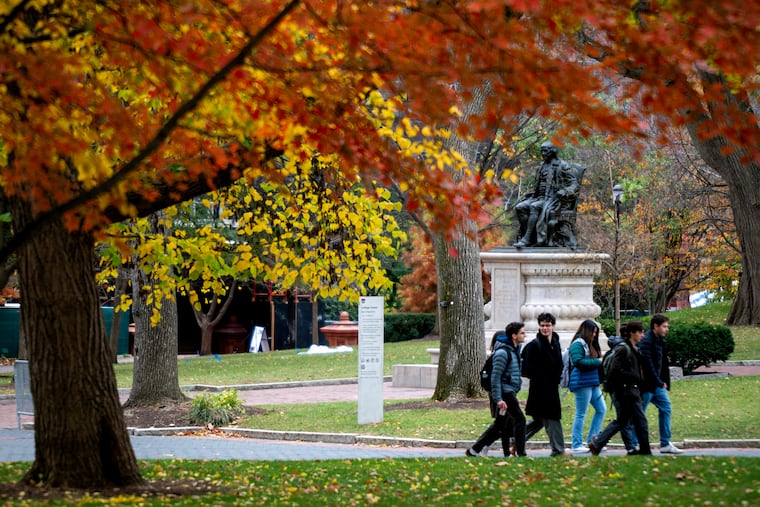
In New York, the prime measurements come from Central Park, a slightly elevated leafy environment in the heart of Manhattan, and from our perspective an excellent location.
Philadelphia, which boasts the nation's largest urban park, relies on observers at an airport next to a river, a swamp, and in the vicinity of runways and air traffic. Twice already this year it has ordered recounts of totals on puny snowfalls.
So why is this done at the airport? The short answer, says Joe Miketta, the meteorologist in charge of the weather service office in Mount Holly, is that we've been doing it there a long time – 77 years – and a change now would break the continuity of the snow record.
Before 1940, snow was measured at various locations in Center City and Old City – probably worse than doing it at Philadelphia International Airport.
Our guess is that when the airport opened, it made sense to move the measuring station to what was then a more-open, far less built-up location.
Things have changed a bit over years. New York City had the good fortune of taking snow measurements in Central Park back in 1868, first at a location near 64th Street, and in the vicinity of around 80th Street since 1920.
I. Ross Dickman, who is in charge of the New York office, says he is unaware of any suggestion through the years that the station be moved.
The comparison is imprecise, as are just about all comparisons between New York and Philadelphia, but the Lemon Hill section of Fairmount Park off East River Drive would be a decent parallel.
However, moving the station would mean starting over, and also finding reliable observers willing to go out at 1 a.m., 7 a.m., 1 p.m., and 7 p.m. to measure snow totals during and after snowfalls.
Finding observers is a problem. The government installed automated observing systems at its stations 20 years ago, but they can't measure snow.
One might think that anyone with an IQ in double figures could stick a ruler in a snow pile, but the government has strict requirements for how to measure the stuff.
For several years, the Mount Holly office contracted with an observer across the river in National Park, a location that met the requirement of being within 5 miles of ASOS apparatus.
Before this winter it signed up and trained a new crew of observers who work for a company located at the airport. The totals reported after the Jan. 30 and Feb. 9 events were so suspect that they were revised upward after review.
In New York, for over 100 years, the weather service, itself, was responsible for the measuring, said Dickman. When the office was relocated to Long Island in 1993, the Central Park Zoo assumed the responsibility.
And in the fall of 2015, the Central Park Conservancy took it over.
No matter who does it or where, snow measurement always will have elements of subjectivity. "Snow fall measurement is not an exact science," says Mount Holly's Miketta.
As retired Mount Holly meteorologist Tony Gigi, says, the fact that totals are issued to the tenth of an inch is misleading – "precise, but inaccurate."
That said, we'll take Central Park over the airport.