A battle shapes up on the waterfront
Maritime business operators and backers of the Philadelphia Regional Produce Market square off over a key property.
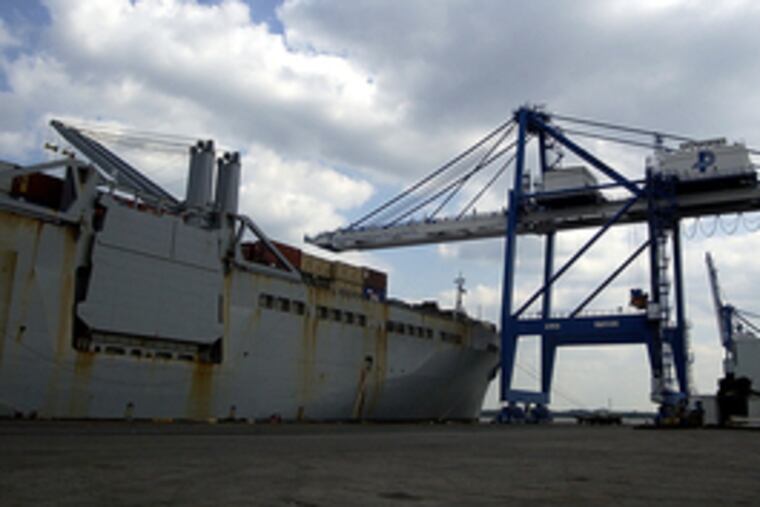
Battle lines are being drawn on the waterfront.
Maritime business operators say that a long-awaited revival of the port is about to happen, and that it offers a real chance of adding more than 100,000 well-paying jobs to the region over the next decade.
But first, the port businesses say, the 35 companies that make up the busy Philadelphia Regional Produce Market must bring their plans for a new terminal to a screeching halt.
The produce market's planned move to the Philadelphia Navy Yard would block southward expansion of the port, which is critical to the job growth, port moguls say.
There was a time when the governors of Pennsylvania and New Jersey tried to turn the bistate Delaware River Port Authority into an agency that would plan ahead and avoid costly conflicts like this. But that bogged down in turf wars.
State Sen. Vincent J. Fumo and Gov. Rendell announced plans to build a $150 million produce terminal at the Navy Yard in 2005, and they are not backing down. Through his spokesman, Gary Tuma, Fumo said last week that the market was "still going to the Navy Yard."
Port officials say private investors are willing to build new port facilities if the government can be persuaded to move the produce market elsewhere.
State Rep. William F. Keller (D., Phila.) released a letter from SSA Marine Inc., of Seattle, the nation's largest maritime terminal operator. The letter said the company could make no firm commitment without more study, but would "be very interested in pursuing" development of a cargo terminal at the Navy Yard.
"Once private industry knows that this will be a fair request-for-proposals process - and that everybody will have an equal shot, I think we'll have people lined up around the block wanting to build here," Keller said.
Port businesses are also lining up powerful lobbyists to press their case to use the Navy Yard site for new port facilities. The Holt family, which operates the state's sprawling Packer Avenue Marine Terminal in South Philadelphia, has retained S.R. Wojdak & Associates, whose client list includes the region's top businesses, educational institutions and trade associations. Delaware River Stevedores and others, as they have before, are using former Senate Majority Leader F. Joseph Loeper.
Cargo passing through the Delaware River terminals includes fruit, steel, wood, paper, crude oil and petroleum products. Business is growing. According to maritime-exchange statistics, 3,325 large cargo ships docked on the river last year, up from 2,989 in 2002.
The port, by its own 15-year-old estimates, creates about 45,000 jobs, and adds $4 billion annually to the regional economy. Many outside the port community view these numbers with skepticism.
Dennis Rochford, president of the Delaware River Maritime Exchange, a trade association, predicts that a new study he is seeking will show more impact.
Paul F. Richardson Associates, a New Jersey consulting firm hired by local maritime businesses and the International Longshoremen's Association, the union representing dock workers, said that expanding the port southward into the Navy Yard would push employment up to 175,000 jobs.
The Richardson report predicts that the number of truck-size cargo containers shipped to the United States will double by 2020. Philadelphia would have to capture only a few percentage points of that increase to achieve the projected growth, the report said.
The South Philadelphia site's direct link to three railroads and highways makes it more efficient than rival seaports, Keller said. Expansion must be southward because of planned casino development to the north and the likelihood that future ships will not fit under the Walt Whitman Bridge, Keller said.
Though small by comparison, the produce market also plays a major role. It employs 1,100 - 80 percent of them Teamsters with full health-care and retirement benefits. And, leading chefs and produce merchants say, the market is important to the flavor and economic success of the region's culinary artistry.
They say the market needs a new facility, with railroad access, to cope with rising fuel costs and to meet tightening federal regulation of food shipments.
In 1988, the governors of Pennsylvania and New Jersey - Bob Casey and Tom Kean - saw their states spending tax dollars to compete with each other. They decided to merge the public port operations of their states under the bistate Delaware River Port Authority. The legislatures of the two states, Congress and the first Bush administration agreed to expand the DRPA's charter so it could do the work.
Six years later, Casey met with then-newly elected New Jersey Gov. Christine Todd Whitman aboard the Spirit of Philadelphia party boat. They signed the port unification order and pledged cooperation to build the maritime contribution to the region's economy.
A new DRPA unit was created. A port unification board was appointed that included a logistics expert, international banker and others. But the effort ran aground almost immediately. "People talked about their fiduciary responsibilities, but it was really about turf. When push came to shove, we ran into all sorts of things," said a former member of the board whose current job prevents him from commenting publicly.
Now the Delaware River Port Authority, once envisioned as a vehicle for planning and cooperation on economic growth, is bogged down in a fierce battle over whether to deepen the river. Pennsylvania says it is necessary to future port growth; New Jersey disagrees. The bistate board has not met for 15 months.
The DRPA is still making its bond payments, but it is technically in default because it is operating without a board-approved budget. Its spending is limited to what was approved for 2005, and increases in fuel, utility and other costs are putting a squeeze on operation of the four toll bridges and the PATCO commuter rail line, said John J. Matheussen, chief executive of the authority.
At the produce market, frustration and anger are rising. "We've spent $1.6 million of our own money on engineering studies at the Navy Yard site," Sonny DiCrecchio, the market's general manager, said Friday.
Going back to the Pier 98 annex site the state first proposed would delay the new terminal by two years. Several of the market's major operators are losing contracts because the old facility doesn't meet new standards. "They can't wait that long," DiCrecchio said. "As of right now we're still being told by the senator and the governor that there's absolutely no slowdown at all. Everything is going as planned."
Keller said the port operators and longshoremen would keep pressing their fight and work to find a new home for the produce market - one that's not where ships could be docking.
A Brewing Storm at Port
2002: Philadelphia Regional Produce Market begins discussions with the city agency that is its landlord about the need for a facility to comply with post-9/11 security and food-handling regulations.
May 2004: Frustrated members of the association that runs the market vote to move to Camden unless it gets an agreement with Philadelphia and state officials by June 15.
June 2004: Market association agrees to stay in Philadelphia, accepting a promise from Gov. Rendell and State Sen. Vincent J. Fumo (D., Phila.) of a $150 million new terminal, to be built on the Pier 98 annex at Columbus Boulevard and Oregon Avenue.
July 2005: State officials shift planning for a new produce market to a site at the east end of the former Philadelphia Navy Base, which had been renamed the Navy Yard.
September 2005: With port officials looking on, Rendell and Fumo announce that the state will build a new home for the produce market at the Navy Yard site.
February 2007: Citing an anticipated rise in the number of cargo containers arriving in the United States, port officials declare that the site selected for the produce market would block lucrative growth of the port.
SOURCE: Inquirer research
EndText