Tenacity & Power
WASHINGTON - When William Thaddeus Coleman Jr. started his search for a job with an old line Philadelphia law firm in the late 1940s, he was sure he had a killer resume.
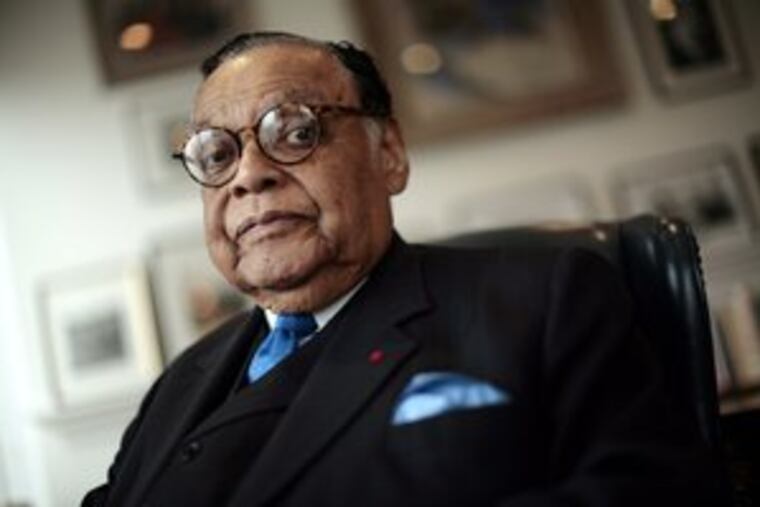
WASHINGTON - When William Thaddeus Coleman Jr. started his search for a job with an old line Philadelphia law firm in the late 1940s, he was sure he had a killer resume.
First in his class at Harvard Law School in 1946, he clerked after graduation for Judge Herbert Goodrich on the U.S. Court of Appeals for the Third Circuit in Philadelphia, Coleman's hometown. The next year, he won a coveted clerkship, along with Elliot Richardson, who would later become U.S. Attorney General, with Supreme Court Justice Felix Frankfurter.
Yet, when Coleman returned to Philadelphia in 1948 in search of a job, all he heard was the sound of doors slamming shut. Coleman is African American, and none of the city's top firms would hire him because of his race, even though Frankfurter himself had written letters of recommendation.
In cases where he did get interviews, Coleman says, the firms gently suggested he look for a job with a local African American firm that focused on more mundane negligence cases.
"I couldn't find a job," said Coleman, who is 86. "I would show up, and a secretary would come out and say Mr. So-and-So is busy; he can't see you right now. And I would say, 'Well, that's all right, I'll wait,' and they would say, 'No, you don't understand, he's busy all day.' "
It was a bitter lesson for Coleman, but those setbacks only stiffened his resolve.
Before long, Coleman landed a job with Paul, Weiss, Rifkind, Wharton & Garrison L.L.P., of New York, then an upstart firm that would grow into one of the world's largest.
By the early 1950s, Coleman's reputation for skillful lawyering filtered back to Philadelphia. Then, Richardson Dilworth, who would go on to become a noted reform mayor, offered him a job at his firm, Dilworth, Paxson, Kalish & Levy, making Coleman the first African American to be employed by a top-line firm in the city.
Now, Coleman is a leading partner in the Washington office of O'Melveny & Myers L.L.P., a sprawling, 1,000-plus-lawyer firm that recruited Coleman 30 years ago to join them after he served as transportation secretary under President Ford.
"He gave our office instant credibility," said former Secretary of State Warren Christopher, a partner at O'Melveny.
His story is a uniquely American tale, and one that roughly parallels the course of the civil rights struggles of the last half of the 20th century, in which Coleman himself played a leading role. It illustrates, too, how opportunities have opened up in elite law firms and government and other institutions that only a few decades ago were closed to minorities. Progress, however, has been halting.
According to NALP, a trade organization for law firms and law schools that focuses on recruitment and placement of lawyers, minorities in 2006 accounted for 5 percent of partners in the nation's major firms, up from 2.5 percent in 1993.
"Coleman is loaded with guts, and that is his middle name," said Sen. Arlen Specter (R., Pa.), a longtime friend.
Coleman was one of a handful of lawyers, including Thurgood Marshall, who wrote the Supreme Court brief in Brown v. Board of Education, the landmark school-desegregation case. And he had worked with the Rev. Dr. Martin Luther King Jr., once helping to free King from jail after a sit-in in the South.
Yet, Coleman is a lifelong Republican, unlike most civil rights leaders, and he has spent his career advocating from privileged perches at the heart of establishment power.
He has worked for every president since Dwight Eisenhower; is a confidant of Supreme Court justices; represented dozens of big companies in complex, high-stakes commercial cases; and sits on the boards of the New York City Ballet and the Philadelphia Museum of Art. Currently, his clients include the investment-banking firm of the Goldman Sachs Group Inc., Merck & Co. Inc., and Cigna Corp., among others.
During an interview in his Washington office, prominent names rolled trippingly off his tongue - Scalia, Breyer, Lyndon Johnson, Clarence Thomas. But not, it seems, as a way to impress. The names emerge naturally during conversation because these are the people he spends his time with.
"People don't realize how much the country has changed," Coleman said.
Most mornings, Coleman is in his office by 8:30 and leaves after 6 for his home in suburban Virginia. His first stop after returning from a trip to Brussels, Belgium, recently about 8 p.m. was his office, where he worked to catch up with some of the tasks that had accumulated in his absence.
It is a work ethic that has stood him in good stead. Coleman has argued 19 cases before the Supreme Court, the bulk of them commercial matters where huge sums were at stake.
Lawyers at O'Melveny who have worked closely with Coleman say his work is distinguished by cleverness and an unwillingness to see any setback as permanent, much as he handled his first rejections by Philadelphia law firms after his graduation from law school.
"The one thing you learn from him is that this is a guy who doesn't understand the word 'no,' " said Richard Parker, cochairman of the antitrust competition practice at O'Melveny. "He keeps trying to achieve the result in a different way. He's dogged and determined."
In one case involving the sale of some of Pan American's overseas assets, Coleman advised his client to complete the transaction while the planes were over the Pacific, thus avoiding millions of dollars in sales taxes.
To make the deal work, the planes had to be registered with the Federal Aviation Administration under their new owner.
But that was tricky because the FAA normally would have been closed by the time the planes were in international airspace and out of reach of the tax man. Not to worry. Coleman, who had recently left government as transportation secretary, arranged for the FAA office to be open late so the planes could be registered.
"I knew what number to call," he said.
Coleman grew up in the Mount Airy section of the city in the '20s and '30s.
It was a time of both subtle and overt discrimination. While race relations in his mixed neighborhood generally were calm, Coleman distinctly remembers white parents advising their children to come inside when they saw Coleman playing with them.
He could not join the Germantown High School swim team because blacks were not allowed in the pool. When his parents complained, school officials responded by disbanding the team.
Yet Coleman's family was prosperous by the standards of that time. His father held three jobs, including a position as executive director at the Wissahickon Boys Club and, by the early 1940s, had an income of more than $10,000. It was enough to send young Coleman to the University of Pennsylvania, where he graduated summa cum laude.
At Harvard, he began what would become a lifelong friendship with Elliot Richardson, the former Republican attorney general under President Richard Nixon.
Coleman betrays no bitterness about his early rejections by Philadelphia law firms. But he relished the times when Dilworth, in an effort to needle competitors, sent him to the offices of competitors to collect files of clients that had chosen to switch to Dilworth's firm.
Some of those firms had rejected Coleman years earlier.
As transportation secretary, Coleman helped oversee the establishment of Amtrak, the national rail line; the completion of the interstate highway system; and construction of the Center City commuter tunnel.
That deal was hammered out in a late-afternoon meeting between Coleman and former Mayor Frank Rizzo. The meeting was slow-going, and Coleman remembers telling Rizzo that he had to leave to catch a plane to return home to Washington for a dinner later that evening.
Rizzo urged him to stay, and when they finally sealed the deal, Coleman rushed to the airport to find that Rizzo had parked two Philadelphia police squad cars behind the plane to prevent it from leaving.
"When I got on the plane, who should be sitting there but Sen. Hubert Humphrey," Coleman said. "He said, 'I know now why I have been held up.' "