New hospital to focus on breast cancer
Surgeon Beth DuPree performed the first procedure yesterday at the region's newest hospital, a Bucks County facility that focuses unabashedly on breasts and melds high-tech equipment for the body with alternative therapies that support the spirit.
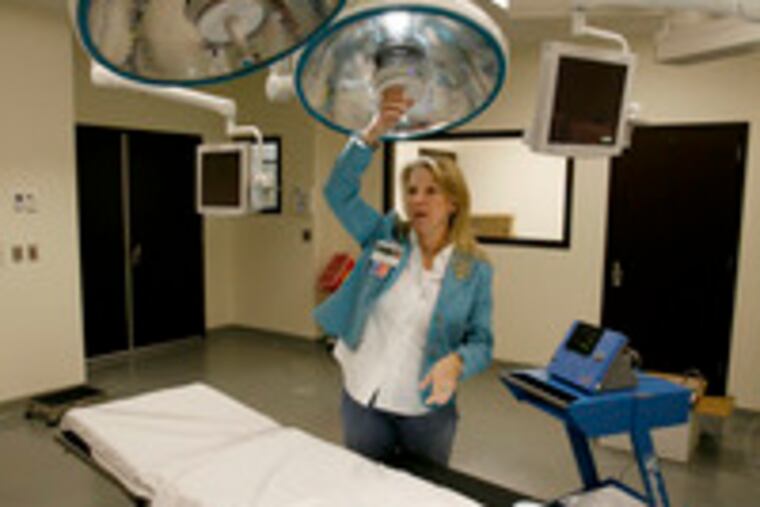
Surgeon Beth DuPree performed the first procedure yesterday at the region's newest hospital, a Bucks County facility that focuses unabashedly on breasts and melds high-tech equipment for the body with alternative therapies that support the spirit.
The Comprehensive Breast Care Institute at DSI of Bucks County was licensed yesterday as a general hospital, but will concentrate on diagnosing and treating breast cancer in all stages, as well as performing cosmetic procedures. It is an affiliate of Diversified Specialty Institutes, a Nashville-based, for-profit company that operates small, specialized hospitals and dialysis centers.
DSI, which expects to attract patients to the breast institute from a 100-mile radius, hopes eventually to build a similar hospital nearby for patients with kidney failure.
DuPree, chief executive officer and medical director of the breast institute, said the new hospital would allow doctors to offer women a faster diagnosis and treatment, so patients would lose fewer days to worry. It also will allow better coordination among doctors who provide the many types of treatment.
"This is a dream for every breast surgeon, to be able to provide this kind of care for your patients," DuPree said. A general surgeon, she limited her practice to diseases of the breast in 2003. Early in her career, she said, she realized that her patients needed help with emotional healing, not just surgery. Last year, she published a book about her philosophy: The Healing Consciousness, A Doctor's Journey to Healing.
The breast institute's opening originally had been scheduled for October, but it was postponed after officials decided to add an emergency department. Licensing was held up again this month because of delays in supplying the pharmacy.
The new 120,000-square-foot, 24-bed, $55 million hospital is loaded with new imaging equipment, including a breast PET scanner. Administrators expect the staff will perform 7,500 imaging scans and 3,500 to 4,000 surgical procedures in the facility's first year. The breast institute has an emergency department, in part because it wanted to be able to serve surgical patients who developed complications.
On the emotional-support side, the institute provides patients with exceptionally nice robes and pajamas. Later this year, it will open a medical spa that will offer complementary therapies such as Reiki, hypnotherapy, massage, reflexology and acupuncture.
The region is well-stocked with cancer-treatment facilities and boasts two National Cancer Institute Comprehensive Cancer Centers. Competitors questioned the value of a specialized facility that skims better-paying services. Its emergence could weaken bigger hospitals that serve a broader array of needs and use imaging and surgical procedures to subsidize some of their other work.
In general, insurance companies reimburse hospitals better for surgical procedures than for care of chronic ailments, said Alan Zuckerman, president of Health Strategies & Solutions in Philadelphia. Imaging centers, he said, are "like a license to print money." Patients generally pay cash for elective, cosmetic surgery and complementary therapies. (A foundation at the institute will help pay for those supportive treatments for its cancer patients.)
The standard DSI retort is that the company's facilities are not in competition with other hospitals. "Our only competitor in this market is breast cancer," said Graham Russell, a DSI executive vice president. "We don't believe that our model is duplicated anywhere in the world right now."
DuPree said she would not say that the region needed another cancer center, and that was not what she intended to run. "This is not a cancer center," she said. "This is a comprehensive breast institute." Other hospitals, she said, advertise by saying: "We treat cancer 24/7." Her slogan, she said, is "We treat people 24/7."
A big believer in supporting patients emotionally, DuPree paid a lot of attention to amenities. She picked out all the paintings on the walls, choosing pictures of women in contemplative or romantic, but not overly frilly, poses.
Patients will have private rooms furnished with flat-screen TVs, computers and memory-foam mattresses. Loved ones can spend the night on futonlike couches. Patients will wear $25 textured cotton robes for mammograms and $90 pale-teal pajamas for a hospital stay. (Gowns at nearby St. Mary Medical Center cost about $5.)
She said DSI could afford some of the nicer touches because it used a cheaper, modular construction process. "What we've chosen to do is spend the money in places that impact the patient," she said.
Meanwhile, St. Mary Medical Center in Langhorne, where many of the 14 doctors who form the core of the breast institute's staff have worked, has its own breast center, equipped with two digital mammography machines, a breast MRI and, in June, a PET/CT scanner. The 370-bed, 500-physician hospital is recruiting more surgeons.
Could the smaller breast hospital hurt St. Mary? "There's clearly a potential for that . . .," said Patrick Knaus, vice president of strategy and business development at St. Mary. "We're hopeful that we've taken enough steps that we'll be able to continue forward."
John Glick, a breast-cancer expert who heads the Abramson Family Cancer Research Institute at the University of Pennsylvania, said deciding on a doctor, not a hospital, was the most important choice a woman with breast cancer made. Other hospitals, including Penn, already offer the same services as the new breast institute, plus easy access to other types of specialists, he said.
"I'm not sure of the need for this type of hospital, because it seems to be somewhat duplicative," he said.
Christine Berg, a medical and radiation oncologist at the National Cancer Institute, said much of breast-cancer treatment could be handled on an outpatient basis, but she had concerns about having surgery that required an overnight stay at a small, specialized facility. "You never know what's going to happen in the middle of the night where it's nice to be in a larger place," said Berg, who is chief of the early-detection research group in the division of cancer prevention. "There is no such thing as minor surgery."
DuPree said most cases were not complicated and "breast care is not a priority" in many larger hospitals. She said she believed those women would get better treatment at the breast institute.
She will continue to perform surgeries on women with complex underlying health problems at St. Mary and may add other hospitals as well. And, she said, she may transfer out patients who develop serious problems while in her hospital. "Our patients' welfare comes first," she said.
The institute cannot do every possible kind of treatment, DuPree said, but neither can St. Mary. Every room can convert to intensive-care capability, and the hospital has a "transition" area for patients who are dying. The staff will be able to call in noncancer specialists for consultation, and has a transfer agreement with nearby Holy Redeemer Hospital.
"We've made a decision to treat people throughout that course of treatment," said Russell, who described DuPree as a national "thought leader" on breast cancer. Most patients will not need complex, end-of-life care. "For the majority of our patients, there will be a cure," he said.
Berg said she believed patients whose cancer had spread needed to be in larger facilities. "If you've got metastatic breast cancer," she said, "you should be in a full-service hospital."