U.S. automakers seeking eased fuel-efficiency goals
WASHINGTON - Top executives of domestic automobile companies pressed congressional leaders yesterday to revisit a plan aimed at increasing fuel-efficiency standards, which automakers say could hurt their industry.
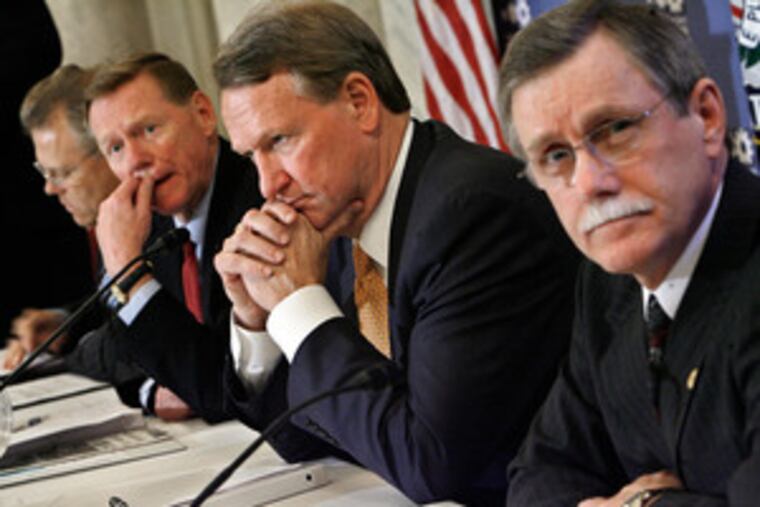
WASHINGTON - Top executives of domestic automobile companies pressed congressional leaders yesterday to revisit a plan aimed at increasing fuel-efficiency standards, which automakers say could hurt their industry.
Leaders of General Motors Corp., Ford Motor Co. and Chrysler Group discussed the impact of health care, trade and energy policies on their companies, and asked House and Senate leaders to consider an alternative to a proposed overhaul of Corporate Average Fuel Economy standards for vehicles.
"They laid out the numbers, and the numbers that were in the Commerce bill, they said, would destroy the domestic auto industry," said Sen. John Ensign (R., Nev.). He participated in a morning meeting with the industry leaders.
During a luncheon with Senate Democrats, GM chairman and chief executive officer Rick Wagoner said it was time to move beyond approaches such as CAFE "that clearly haven't solved these critical problems." He suggested more attention on developing biofuels such as ethanol and research on advanced batteries for hybrids and electric vehicles.
Next week, the Senate is expected to consider a proposal to raise CAFE standards to a fleet average of 35 miles per gallon for a manufacturer's cars and trucks by 2020, an increase of about 10 m.p.g. over current levels. From 2020 to 2030, the auto industry would face 4 percent annual increases.
Officials in the auto industry have called the Senate bill unworkable and resisted attempts to increase the requirements in the past.
But they concede that Congress is likely to impose higher standards this year as consumers deal with $3-plus gasoline prices and remain worried about global warming. The industry executives want to help shape any new requirements.
In Washington, Wagoner was joined by Ford chief executive Alan Mulally, DaimlerChrysler AG's Chrysler Group chief executive Tom LaSorda, and United Auto Workers president Ron Gettelfinger.
LaSorda said Chrysler faced a $1,000 disadvantage per vehicle to Japanese competitors because of health-care costs. The three companies cover more than two million employees, retirees and their dependents.
"American manufacturing and a key component - the automotive sector - are at a crossroads," LaSorda said. "We are either going to adjust to the realities of the global economy or we will not survive."
Mulally said the nation's trade policy had hurt American manufacturers, citing "a willingness in trade negotiations to overlook or even trade off manufacturing's interests for those of other sectors that are perceived as either sacred cows or the new frontier."
But much of the private discussions were focused on fuel economy.
Michigan's two Democratic senators, Carl Levin and Debbie Stabenow, are working on an alternative to the current plan that would direct regulators to improve standards to 36 m.p.g. for cars by 2022 and 30 m.p.g. for pickup trucks, SUVs and vans by 2025.
The approach would be more palatable to the industry because it would give it more time to improve vehicle efficiency and keep separate the standards for passenger cars and light trucks.