Settlement gives meat workers more pay
Putting on and removing extensive gear will be on the clock at Hatfield. The deal includes back wages.
The lawsuit took aim at a narrow window - just a few minutes of each meat cutter's day.
But advocates for the largely Latino workforce at Hatfield Quality Meats hailed the settlement, which awards back pay to 1,600 employees for time spent putting on and stripping off protective gear, as a quiet victory for the immigrant laborers who dominate meatpacking in Hatfield and nationwide.
The $1.3 million agreement, announced last week in Efrian Rodriguez-Fargas, Alta Gracia Herrera and Marisol Pagan v. Hatfield Quality Meats Inc., covers workers who wear required protective clothing that can include metal-mesh gloves, face protectors, steel-toed shoes, plastic forearm guards, and aprons made of cut-resistant material.
Working on fast-moving disassembly lines, many workers use sharp knives to turn fresh-killed hogs into bacon, frankfurters, sausage and other products inside a brick-and-steel building that sprawls for acres across a field newly planted with corn in central Montgomery County.
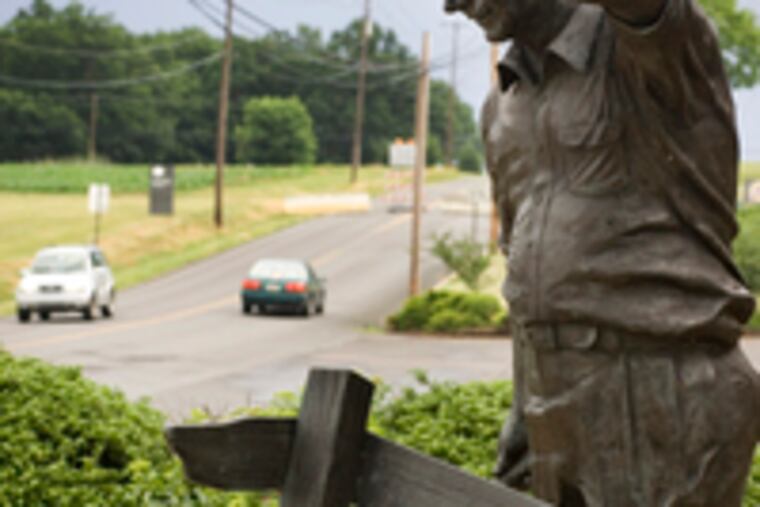
At one entrance, a bronze statue depicts company founder John C. Clemens in a straw hat, mopping his brow with a bandanna as he prods a pig through a gate with a wooden staff. The business he founded in 1895 is still family-owned and nonunion.
Like much of the meatpacking industry, it has been transformed by the influx of immigrant workers that began after older, unionized urban plants in the Midwest closed in the 1980s, and by the migration east of Latino people, said Roger Horowitz, a labor historian at the Hagley Museum and Library in Wilmington.
"Clothes-changing has been an issue for a long time. You have to put on a lot of gear in meatpacking," Horowitz said. "It has gotten worse because federal law requires more gear to prevent injuries."
Until the settlement, workers employed before 2006 were paid for the time they logged at work stations, not the time they took to don, doff, clean and maintain gear and move from changing rooms to the disassembly line, according to the suit.
The settlement, approved by U.S. District Court in Philadelphia after a year of negotiations, applies to hourly employees who worked at the plant from March 2000 through May 2006, including 400 former workers. Those workers earned about $10 an hour.
Under the agreement, back pay is calculated according to each employee's length of service and job category. Depending on how legal fees are apportioned, the typical worker will net about $550.
"That's significant. That could be rent for a month. It could take care of the groceries. With remittances being so important for immigrants, $550 could carry a family for months in a place like El Salvador," said Kristin Shipler, director of civic engagement for Congreso de Latinos Unidos, a nonprofit provider of human services to Latinos in Philadelphia.
The Hatfield settlement followed a 2005 U.S. Supreme Court ruling in a "donning and doffing" case named for Latino employees at Iowa Beef Processors Inc.'s slaughterhouse in Pasco, Wash.
In that case, IBP Inc. v. Gabriel Alvarez, et al., the court interpreted the Fair Labor Standards Act to mean that wearing "unique" protective clothing (as opposed to just a hard hat, for example) is "an integral and indispensable part of the principal activity" at the workplace, and therefore time for donning and doffing such gear should be compensated.
Peter Winebrake, lead counsel for the Hatfield plaintiffs, said the agreement prevented them from discussing it with reporters. One employee reached outside the plant, who asked not to be identified, said he was happy with the settlement. Asked to elaborate, he added simply, "I like to get paid."
In a release issued jointly with the company, Winebrake hailed the settlement as important for the workers and commended Hatfield for reacting responsibly "to the changing legal landscape" since Alvarez.
Hatfield president Doug Clemens, a fourth-generation descendent of the company's founder, said settling the case was in Hatfield's interest.
"Our firm belief is that Hatfield's compensation policy actually exceeds the requirements to be in full compliance under all federal and state labor laws," he said. "However, instead of dragging this matter through a long and arduous litigation process, it was our desire to settle quickly."