Tough lessons offer insight to compromise, small wins
Michael Kalogris was used to thinking in grand terms: multimillion-dollar business deals, a beloved vintage Mercedes, a job as chief executive officer of a cell-phone company.
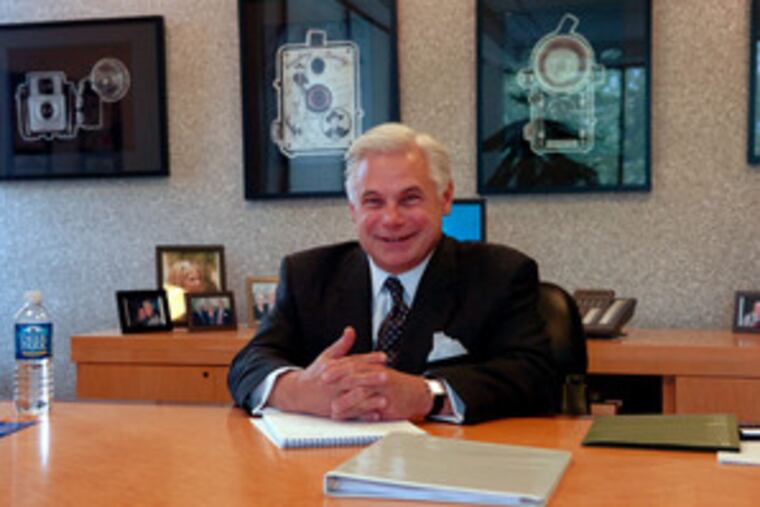
Michael Kalogris was used to thinking in grand terms: multimillion-dollar business deals, a beloved vintage Mercedes, a job as chief executive officer of a cell-phone company.
But in a few moments last spring on a short curve of Yellow Springs Road in Berwyn, he nearly lost his life, and he had to learn to start thinking of progress in inches and seconds.
His shift in perspective - a tough schooling in compromise and small victories - later helped him stave off bankruptcy at his company, Berwyn's one-million-subscriber SunCom Wireless Inc. But first, he had to recover from the May 7, 2006, accident, caused by a collision with a British visitor driving on the wrong side of the road.
"We hit the apex of that curve, and boom, that was it," said Kalogris, 58, who returned to work in mid-August.
The accident, which also severely injured his son-in-law, crushed Kalogris' chest; shattered parts of his feet, hands, arms and legs; and caused internal bleeding and injuries.
It took 31/2 weeks for Kalogris to stand for just a few seconds. After he achieved that goal, he transferred from the Hospital of the University of Pennsylvania to Bryn Mawr Rehabilitation Hospital, where he switched from narcotics for pain to ibuprofen, hoping it would give him more energy and awareness, and speed his recovery.
Three hour-long sessions every day for a month enabled him to leave Bryn Mawr for his Malvern home July 4, although he still had to use a wheelchair and a walker.
Did he ever feel like giving up?
"I try not to be that kind of person," he said, looking away as if he would prefer not to remember those moments.
"You just need to have the vision," he continued. "When your brain says 'I can't get there from here,' that's when your mind or your heart has to say 'I don't know how I'm going to get there, but I'm going to do it.' "
While Kalogris recuperated, SunCom chief financial officer Eric Haskell served as chief executive.
SunCom, formerly known as Triton PCS, operates a cellular network in the Carolinas, eastern parts of Georgia and Tennessee, Puerto Rico, and the U.S. Virgin Islands. It had struggled for years, especially after 2004, when one of its primary customers, AT&T Wireless, was acquired by Cingular.
AT&T, which paid SunCom for use of its network, had accounted for 20 percent or more of the Berwyn company's revenue, Stanford Group Co. analyst Michael Nelson said. But the merger meant AT&T no longer needed to use SunCom's network in the Carolinas and Puerto Rico. (Thanks to a series of corporate couplings, Cingular now belongs to AT&T again.)
The loss of the AT&T relationship accelerated a crisis at SunCom. It lost $497 million in 2005 and $337 million in 2006. It faced crushing debt of $1.7 billion and annual interest expenses of more than $140 million.
Kalogris had been trying to restructure the debt - most of it taken on in the company's early years as it built its network - for almost a year when the accident happened.
"We were at an impasse when I got hurt," Kalogris said. By the time he returned to work last August, dealing with the compromises and setbacks of rehab offered insight into how to resolve negotiations with debtholders and stockholders.
"I realized we were never going to get to the point where any one party was the happiest," he said. "But we could get to the point where everybody was slightly unhappy."
Debtholders swapped about $711 million of their debt for equity, and now own about 87.5 percent of SunCom's shares. They also won seats on the company's board of directors. The firm's largest shareholders are investment companies, including Highland Capital Management, which owns about 31 percent of SunCom's shares. Highland said in a statement that it believed SunCom's strong subscriber base and "robust" network - along with favorable demographic trends and other factors - would bode well for the company's growth potential.
The swap meant shareholders lost most of the value of their investment - their shares now represent about 12.5 percent of the total - but bankruptcy likely would have meant losing all of it.
Kalogris has sold about $3.7 million worth of shares so far this year. He noted that he still owned 153,000 shares, but sold some to raise cash, in part to invest in a new boutique his daughter plans to open in Northern Liberties.
A year after his accident, he moves a little slowly, hampered by plates and screws in both knees. But a thicket of slightly wild white hair and an easy smile lend an air of impish energy and hide the effects of the accident from those who don't know.
The 1958 Mercedes-Benz 300SL he was driving before last year's collision is gone, replaced by a Mercedes sedan he chose because it performs well in crashes.
Kalogris and his board hope to sell the company, believing it the best way to help it compete in a hyper-competitive cell-phone market. But the restructuring reduced annual interest payments by $64 million, giving the company breathing room, even if a sale did not occur.
Standard & Poor's rates SunCom's corporate debt "CCC-plus," which means it is vulnerable to business conditions to meet financial obligations. But because of the restructuring, S&P changed its outlook for the debt from negative to positive.
While the company is still expected to lose money this year - $40 million to $50 million in operating losses, by S&P's estimate - Kalogris noted that SunCom's earnings before interest, taxes, depreciation and amortization have improved.
Wall Street often looks to EBITDA growth to measure the progress of a young company making heavy capital investments, although accountants often frown on the measure because it excludes so many expenses.
SunCom's EBITDA grew from $7.4 million in the first quarter last year to $42.6 million in the first quarter this year.
Kalogris attributed that to the popularity of SunCom's products, including a calling plan that allows unlimited calls to and from 10 numbers. SunCom also allows instant in-store rebates on phone purchases, saving customers the hassle of having to mail in information.
"We do offer better value," Kalogris said, "but, more importantly, we treated customers the way they want to be treated."