Flat-screen free fall
Prices for plasma and liquid-crystal TV sets have plummeted. That's good news for consumers, but not for electronics retailers.
Times are brutal for electronics retailers, and bargain-hunting consumers like Tinana McCrea are a big part of the reason.
The 19-year-old student at the Art Institute of Philadelphia wanted a flat-screen television for her new apartment. She hunted for the perfect set at Best Buy, Circuit City, Sam's Club and Big Lots.
Despite all she had read about picture resolution and plasma screens vs. liquid-crystal displays, the biggest factor in her decision to buy a Vizio-brand television with a 32-inch screen was its price. McCrea paid $587 - at Wal-Mart, which recently expanded its selection of flat-panel TVs.
"I wanted a flat screen and I wanted it to be nice," McCrea said. "I think I got a good deal."
Consumers' lust for bargains has dragged down companies that focus exclusively on electronics. Tweeter Home Entertainment Group Inc. filed for bankruptcy June 11, citing poor television sales as a reason. Best Buy Co. Inc. recently lowered its 2008 profit estimate, saying a softer economy had slowed sales of higher-margin items such as flat-screen TVs. Circuit City Stores Inc. told a similar tale when it reported a $54.6 million loss in the first quarter of this year.
The woes of Tweeter, Best Buy and Circuit City result in part from misjudging consumer desire and from competing against the ever-ravenous Wal-Mart.
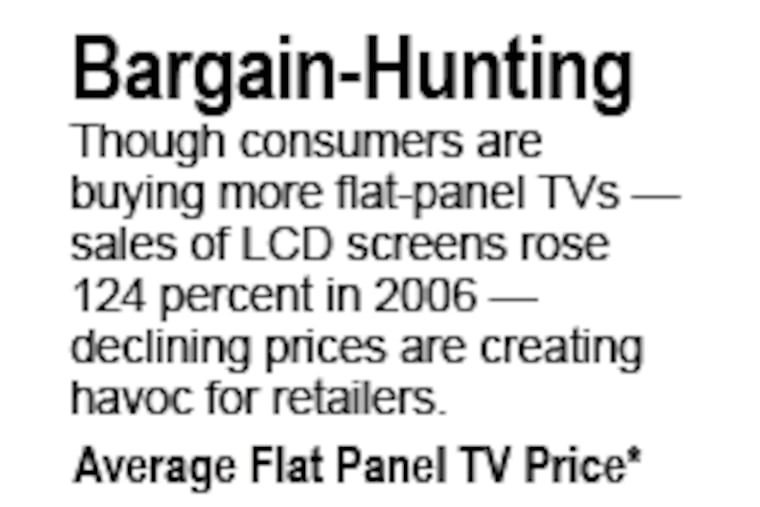
Consumers have continued to buy flat-screen TVs as if they were another iPod. In April, for example, unit sales of plasma TVs rose 18 percent over April 2006. But revenue from those sales fell more than 20 percent because of a 33 percent drop in the average selling price, according to research firm the NPD Group Inc.
The average price for liquid-crystal display, or LCD, flat-panel TVs fell to $976 in April from $1,018 a year earlier, NPD said.
In a conference call with investors last month, Circuit City chief executive officer Philip J. Schoonover acknowledged that his company might have focused too much on selling a higher-tech television when consumers cared more about price.
"We have to be aware that a $1,000 TV for a lot of customers is a high-end TV," he said.
Circuit City also said poor sales of tube and projection TVs countered slightly higher flat-panel sales.
Television-makers and retailers have often emphasized size in their promotions. Sharp Electronics Corp. grabbed headlines by introducing a 108-inch LCD screen at January's Consumer Electronics Show.
But a relatively small screen, the 42-incher, struck a chord last season, IDC Research Inc. analyst Eric Haruki said.
Last fall, Wal-Mart said it was dropping the price of the 42-inch Panasonic plasma TV from $1,899 to $1,299, setting off a price war.
"Next thing you know, prices were dropping across the board," Haruki said. By Black Friday, the day after Thanksgiving and typically the biggest shopping day of the year, Best Buy was offering the 42-inch Panasonic for $999.
Factories in Asia added production easily, allowing retailers to keep up with the increased demand triggered by lower prices, Haruki said.
In fact, small size was so big that the average sales price of an even smaller screen, the 32-inch LCD, rose $40 between March and April of this year, countering price declines in other categories, NPD said.
"As of last season, we started to see 32-inch LCD competing very well against similarly sized tube TVs," NPD analyst Ross Rubin said.
Peter Dissin, a real estate investor and mortgage broker from Lower Merion Township, was initially in the market for just one television.
But he was so blown away by the 38-inch Philips LCD he bought on the Home Shopping Network for $1,800 that he started shopping for a second.
Six months later he settled on a Sharp 27-inch HD television for $599 from Costco. His old television went straight into storage.
"Once you watch it, there's no going back," Dissin said. "I don't go watch the Eagles' game at my friends' house anymore unless they've got a high-definition TV."
For more than three months, Marc Weinstein combed through magazines and the Internet before settling on a 50-inch Vizio plasma.
He found one at Costco for $1,899.
He then hired a contractor, who helped him hide the television cords, determine the best viewing height and mount the television on the wall of his living room.
"There was a whole science to it that we didn't even know about," said Weinstein, a forensic economist who lives with his wife and two children in Lafayette Hill.
Weinstein was so pleased with his buying experience that when a Philadelphia teenager with bone cancer requested a 50-inch plasma television through the Make-A-Wish Foundation, where Weinstein volunteers, he knew just where to send the organization's wish coordinators - to Costco.
The flat-panel price wars are experiencing a temporary lull, since holidays and the Super Bowl drive purchases. Investment analysts, however, do not see Tweeter, Circuit City and Best Buy turning sales around easily when consumers start buying again.
Jefferies & Co. Inc. analyst Timothy Allen said many wealthy households already owned flat-panel TVs. Less affluent people may require even lower prices before they buy, he said.
"The bottom 60 percent are not going to spend $2,000, $3,000 or $4,000," he said. "They probably need a price point of $500 to $700."
He told investors recently that the "sweet spot" for sales and profit growth in the flat-panel TV cycle had likely passed. Circuit City in particular faces challenges, he said, because it announced plans in March to lay off about 3,400 retail employees and replace them with lower-paid workers. That may lower morale so much that workers have little incentive to help customers and sell products, Allen said.
Circuit City representative Jackie Foreman said the company had changed operating procedures "to improve the customer experience." One change: Employees now restock stores before they open, leaving workers more time to help customers during operating hours.